IC Markets




























Is Forex Trading Legal in Indonesia?
Yes. Indonesia is one of the few countries in the region with a working licensing system for it. Here is how Bappebti fits in, and why most traders still use a broker abroad.
 WriterAbir KhanWriterWrites the guides · checks every figure against primary sources View profileAbout Abir →
 Market analysisTanbir Habib RiyadForex & Crypto AnalystForex and crypto analyst · technical and fundamental analysis View profileAbout Tanbir →
 Fact-checking & riskJannatul FerdaushFact-Checker & Risk AnalystFact-checks every figure · risk analysis · Applied Statistics, University of Dhaka View profileAbout Jannatul →
 Trading reviewJowel RanaCo-Founder & Forex TraderCo-founder · forex trader · reviews guides from a trader's view View profileAbout Jowel →
 Final approvalRanjan NiskrityFounder, Owner & Forex TraderFounder and owner · forex trader · signs off every guide View profileAbout Ranjan →
Key takeaways
- Forex trading is legal in Indonesia and regulated by Bappebti under Law No. 32 of 1997 (amended by Law No. 10 of 2011).
- Bappebti licenses local brokers, keeps a public register and blocks unlicensed sites in batches of hundreds.
- Offshore brokers licensed by ASIC or CySEC aren't on Bappebti's register but aren't illegal for you to use.
- Local brokers mean an Indonesian regulator and complaints route, at the cost of higher minimums and wider spreads.
Yes, forex trading is legal in Indonesia, and it has been for years. The market sits under Bappebti (Badan Pengawas Perdagangan Berjangka Komoditi), the commodity-futures regulator inside the Ministry of Trade. It licenses brokers, runs a public register, and operates a complaints process that functions.
That puts Indonesia ahead of most of Southeast Asia. In the Philippines, neither the Securities and Exchange Commission nor the central bank (Bangko Sentral ng Pilipinas) licenses a local retail forex broker, so no local company may legally offer it. In Vietnam, the State Bank of Vietnam treats unlicensed local trading floors as illegal to operate, even though many Vietnamese traders still fund offshore accounts anyway. Indonesia has a real rulebook.
The catch, and the reason this guide exists, is that the rulebook and the market do not quite line up. Most Indonesian traders use a broker licensed somewhere else, funded through a local bank, and understanding why is the whole point. It is a decision about cost and access, not about whether you are allowed to trade. Our best forex brokers in Indonesia guide has the shortlist and the practical detail on deposits, tax and trading hours.
What Bappebti does, and what it does not
Bappebti licenses local futures and forex brokers, sets how much capital they must hold, and oversees the exchange (Bursa Berjangka Jakarta) and the clearing house that domestic trades pass through. It keeps two lists that are worth your time. One is the register of licensed brokers, which are firms you can complain about and expect a response from. The other is a blacklist of websites it has ordered blocked for operating without a licence, which it updates in batches of hundreds at a time.
Its authority to do either comes from a specific law, not a ministry circular: Law No. 32 of 1997 on Commodity Futures Trading, as amended by Law No. 10 of 2011. That law is what lets Bappebti license brokers, run the exchanges, and order a site blocked in the first place.
What Bappebti does not do is regulate the offshore broker you probably want to use. A broker licensed by ASIC in Australia or CySEC in Cyprus is not on Bappebti’s register, is not breaking Indonesian law by taking your business, and is not “banned”. It is simply outside the system. If that broker mistreats you, your complaint goes to its regulator abroad, not to Bappebti.
- Licensed local brokers are genuine, but the minimum deposit is often Rp 5–50 million and the platform choice is narrow.
- Spreads and execution at licensed locals rarely match the large international names.
- The value of the local licence is the dispute process. If you are trading small and price-sensitive, you may decide that is not worth the cost.
Before you fund any account, local or international, type the broker’s name into the Bappebti blocked-sites list. If it is there, walk away. If it is simply not listed because the licence is held abroad, that is normal and expected.
OJK vs Bappebti, and three licensed names
Two regulators show up in Indonesian finance and it is easy to mix them up. Bappebti, under the Ministry of Trade, licenses commodity and forex brokers and oversees the futures exchanges, Bursa Berjangka Jakarta (BBJ) and the Indonesia Commodity Derivatives Exchange (ICDX). OJK (Otoritas Jasa Keuangan) is a separate agency that supervises banks, insurance and the stock market. An OJK licence has nothing to do with forex; the number that matters for a broker here is its Bappebti registration.
Three firms that have held a Bappebti broker licence for years: PT Monex Investindo Futures, PT Valbury Asia Futures, and PT Rifan Financindo Berjangka. Naming them is not an endorsement, run a Bappebti licence check on Bappebti’s own legality-check tool before you commit to any of them, since standing, minimum deposit and fees all change.
How most Indonesians trade
The common setup is an account with a broker licensed by ASIC, CySEC or the FCA (UK), funded by local bank transfer through BCA, Mandiri, BNI or BRI. The broker works with an Indonesian payment partner, so you send rupiah to a domestic account and it lands in the trading balance in 10 to 60 minutes, usually with no fee. The rupiah is converted to USD at the broker’s rate, a little worse than mid-market, and that spread applies again when you withdraw.
Traders who stay with a licensed local broker are usually running larger size and want the certainty of a domestic complaints process. Everyone else takes the trade-off for lower minimums, tighter spreads, and MT4 or MT5 instead of a proprietary platform.
The economics are stark. A licensed local broker might want Rp 5 million to open and quote EUR/USD around 2 pips. A CySEC broker will take Rp 500,000, quote under 1 pip, and clear a BCA transfer in an hour. For a trader with a small account, that difference decides the whole thing before regulation even enters the conversation.
Putri priced up two Bappebti-licensed brokers first. Both wanted Rp 5 million to open and supported one platform each. She opened a CySEC-regulated account instead: Rp 500,000 minimum, MT5, and BCA transfers that cleared in under an hour. Her first withdrawal, Rp 1.2 million, arrived in her BCA account in about three hours with no fee. She keeps a spreadsheet of every deposit and withdrawal so that if the tax office ever asks, the trail is clean. Her view is that the local licence was reassuring, but the economics only worked once she moved.
Islamic accounts and the halal question
Swap-free accounts matter to a large share of Indonesian traders. Many Indonesian scholars permit spot forex on an account where no overnight interest is charged or paid, though views differ and you should check with someone you trust. If you need a swap-free account, confirm two things: that it is genuinely interest-free, and whether the broker starts charging a fixed administration fee per lot after a grace period of a few days. That fee, over a long-held position, can cost more than the swap it replaced.
Opening an account without getting burned
The mistakes that cost Indonesian traders money are almost never the trade itself. They are choosing an unregulated broker off an Instagram ad, or handing money to a “mentor” who says they will trade it for you. Work down this list and you avoid both.
- Pick a broker with an ASIC, CySEC or FCA licence and check the number on the regulator’s own website.
- Confirm local bank transfer (BCA, Mandiri, BNI, BRI) is a supported deposit method before you register.
- Fund the minimum, place one small trade, and withdraw it. Confirm the money comes back to an account in your own name.
- Only then add more, and never more than you can afford to lose while learning.
The one thing that is clearly not allowed
Unlicensed people in Indonesia collecting money to “trade on your behalf” is against the rules, and Bappebti warns about it regularly. That is not investing. It is the structure most local forex scams use: a fixed monthly return, a “manager”, and a personal bank account for deposits. Trade your own account, in your own name, and never send money to a personal rekening handed to you by a mentor.
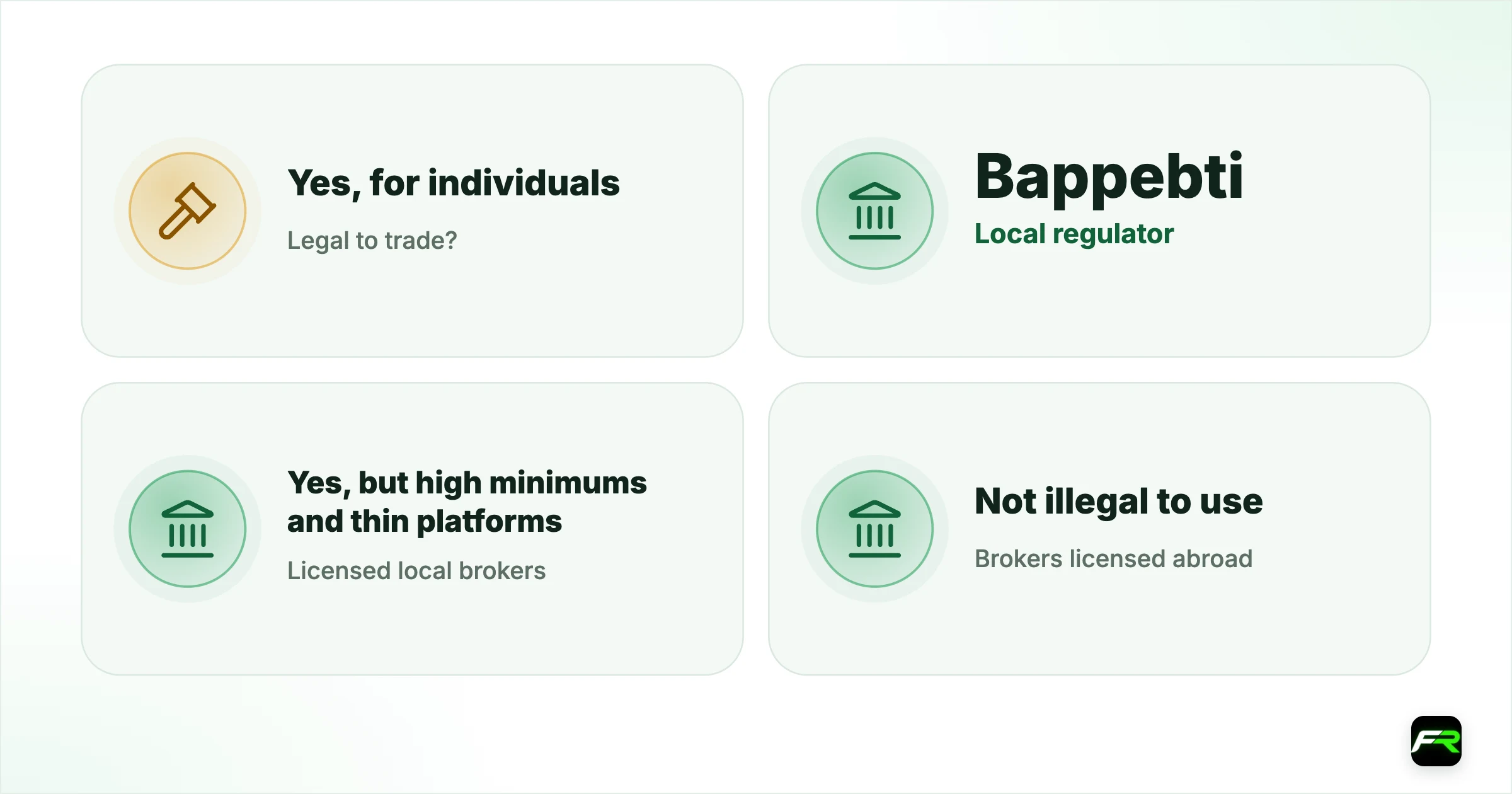
| Legal to trade? | Yes, for individuals |
|---|---|
| Local regulator | Bappebti |
| Licensed local brokers | Yes, but high minimums and thin platforms |
| Brokers licensed abroad | Not illegal to use; no Bappebti recourse |
| Common funding | BCA, Mandiri, BNI, BRI local transfer |
| Check before depositing | Bappebti blocked-sites list |
If a “mentor” or “fund manager” asks you to send money to a personal account, stop. Real deposits only happen inside the broker’s own platform, in your own name.
Frequently asked
Is forex trading legal in Indonesia?
Yes. It is regulated by Bappebti, which licenses local brokers and oversees the futures exchange. Trading with a legitimate broker, local or licensed abroad, is not an offence for an individual.
Is it haram to trade forex in Indonesia?
Many Indonesian scholars permit spot forex on a swap-free account where no interest is charged or paid. Views differ, so check with someone you trust, and confirm the swap-free account is genuinely interest-free rather than just relabelled with an administration fee.
Can Bappebti help if a broker abroad will not pay me?
No. Bappebti only handles disputes with brokers it licenses. With a broker regulated overseas your complaint goes to that regulator, such as ASIC, CySEC or the FCA. That is the trade-off for the lower cost and better pricing.
Why do Indonesian traders use offshore brokers if local ones are legal?
Cost and access. Licensed local brokers often require Rp 5 million or more to open, support one platform, and quote wider spreads. Offshore brokers take small deposits, offer MT4 and MT5, and price tighter. For small accounts the difference is decisive.
How do I check if a broker is blocked in Indonesia?
Bappebti publishes a regularly updated list of blocked websites. Search the broker’s exact domain there before depositing. Being absent from the list because the broker is regulated abroad is normal; being on it is a hard stop.
What leverage does Bappebti allow?
Bappebti’s leverage limit for its licensed local brokers is roughly 1:100 on major pairs, tighter than most offshore jurisdictions, which is part of why local platforms feel more conservative. Our forex leverage limits by country guide has the full comparison table.
How is forex profit taxed in Indonesia?
For an individual tax resident, forex profit is ordinary income added to your other earnings and taxed at Indonesia’s progressive personal rates, from 5% up to 35%. You self-report it on your annual SPT, there is no separate lower rate for trading gains and no exemption for using an offshore broker. Our Indonesia forex tax guide covers the one exception, where a final tax applies at the exchange instead.
The team behind this guide
Researched, checked and approved by five forex specialists
Every guide is written, fact-checked and edited before it goes live, and updated when the facts change. Spotted an error? Tell us.