IC Markets




































Is Forex Trading Income Taxable in Malaysia?
It turns on whether your trading looks like a business and on the foreign-source income rules, which have changed. Casual traders often owe nothing; systematic traders may owe income tax.
 WriterAbir KhanWriterWrites the guides · checks every figure against primary sources View profileAbout Abir →
 Market analysisTanbir Habib RiyadForex & Crypto AnalystForex and crypto analyst · technical and fundamental analysis View profileAbout Tanbir →
 Fact-checking & riskJannatul FerdaushFact-Checker & Risk AnalystFact-checks every figure · risk analysis · Applied Statistics, University of Dhaka View profileAbout Jannatul →
 Trading reviewJowel RanaCo-Founder & Forex TraderCo-founder · forex trader · reviews guides from a trader's view View profileAbout Jowel →
 Final approvalRanjan NiskrityFounder, Owner & Forex TraderFounder and owner · forex trader · signs off every guide View profileAbout Ranjan →
Key takeaways
- Malaysia has no general capital-gains tax for individuals; the question is whether your trading counts as a business.
- LHDN applies the "badges of trade": frequency, system, time and capital committed, and profit motive.
- Occasional trading alongside a job is more likely untaxed; systematic trading is more likely business income.
- Keep records either way, and check the foreign-source income rules with an accountant.
Malaysia's tax authority is the Inland Revenue Board of Malaysia (Lembaga Hasil Dalam Negeri, LHDN), applying the Income Tax Act 1967. Malaysia does not have a general capital-gains tax on individuals, so the question is not “what rate applies to trading gains” but “is this trading a taxable activity at all”. The answer depends on whether your trading amounts to a business in the eyes of the tax authority, and on how the foreign-source income rules apply to money from an offshore broker.
This is a general overview, not tax advice. Tax rules change, they depend on your personal circumstances, and the treatment of offshore trading is an area where enforcement and interpretation both evolve. Speak to a qualified local accountant before you file, ideally before you have a large gain to explain.
Is your trading a business?
Malaysian tax practice looks at the “badges of trade” to decide whether an activity is a taxable business or a non-taxable personal pursuit. For forex, the relevant factors are how frequently you trade, whether you do it systematically with a method and records, the time and capital you devote to it, and whether profit is the clear motive.
- Occasional trader: a handful of trades, a small account, done alongside a full-time job. This is more likely treated as a personal activity, with gains not taxed.
- Systematic trader: frequent trading, a defined strategy, meaningful capital, treated like an income source. This is more likely treated as carrying on a business, with profits assessed as business income at personal rates.
There is no bright line. Two people with similar accounts can be treated differently based on how organised and profit-focused the activity looks. If you are trading seriously, assume it is taxable and keep records.
Decoding the term: what are “badges of trade”?
“Badges of trade” is not Malaysia-specific terminology invented for this article, it is a real, long-established concept from UK and wider Commonwealth tax case law, adopted into Malaysian tax practice to answer one question: is this activity a trade (taxable business income) or a personal/investment activity (generally not taxed)? There is no single test; instead, several factors are weighed together, including how often you transact, whether you have a system or method, how much time and capital you commit, and whether your conduct shows a clear profit motive versus something closer to a hobby or occasional pursuit. No one factor decides it alone, which is exactly why two similar-looking traders can be assessed differently.
The foreign-source income question
Money earned from an offshore broker is foreign-source income. Malaysia moved to tax foreign-source income received in Malaysia from 2022, but exemptions for individuals on remitted foreign income have been provided and extended, subject to conditions. The interaction between “is it a business” and “is the foreign income exempt on remittance” is exactly the kind of thing that changes with each budget, so the current position must be checked with an accountant rather than assumed from an older article.
Hafiz trades full-time and treats it as his income. His accountant advised that his trading clearly amounts to a business on the badges of trade, so the profits are assessable, and walked him through how the foreign-source income exemption currently applied to his remittances. A colleague who places a few trades a month around a salaried job was advised his activity did not amount to a business and his small gains were not taxed. Same broker, very different treatment, driven by scale and intent.
Legal compliance vs. tax obligations
Everything above is about whether and how trading profit is taxed. It is a separate question from whether using an offshore, unlicensed forex or CFD broker is itself compliant with Malaysian rules. Bank Negara Malaysia (BNM) administers Foreign Exchange Administration (FEA) rules that sit apart from income tax entirely. Malaysian residents generally have flexibility to hold and use foreign currency, but whether routing funds to an unlicensed offshore broker specifically fits within that flexibility is a genuine, distinct compliance question, not one this article resolves. If it matters to your situation, that is a question for an accountant or lawyer familiar with BNM's current rules, not an assumption to make either way.
How forex losses are treated
If your trading is classified as a business, losses generally follow the same treatment as other business losses: they can be set off against other business income in the same year, and unabsorbed losses can generally be carried forward against future business income (currently up to 10 consecutive years under Malaysian rules), subject to conditions. If your trading is instead treated as a personal, non-business activity, losses are typically just losses, with no offset against your other income, in the same way gains from that activity would not be taxed either. Which side of that line you're on is decided by the same badges-of-trade test used for gains.
What to keep either way
- Trade history and monthly net profit or loss.
- Every deposit and withdrawal, with dates and ringgit amounts.
- A note of when profits were remitted to Malaysia, if at all.
- Enough detail to show whether the activity is occasional or systematic, if asked.
A worked example
Take two Malaysians with the same RM 20,000 net trading profit for the year. The first placed around roughly 15 trades over twelve months, spends around an hour a week on it, and has a full-time salaried job. On the badges of trade, an accountant is likely to view this as a personal activity, and the RM 20,000 is not assessed. The second trades most days, has a written strategy, keeps a journal, and treats the account as a serious income source. That looks like a taxable trade, so the RM 20,000 is assessed as business income at personal rates, and the foreign-source income rules on remittance then determine the timing. Same number, opposite outcome, decided by how the activity is conducted.
Why the rules are hard to pin down
Malaysia’s treatment of foreign-source income has been through several changes since 2022, with taxation introduced, exemptions granted, and those exemptions extended in stages. Any specific statement about the current exemption window will date quickly. The stable points are: there is no general capital-gains tax, a genuine trading business is taxable, and foreign-source income has its own remittance rules. The current-year detail is a question for an accountant, not an old article.
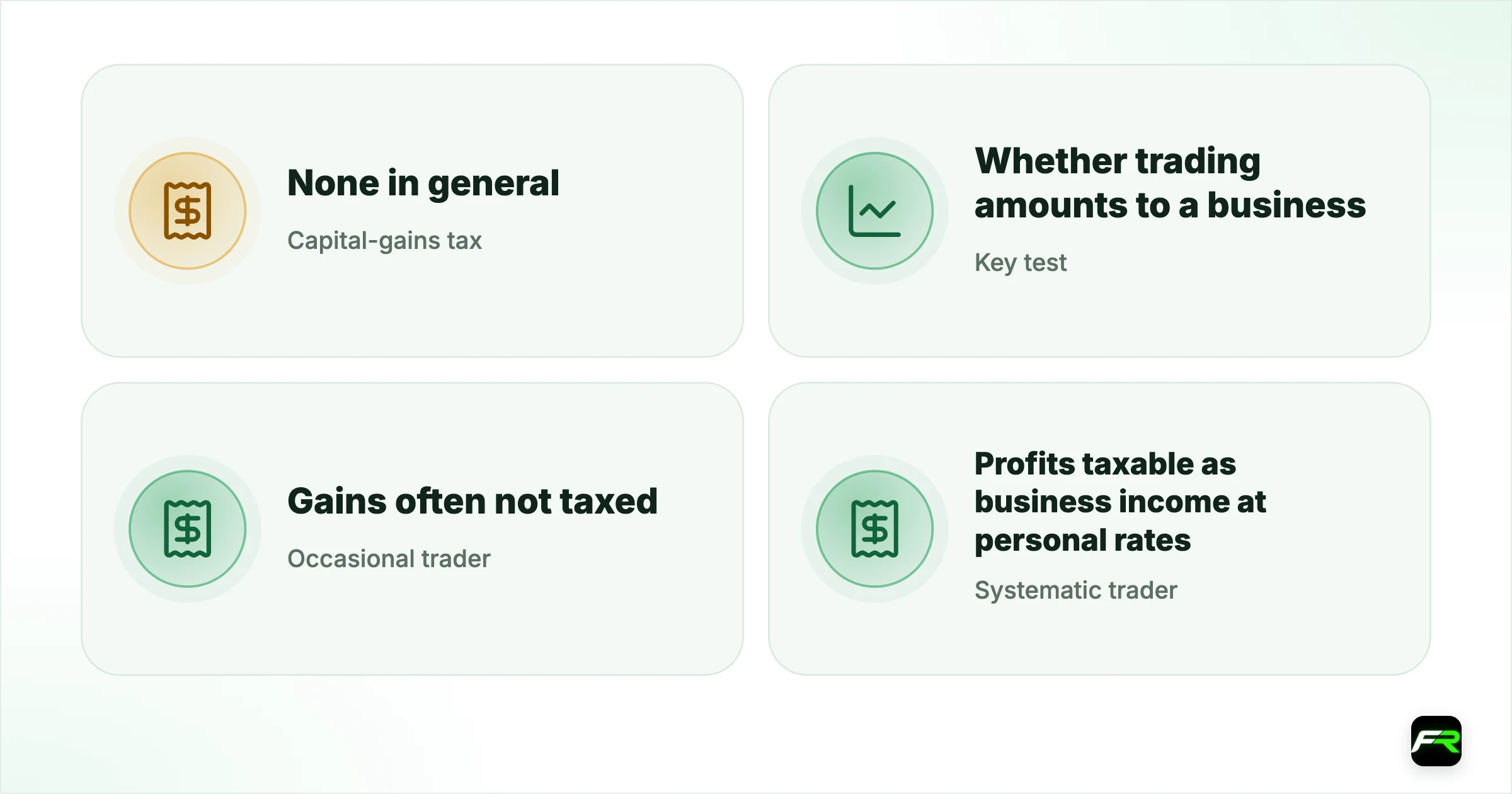
| Capital-gains tax | None in general |
|---|---|
| Key test | Whether trading amounts to a business (badges of trade) |
| Occasional trader | Gains often not taxed |
| Systematic trader | Profits taxable as business income at personal rates |
| Foreign-source income | Rules changed from 2022 and exemptions were extended; check the current position |
Do not rely on “Malaysia has no capital-gains tax” to conclude your trading is tax-free, note too that this general statement has one exception unrelated to individual forex trading: since 2024 Malaysia taxes gains on disposals of unlisted shares by companies, a narrow carve-out that does not affect personal trading accounts but means "no CGT" is no longer true without qualification. If it looks like a taxable trade, the profits are treated as income, and the foreign-source rules add another layer. Confirm your position for the current year.
Comparing rules across the region, or funding an account for the first time? See the same question for the Philippines, Indonesia, how to spot a fake forex broker.
Sources and where to check it yourself
- Inland Revenue Board of Malaysia (LHDN): official guidance on income tax and foreign-source income
For the rules and brokers that apply where you live, see our guide to forex brokers in Malaysia.
Frequently asked
Is forex trading tax-free in Malaysia?
Not automatically. Malaysia has no general capital-gains tax, but if your trading amounts to a business it is taxable as business income at personal rates. Occasional trading around a job is more often treated as a non-taxable personal activity.
How does Malaysia decide if trading is a business?
Through the badges of trade: frequency, system and method, time and capital committed, and profit motive. Frequent, systematic, profit-focused trading is more likely to be treated as a business.
Is money from an offshore broker foreign-source income?
Yes. Malaysia moved to tax foreign-source income received in Malaysia from 2022, with exemptions for individuals that have changed more than once since 2022, most recently extended subject to conditions that are worth confirming for the current year rather than assuming an older article still applies. The current position should be checked with an accountant.
What rate would apply if my trading is taxable?
Business income is taxed at the personal income tax rates, which are progressive. There is no separate flat rate for trading profits.
Do I need to keep records if I only trade occasionally?
Yes. If your activity is ever questioned, records are what show whether it was occasional or systematic. Keep trade history, deposits, withdrawals and remittance dates regardless.
Does a swap-free account change the tax position?
No. The account type does not affect whether the activity is a business or how foreign-source income is treated. It only removes the overnight interest.
Is spread betting or CFD forex treated differently in Malaysia?
The label matters less than the substance. Whatever the product, the tests are the same: does the activity amount to a business, and how does the foreign-source income arise and get remitted. An accountant applies those tests to your actual trading.
What if I move to Malaysia mid-year as a trader?
Your residency status for the tax year and when your income arose both matter, and the foreign-source rules interact with residency. This is a situation to take to an accountant before you file, not to guess at.
The team behind this guide
Researched, checked and approved by five forex specialists
Every guide is written, fact-checked and edited before it goes live, and updated when the facts change. Spotted an error? Tell us.