IC Markets





































Forex Brokers With FPX and Online Banking (Malaysia)
FPX makes funding a forex account in Malaysia cheap and fast: direct from your bank, usually free, minutes to clear. Here is how it works and what still costs you.
 WriterAbir KhanWriterWrites the guides · checks every figure against primary sources View profileAbout Abir →
 Market analysisTanbir Habib RiyadForex & Crypto AnalystForex and crypto analyst · technical and fundamental analysis View profileAbout Tanbir →
 Fact-checking & riskJannatul FerdaushFact-Checker & Risk AnalystFact-checks every figure · risk analysis · Applied Statistics, University of Dhaka View profileAbout Jannatul →
 Trading reviewJowel RanaCo-Founder & Forex TraderCo-founder · forex trader · reviews guides from a trader's view View profileAbout Jowel →
 Final approvalRanjan NiskrityFounder, Owner & Forex TraderFounder and owner · forex trader · signs off every guide View profileAbout Ranjan →
FPX (Financial Process Exchange) is the reason funding a forex account is not a headache in Malaysia the way it is in Pakistan or Bangladesh. It moves ringgit straight from your online banking to the broker’s payment partner, usually free, and it clears within minutes. Withdrawals return the same way. That leaves the broker’s currency conversion as your only real cost. Our best forex brokers in Malaysia guide covers which firms support FPX and Touch ‘n Go.
How an FPX deposit works
In the broker’s deposit page you choose FPX or “online banking”, enter the amount in ringgit, and the broker shows the USD your account will receive at its own rate. You are then redirected to your own bank’s login page, where you authorise the payment exactly as you would any other online transfer. Maybank2u, CIMB Clicks, Public Bank and the rest are all supported. Control returns to the broker and the trading balance updates within a few minutes, occasionally up to half an hour at busy times.
Because FPX is a bank-to-bank rail regulated in Malaysia by PayNet, the transfer itself is as secure as any online banking payment you make. Your money goes from your bank to the broker’s payment partner’s bank; nothing sits with a third party you have to trust separately. The one thing FPX cannot vouch for is the broker on the receiving end crediting and honouring the funds, which is why the licence check still matters as much as it would with any other method.
Touch ‘n Go and Boost
Some brokers also support Touch ‘n Go eWallet or Boost. These work like FPX for smaller amounts and sometimes carry a small fee. Withdrawals return to the same wallet.
Run the full loop before you commit: deposit the minimum by FPX, place one small trade, withdraw it. FPX withdrawals usually take a day. If the broker drags it out, you have learned that cheaply.
If an FPX Transfer Fails or Gets Stuck
Occasionally the redirect breaks down mid-transaction: your bank’s confirmation page times out, the connection drops before you see the broker’s “successful” screen, or the money leaves your account but the trading balance never updates. This is a known friction point with bank-redirect systems generally, not something specific to a shady broker, it can happen with a fully licensed one too.
Check your bank statement first; if the debit shows as pending rather than completed, it usually reverses on its own within a day or two. If the money has genuinely left your account and the broker still has not credited it after the usual few minutes, contact the broker’s support directly with the FPX reference number and the exact timestamp from your bank app, that reference is what lets the broker trace the payment and credit or reverse it. Do not repeat the payment while the first one is still unresolved, and do not accept an “agent” or third party offering to sort it out for a fee; that is exactly the situation a middleman tries to exploit.
Phishing Risk During the Bank Redirect Step
The moment FPX hands you off to your bank’s login page is also the moment scammers target. Fake FPX and online-banking pages that mimic Maybank2u, CIMB Clicks or Public Bank’s login screens are a known scam vector in Malaysia, usually reached through a phishing link rather than a genuine broker’s deposit page. The fake page looks identical, and typing your credentials into it hands them straight to the scammer.
Only start an FPX redirect from a deposit page you reached by typing the broker’s own URL yourself, never from a link in an email, SMS or social media message. Check the address bar shows your actual bank’s domain before entering anything, and treat any redirect that asks for your login twice, or asks for a TAC/OTP outside your bank’s normal flow, as a reason to stop and contact your bank directly.
What still costs you
- FPX deposit fee: usually zero.
- Broker MYR-to-USD conversion: roughly 0.3 to 0.7% worse than interbank, both directions.
- On an RM 1,000 deposit that is around RM 3 to 7 each way.
Farah funds a CySEC account by FPX, RM 400 at a time, with no fee, credited within five minutes. Her first withdrawal, RM 150, took one business day back to her Maybank account. She keeps position sizes tiny and moves money in and out rarely, because even a fraction of a percent conversion spread adds up when you do it every week.
A typical Malaysian setup
Put together, the common arrangement for a Malaysian trader looks like this: an account with a broker on a strong offshore licence (CySEC, ASIC or FCA), funded by FPX from a Maybank, CIMB or Public Bank account, with a swap-free account if it is needed and its terms confirmed in writing. Deposits clear in minutes and cost nothing on the FPX side. Withdrawals go back to the same bank in about a business day. The only recurring cost is the ringgit-to-USD conversion of a few tenths of a percent each way.
The friction that remains is regulatory, not practical. The broker is on the Bank Negara Financial Consumer Alert list because it is not licensed in Malaysia, and you have no local recourse if it fails. FPX makes the money movement easy; it does nothing about that. So the effort you save on funding should go into choosing a broker whose licence and withdrawal record you have checked, rather than the one with the smoothest checkout.
If a Broker Won’t Return Funds to Your Original Bank
The rule that an FPX withdrawal has to return to the account you deposited from exists to stop money laundering, and a legitimate broker follows it without being asked. If a broker instead asks you to accept withdrawal to a different bank, a different person’s account, or a crypto wallet instead of your original FPX account, or simply stalls indefinitely when you request the standard withdrawal, that is not a technical glitch, it is one of the clearest signs you are dealing with an operation that does not intend to pay you back.
Put the request in writing through the broker’s own support channel and keep the reference. A broker that still will not return funds to your original bank within its stated timeframe is not going to start being reliable later; that is the point at which most traders in this situation stop waiting and start documenting everything for a chargeback or complaint instead.
The Islamic-account point
If you need a swap-free account, that is a separate question from funding, and FPX has nothing to do with it. Confirm the swap-free terms before you open the account: whether it is genuinely interest-free, and whether an administration fee applies after a grace period. A broker that is evasive about the fee structure on its Islamic account is one to be wary of generally. Our swap-free guide covers exactly what to ask and what a fair set of terms looks like.
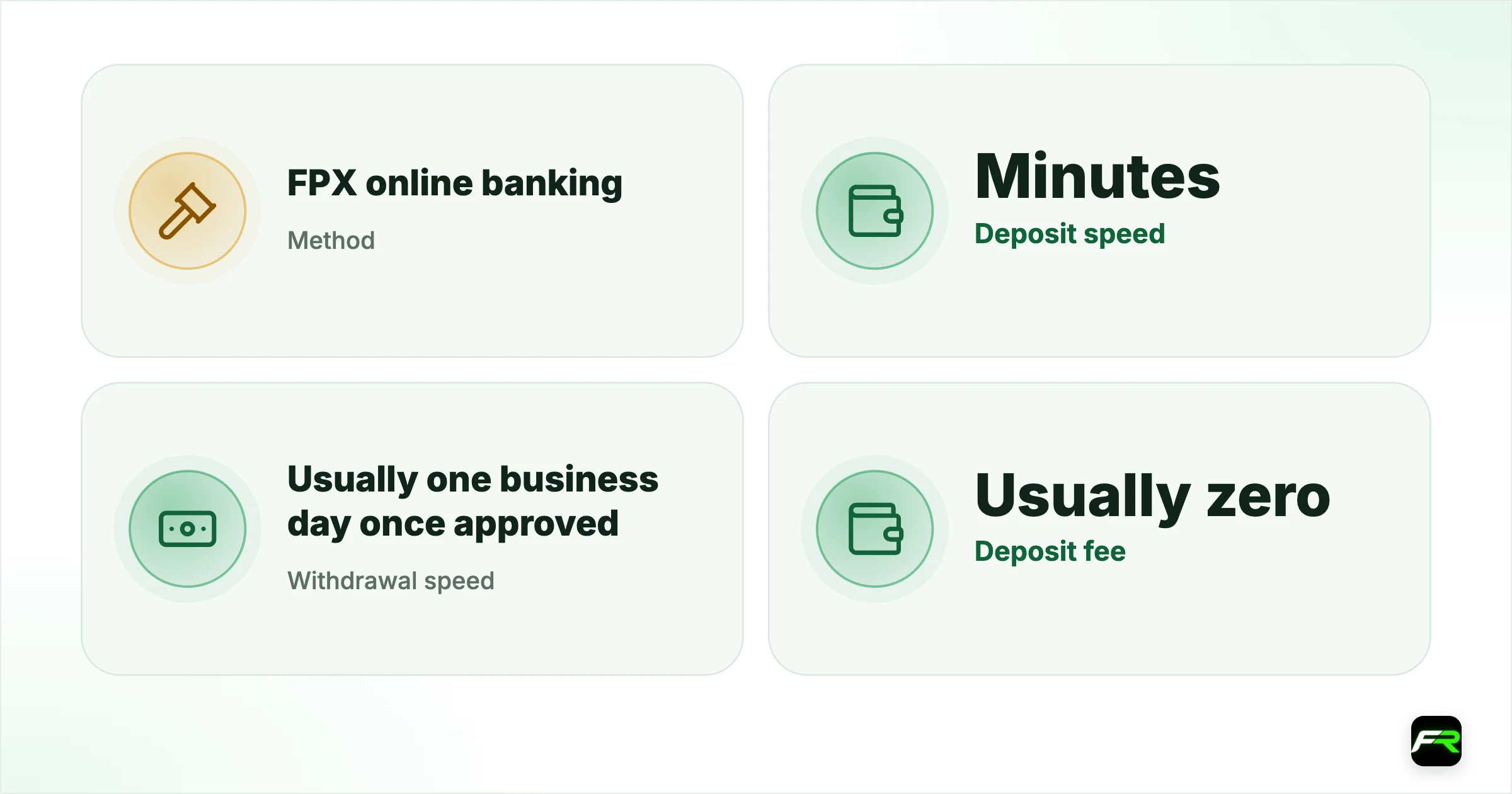
| Method | FPX online banking (bank-to-bank) |
|---|---|
| Deposit speed | Minutes |
| Withdrawal speed | Usually one business day once approved |
| Deposit fee | Usually zero |
| Conversion cost | ~0.3–0.7% each way |
FPX is safe; the broker is the variable. A slick FPX checkout does not tell you whether the broker will pay you back. Verify the licence and read real withdrawal reviews first.
Frequently asked
Which forex brokers accept FPX in Malaysia?
Many brokers serving the region support FPX or “online banking” through a payment partner. Check the deposit page for the specific broker entity you sign up with.
Is FPX free for forex deposits?
The FPX side is usually free. The cost that remains is the broker’s MYR-to-USD conversion, roughly 0.3 to 0.7% worse than interbank, charged both when you deposit and when you withdraw.
What do I do if FPX deducted the money from my bank but my broker balance didn’t update?
Check your bank statement first; if the debit is still pending it will usually reverse within a day or two on its own. If it has gone through and the broker still has not credited it after the usual few minutes, contact the broker’s own support with the FPX reference number and timestamp rather than waiting it out silently, that reference is what lets them trace and credit the payment.
How fast are FPX withdrawals from a forex broker?
The FPX leg is fast; the delay is the broker’s approval, usually about one business day. A withdrawal that takes much longer without explanation is a warning sign.
Can I fund a forex account with Touch ‘n Go?
Some brokers support Touch ‘n Go eWallet and Boost for smaller amounts. They may carry a small fee, and withdrawals return to the same wallet. FPX is the cheaper default for larger sums.
Does using FPX make my broker legal in Malaysia?
No. Unlicensed offshore brokers are on the Bank Negara alert list regardless of how you fund them. FPX is a payment convenience, not a regulatory status.
Which banks support FPX for forex deposits?
All the major Malaysian retail banks are on the FPX network, including Maybank, CIMB, Public Bank, RHB, Hong Leong and Bank Islam. The broker’s payment page lists the ones its partner accepts, which is usually most of them.
Is there a limit on FPX deposits?
FPX itself has per-transaction limits set by your bank, often around RM 30,000 for retail online banking, and the broker may set its own minimum and maximum. For most retail traders the bank limit is well above what they deposit.
Can I withdraw to a different bank than I deposited from?
Your original deposit normally has to return to the source bank account. Profit above that can sometimes go elsewhere. Choose your withdrawal bank when you make the first deposit.
The team behind this guide
Researched, checked and approved by five forex specialists
Every guide is written, fact-checked and edited before it goes live, and updated when the facts change. Spotted an error? Tell us.