IC Markets


































Bappebti-Regulated Brokers vs Offshore: What Indonesians Use
Indonesia has a real local licensing system. Most traders still open an account abroad. This is the cost-and-access comparison that decides it, laid out with numbers.
 WriterAbir KhanWriterWrites the guides · checks every figure against primary sources View profileAbout Abir →
 Market analysisTanbir Habib RiyadForex & Crypto AnalystForex and crypto analyst · technical and fundamental analysis View profileAbout Tanbir →
 Fact-checking & riskJannatul FerdaushFact-Checker & Risk AnalystFact-checks every figure · risk analysis · Applied Statistics, University of Dhaka View profileAbout Jannatul →
 Trading reviewJowel RanaCo-Founder & Forex TraderCo-founder · forex trader · reviews guides from a trader's view View profileAbout Jowel →
 Final approvalRanjan NiskrityFounder, Owner & Forex TraderFounder and owner · forex trader · signs off every guide View profileAbout Ranjan →
Indonesia is unusual in the region: it has a working local framework for retail forex, run by Bappebti, with licensed brokers, an exchange, and a complaints process. And yet most Indonesian retail traders use a broker regulated in Australia or Cyprus. This guide explains why, so you can make the call for your own situation rather than following the crowd or the ads. For the shortlist itself, see our best forex brokers in Indonesia guide.
What a Bappebti licence gives you
A Bappebti-licensed broker operates inside a structure: trades pass through the Jakarta Futures Exchange and a clearing house, client money sits in segregated accounts at Indonesian banks, and disputes can be escalated to Bappebti itself. If a licensed local broker refuses a withdrawal or misprices your fills, you have a regulator in your own country, in your own language, with the power to act.
That is genuinely valuable, and it is the whole reason the local option exists. The question is what it costs you to get it.
What it costs: the numbers
| Bappebti-licensed local | ASIC or CySEC broker | |
|---|---|---|
| Minimum deposit | Often Rp 5–50 million | Rp 150,000–1,500,000 |
| EUR/USD spread (typical) | 1.5–2.5 pips | 0.1–1.0 pip |
| Platforms | Usually one proprietary platform | MT4, MT5, sometimes cTrader |
| Leverage | Capped lower | 1:200 to 1:1000 |
| IDR deposit | Bank transfer only | Bank transfer, sometimes e-wallet |
| If something goes wrong | Bappebti | The foreign regulator |
For a trader opening with Rp 50 million and holding positions for weeks, the spread difference is small relative to the balance, and the local dispute process is worth having. For a trader opening with Rp 500,000 and scalping the majors, the spread is the entire edge, and the minimum deposit alone rules the local option out.
Dimas started with a Bappebti-licensed broker because it felt safer. The Rp 10 million minimum wiped out his savings buffer, and EUR/USD cost him around 2 pips a trade. After six months he moved to an ASIC-regulated broker, funded Rp 800,000 by BCA transfer, and now trades the same pair under 1 pip. His view: the local licence gave him the confidence to start, but the economics only worked once he switched. He keeps the local account open with a small balance in case he ever wants the dispute process.
When the local option is the right one
- You are funding a large account and the spread difference is noise next to the balance.
- You value a complaints process in Indonesia more than tighter pricing.
- You are uncomfortable having no local recourse and would trade smaller or not at all without it.
- You are trading rarely and holding for weeks, so the per-trade cost barely matters.
When traders go offshore
- Small starting balance, where the local minimum is a hard barrier.
- Active trading where the spread is most of your cost.
- You want MT4 or MT5, an Islamic account, or a specific product the locals do not offer.
- You accept that a problem means dealing with ASIC or CySEC instead of Bappebti.
What a Bappebti dispute looks like
This is the part the offshore option cannot match. If a licensed local broker refuses a valid withdrawal, misprices your fills, or closes positions without cause, you can put a formal complaint to the broker, then escalate to the Jakarta Futures Exchange and to Bappebti. Because the broker holds a licence it wants to keep, and client money sits in segregated accounts at Indonesian banks, there is genuine leverage behind that complaint.
With an offshore broker, the equivalent is filing with ASIC in Australia or CySEC in Cyprus, in English or Greek, across time zones, with no guarantee the regulator will treat a small overseas retail complaint as a priority. Some traders have recovered money that way; many have not bothered because the effort outweighed the amount. That asymmetry is exactly what you are paying the higher local costs for.
The middle path
Some Indonesian traders run both. A small live balance offshore for day-to-day trading, and a local account they could scale into if they ever wanted the regulatory certainty for a larger sum. It costs nothing to keep the local account open, and it means the choice is not permanent. If your account grows to the point where a stuck withdrawal would genuinely hurt, that is the moment to think seriously about moving the bulk of it onshore.
Whatever you choose, check the broker against the Bappebti blocked-sites list first. An offshore broker being absent from it is normal. An offshore broker being on it is a hard stop.
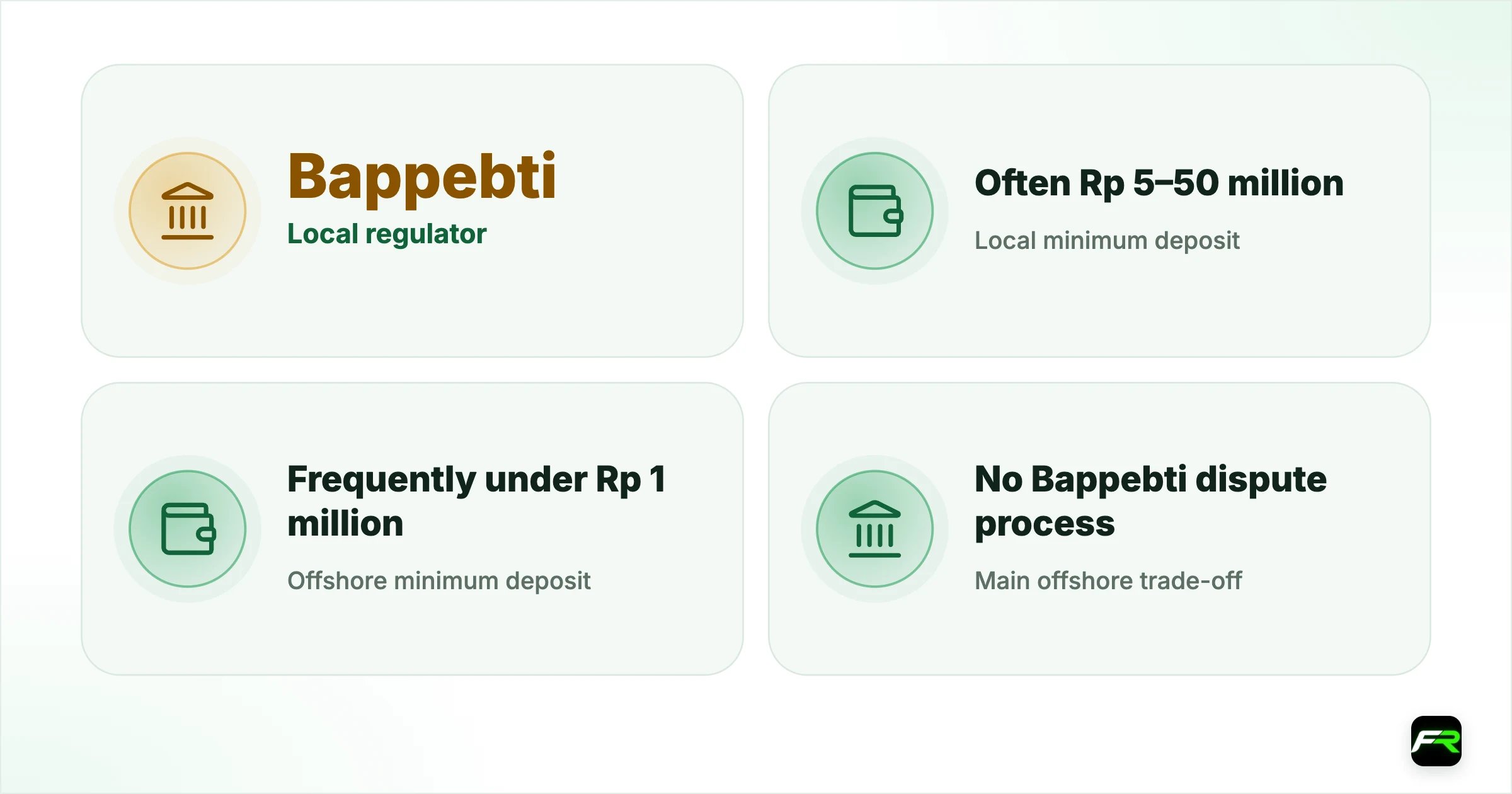
| Local regulator | Bappebti |
|---|---|
| Local minimum deposit | Often Rp 5–50 million |
| Offshore minimum deposit | Frequently under Rp 1 million |
| Main offshore trade-off | No Bappebti dispute process |
| Common approach | Offshore for trading, local optional for large sums |
A broker that claims a Bappebti licence should appear on the Bappebti register. If it does not, the claim is false, regardless of what logo is on the site.
Frequently asked
Are Bappebti-licensed brokers safe?
They operate inside a real structure: an exchange, a clearing house, segregated client money at Indonesian banks, and a regulator you can complain to. The main downsides are higher minimum deposits and wider spreads, not safety.
Why do most Indonesian traders use offshore brokers?
Cost and access. Local minimums often start at Rp 5 million or more, spreads are wider, and platform choice is limited. Offshore brokers take small deposits, price tighter, and offer MT4 and MT5. For small accounts the difference is decisive.
Can I check whether a broker is Bappebti-licensed?
Yes. Bappebti publishes a register of licensed brokers and a separate list of blocked websites. Check both before depositing.
Is it worth keeping a local account open as well?
Some traders do, with a small balance, so they can scale into the regulated option later without opening a new account. It costs nothing and keeps the choice reversible.
Do offshore brokers accept IDR bank transfer?
Many that serve Southeast Asia do, through a local payment partner, so you send rupiah to a domestic account and it converts to USD in your trading balance. Confirm it is supported before you sign up.
The team behind this guide
Researched, checked and approved by five forex specialists
Every guide is written, fact-checked and edited before it goes live, and updated when the facts change. Spotted an error? Tell us.