IC Markets





































Prop Firm Challenges: Worth It for Asian Traders?
Pay a fee, pass an evaluation, trade for a profit split. How prop challenges work for Asian traders, and where rules and payouts bite.
 WriterAbir KhanWriterWrites the guides · checks every figure against primary sources View profileAbout Abir →
 Market analysisTanbir Habib RiyadForex & Crypto AnalystForex and crypto analyst · technical and fundamental analysis View profileAbout Tanbir →
 Fact-checking & riskJannatul FerdaushFact-Checker & Risk AnalystFact-checks every figure · risk analysis · Applied Statistics, University of Dhaka View profileAbout Jannatul →
 Trading reviewJowel RanaCo-Founder & Forex TraderCo-founder · forex trader · reviews guides from a trader's view View profileAbout Jowel →
 Final approvalRanjan NiskrityFounder, Owner & Forex TraderFounder and owner · forex trader · signs off every guide View profileAbout Ranjan →
A prop firm challenge works like this: you pay a fee, usually USD 50 to 600 depending on account size, and trade a demo account to a profit target, typically 8 to 10%, without breaching a daily loss limit or a maximum drawdown. Pass, and you get a “funded” account where you trade to the firm’s rules and keep a share of the profit, commonly 70 to 90%. It is an appealing pitch for a skilled trader with little capital. Whether it is worth it depends on details the marketing skips.
Understand the business model
There are two kinds of prop firm. Some genuinely want profitable traders, take real risk on funded accounts, and make money from a cut of trader profits. Others make most of their money from challenge fees, so the failure rate is high, the fee is non-refundable, and every failed challenge is revenue. A firm in the second category has an incentive to set rules that are hard to pass and to make payouts slow.
You usually cannot tell which kind you are dealing with from the website. What you can do is read the rules and the payout terms closely, and look for a track record of traders being paid, discussed on independent forums such as Trustpilot rather than the firm’s own testimonials.
Where to Check Independent Payout Reports
A firm’s own site will always show its best cases, so treat testimonials on the challenge page as marketing, not evidence. Independent, third-party review platforms such as Trustpilot carry unmoderated reviews for most large prop firms, including complaints about slow or refused payouts, which is exactly the pattern you are trying to catch before you pay a fee. Trading forums and subreddits dedicated to prop firms are worth the same scrutiny: search the firm’s name plus “payout” and read the recent posts, not just the pinned success stories, since a firm that has genuinely stopped paying tends to show up in complaints within weeks.
Look for patterns rather than single bad reviews, every firm has some unhappy traders who breached a rule and blame the firm. What matters is whether multiple independent accounts describe the same specific problem: a payout that never arrived, an account closed right before a payout was due, or support that goes silent once money is owed.
The rules that trip people up
- Daily loss limit: often 4 to 5% of the starting balance, measured from the day’s opening equity or highest equity. One bad session ends the account.
- Maximum drawdown: typically 8 to 10%, sometimes trailing, so a drawdown from a new equity high still counts. This is the one that catches disciplined traders after a good run.
- Consistency rules: some firms require no single day to account for too much of your total profit, which forces you to trade small consistently.
- News restrictions: some prohibit holding trades over high-impact news, which for an Asian trader can rule out the exact hours you are awake.
- Minimum trading days: you cannot pass in a day, which is fine, but it means the fee buys a commitment of time.
The Asian trader’s specific problems
Two issues hit traders in this region harder. First, timezone: many prop firms are built around US market hours, and their news calendars, support hours and even the volatility their rules assume are US-centric. If you trade the Asian session, you are working with lower volatility and thinner moves, which makes an 8% target in a limited window harder, not easier.
Second, payouts. Prop firm payouts usually go through specific processors, sometimes crypto only, sometimes a service with limited coverage in your country. Before you pay for a challenge, confirm the firm can pay you, in your country, by a method you can use. Traders have passed challenges and then been unable to receive the money cleanly.
Hasan passed a USD 100 challenge for a USD 25,000 account trading the Asian session, hit a USD 1,900 profit, and requested a payout. The firm paid in USDT only. Buying and selling USDT locally, plus the network fees, cost him about 6% of the payout, and the first request was delayed three weeks with a document back-and-forth. He kept trading the account but now treats the payout friction as a real cost, and he checked the second firm he tried could pay by a method that worked for him before paying the fee.
How a Prop Firm Payout Is Taxed
A funded-account payout is income, not a trading profit in the conventional sense, because you are being paid a share of the firm’s money under a contract rather than realising a gain on your own capital. Most tax authorities in the region treat it as taxable income or self-employment income in the year you receive it, separate from any question about whether the challenge fee itself was deductible. The firm is very unlikely to withhold tax on your behalf or issue you a local tax document, so the reporting obligation sits entirely with you.
Keep the challenge-purchase receipt, the pass notification, and every payout confirmation with its date and USD or USDT value at the time you received it, converting a crypto payout to your local currency can itself be a separate taxable event in some countries, on top of the payout being taxed as income. Rules vary enough by country that this is worth a short conversation with a local tax adviser once you have a payout to report, rather than assuming it falls into a grey area because the firm itself is offshore.
Is it worth it?
For a genuinely skilled, disciplined trader with a proven process and no capital, a well-run prop firm can be a reasonable way to trade larger size than they could fund themselves. For everyone else, which is most people who buy challenges, it is a paid demo with strict rules, and the fee is the cost of finding out you are not ready. Treat the fee as spent the moment you pay it. If passing would genuinely change your trading life, and you have the process to pass, it can be worth a considered attempt. If you are hoping it will force you to become disciplined, it will not.
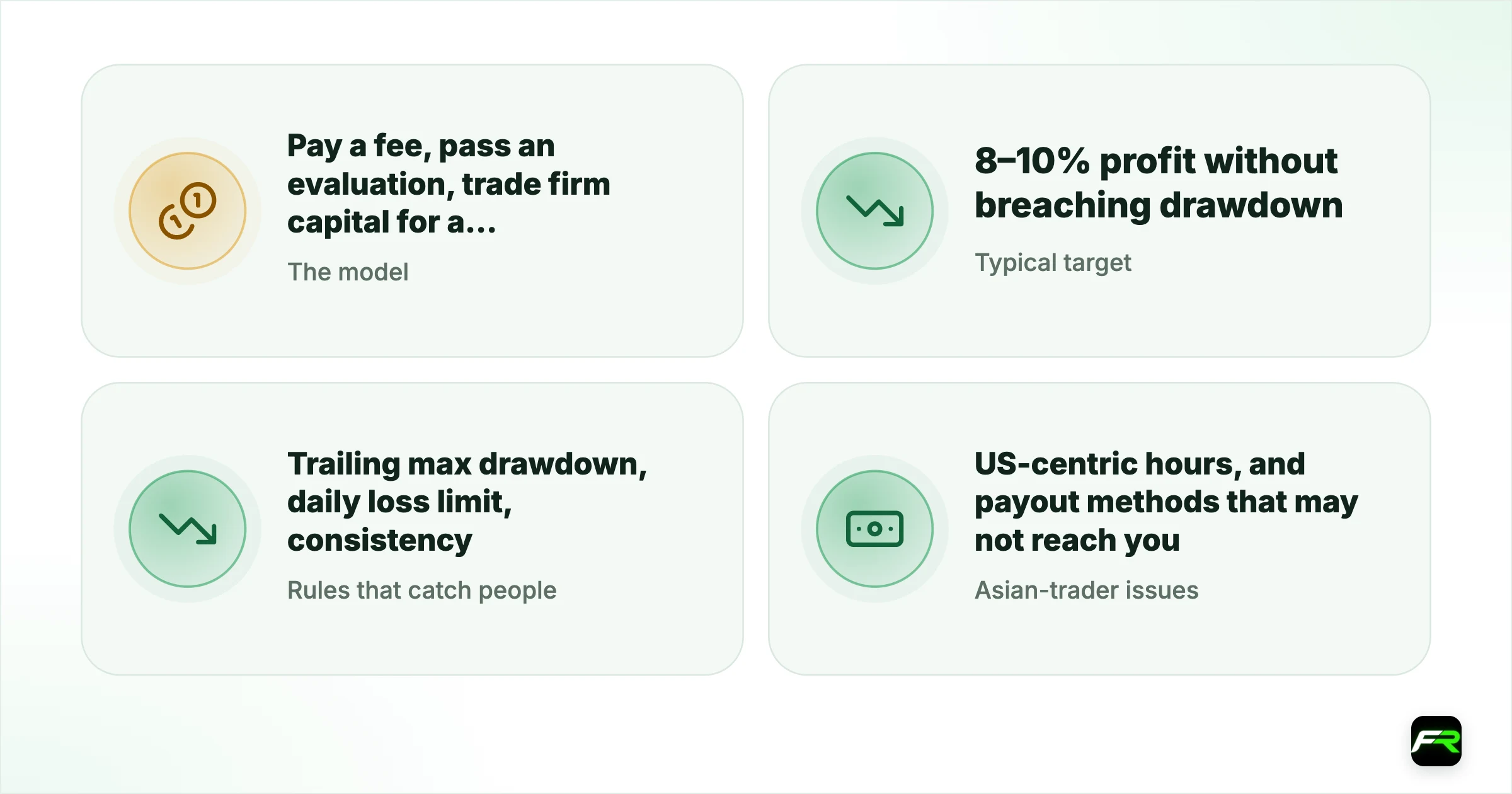
| The model | Pay a fee, pass an evaluation, trade firm capital for a profit split |
|---|---|
| Typical target | 8–10% profit without breaching drawdown |
| Rules that catch people | Trailing max drawdown, daily loss limit, consistency |
| Asian-trader issues | US-centric hours, and payout methods that may not reach you |
| Honest framing | A paid demo with rules; worth it only for an already-proven trader |
Before paying for any challenge, confirm the firm can pay you in your country by a method you can use. Passing and then being unable to receive the money is a common and avoidable outcome.
Frequently asked
Are prop firm challenges worth it for Asian traders?
For a genuinely skilled, disciplined trader with no capital, a firm with a genuine funded-account model can be a way to trade larger size. For most people who buy challenges, it is a paid demo with strict rules, and the non-refundable fee is the cost of learning you are not ready.
How do prop firm challenges work?
You pay a fee, trade a demo account to a profit target (usually 8 to 10%) without breaching a daily loss limit or maximum drawdown. Pass, and you get a funded account trading the firm’s capital for a profit split, commonly 70 to 90%.
What is the hardest prop firm rule to pass?
Usually the trailing maximum drawdown, which measures from your highest equity, so a normal pullback after a good run can breach it. Daily loss limits and consistency rules also catch people.
Do prop firms pay out?
Some do; some make most of their money from challenge fees and make payouts slow and difficult. Check independent forums such as Trustpilot for accounts of real payouts, and confirm the payout method works in your country before you pay.
Can I do a prop firm challenge trading the Asian session?
You can, but many firms are built around US market hours, and the Asian session’s lower volatility makes an 8% target in a limited window harder. Check the firm’s news rules against your trading hours.
How are prop firm payouts sent to Asian traders?
Most commonly through specific processors, sometimes crypto only. Buying and selling USDT locally can cost several percent, and coverage varies by country. Confirm the method before paying for a challenge.
Are prop firm payouts taxable in my country?
In most countries, yes, a funded-account payout is generally treated as taxable income in the year you receive it, and the firm will not withhold tax or issue you a local tax form. Keep records of the challenge fee, the pass, and every payout with its date and value, and check with a local tax adviser once you actually have a payout to report.
The team behind this guide
Researched, checked and approved by five forex specialists
Every guide is written, fact-checked and edited before it goes live, and updated when the facts change. Spotted an error? Tell us.