IC Markets





































Copy Trading for Beginners in Asia: an Honest Guide
Copy trading is sold as passive income. It is not passive, the headline returns hide the risk, and you still carry every loss. Here is how it works and how to use it sensibly if you do.
 WriterAbir KhanWriterWrites the guides · checks every figure against primary sources View profileAbout Abir →
 Market analysisTanbir Habib RiyadForex & Crypto AnalystForex and crypto analyst · technical and fundamental analysis View profileAbout Tanbir →
 Fact-checking & riskJannatul FerdaushFact-Checker & Risk AnalystFact-checks every figure · risk analysis · Applied Statistics, University of Dhaka View profileAbout Jannatul →
 Trading reviewJowel RanaCo-Founder & Forex TraderCo-founder · forex trader · reviews guides from a trader's view View profileAbout Jowel →
 Final approvalRanjan NiskrityFounder, Owner & Forex TraderFounder and owner · forex trader · signs off every guide View profileAbout Ranjan →
Key takeaways
- Copy trading mirrors another trader's positions in your account, scaled to the amount you allocate.
- Leaderboards show survivors, not the providers who blew up.
- A smooth equity curve can hide martingale or never-closed losers until the account collapses at once.
- Check the drawdown history, the provider's fees and the broker's licence before copying anyone.
Copy trading lets you automatically mirror another trader’s positions in your own account. It is promoted heavily by brokers and affiliate marketers across Asia as a way to “earn while you learn” or “let the experts trade for you”. The mechanism is real, and some brokers offer it as a properly regulated, clearly-priced feature of the platform rather than a bolted-on plugin. The marketing, and the way beginners use it, is where the problems start.
How it works
You browse a list of “strategy providers” or “signal providers”, each showing a performance chart, a follower count, and stats like win rate and maximum drawdown. You allocate an amount to copy one, and from then on their trades open and close in your account, scaled to your allocation. Depending on the broker's model, the provider is typically paid one of these ways, a performance fee or a share of the spread markup, rather than both stacked on top of each other; the broker earns its own margin on the trading activity either way.
Why the headline numbers mislead
Survivorship
The names you see near the top are the ones who did well recently. The platform is not showing you the hundreds who blew up and disappeared. One with a great six-month chart may simply be the trader whose risky style has not failed yet.
Hidden drawdown and martingale
A smooth, steadily rising equity curve is often produced by a strategy that never lets a loser close. It adds to losing positions (martingale) or holds them indefinitely, so the account looks perfect until the day it does not, and then it loses everything at once. The “maximum drawdown” figure only reflects what has happened so far, not what the strategy can do.
The provider can change
Nothing stops someone who traded carefully for six months from taking a huge risk in month seven, either out of overconfidence or because their own incentives push them to. You are copying a person, and people change.
Siti allocated RM 2,000 to a provider with an 18-month chart that only ever went up and a 4% stated maximum drawdown. For three months she made a steady 6 to 8% a month and told friends. In the fourth month the provider held a losing EUR/USD position through a news spike, doubled it twice, and the account, hers included, lost 70% in two days. The 4% drawdown figure had simply never been tested. She had assumed “low drawdown” meant “low risk”; it meant “has not lost yet”.
What copy trading does not give you
- It is not passive. You still have to choose who to follow, monitor them, and decide when to stop, and the decision to stop is the hardest one.
- It does not build skill. You learn nothing about analysis or risk from watching trades you did not think through.
- It does not remove your risk. Every loss they take is your loss, in full.
- It is not diligence-free. Vetting a provider properly is more work than learning to place a few trades yourself.
How to check a provider’s track record
- Use the platform’s own verified statistics, not a screenshot they posted themselves. Most copy-trading platforms display an audited equity curve, drawdown and follower count you cannot edit.
- Look at the drawdown period, not just the return. Someone who has been through a losing stretch and recovered has shown you something; an unbroken uptrend has not been tested yet.
- Check how long the track record actually is on that specific platform. Someone who switched platforms recently may be presenting a shorter, cherry-picked history.
- Read their own trade history for position sizing that grows after losses. That pattern usually means martingale, whatever the equity curve looks like.
- Confirm the copy-trading feature itself is offered by a broker regulated by a recognised authority for your region, such as Malaysia’s Securities Commission, Thailand’s SEC, Singapore’s MAS, the Philippines’ SEC or BSP, Indonesia’s Bappebti, or Pakistan’s SECP, and note that in several of these markets, retail forex/CFD brokers are not directly licensed locally, so most traders end up using an offshore-regulated entity (FCA, ASIC, CySEC) instead. Either way, confirm the entity on the regulator’s own register rather than taking the broker’s claim at face value, the full routine is in how to spot a fake forex broker.
The fees eat the returns
Copy trading stacks costs. The provider takes a performance fee, often 20 to 30% of profits, or a fixed monthly fee. The broker widens the spread on copied trades or adds a markup. If the provider trades frequently, which a more active trading style can encourage because visible activity attracts followers, you are paying spread on every one of those trades. A provider showing a 40% annual return before fees can hand you something closer to 20% after the performance fee and the spread drag, and that is in a good year. In a flat year the fees can leave you down while their public chart still looks acceptable.
The asymmetry is the problem. They are paid on your gains but do not share your losses. That structure rewards risk-taking with your money, because a big win pays them and a big loss costs them only some followers. Read the fee terms as carefully as the performance chart, because they change the maths more than most people expect.
If you do use it
- Use a broker on a strong regulator where the copy-trading feature is part of the regulated offering, not a third-party add-on.
- Allocate a small amount you can afford to lose entirely, and treat it as tuition rather than an investment.
- Pick providers with a long track record (18 months or more) through at least one difficult market period, and a realistic return, a provider consistently claiming 20% a month is claiming a return that essentially no sustainable trading strategy produces, and is a reason for scepticism rather than excitement.
- Read how they trade. If the equity curve is suspiciously smooth, assume martingale and stay away.
- Set your own stop: if the copied allocation falls a set percentage, you pull out, regardless of what they say.
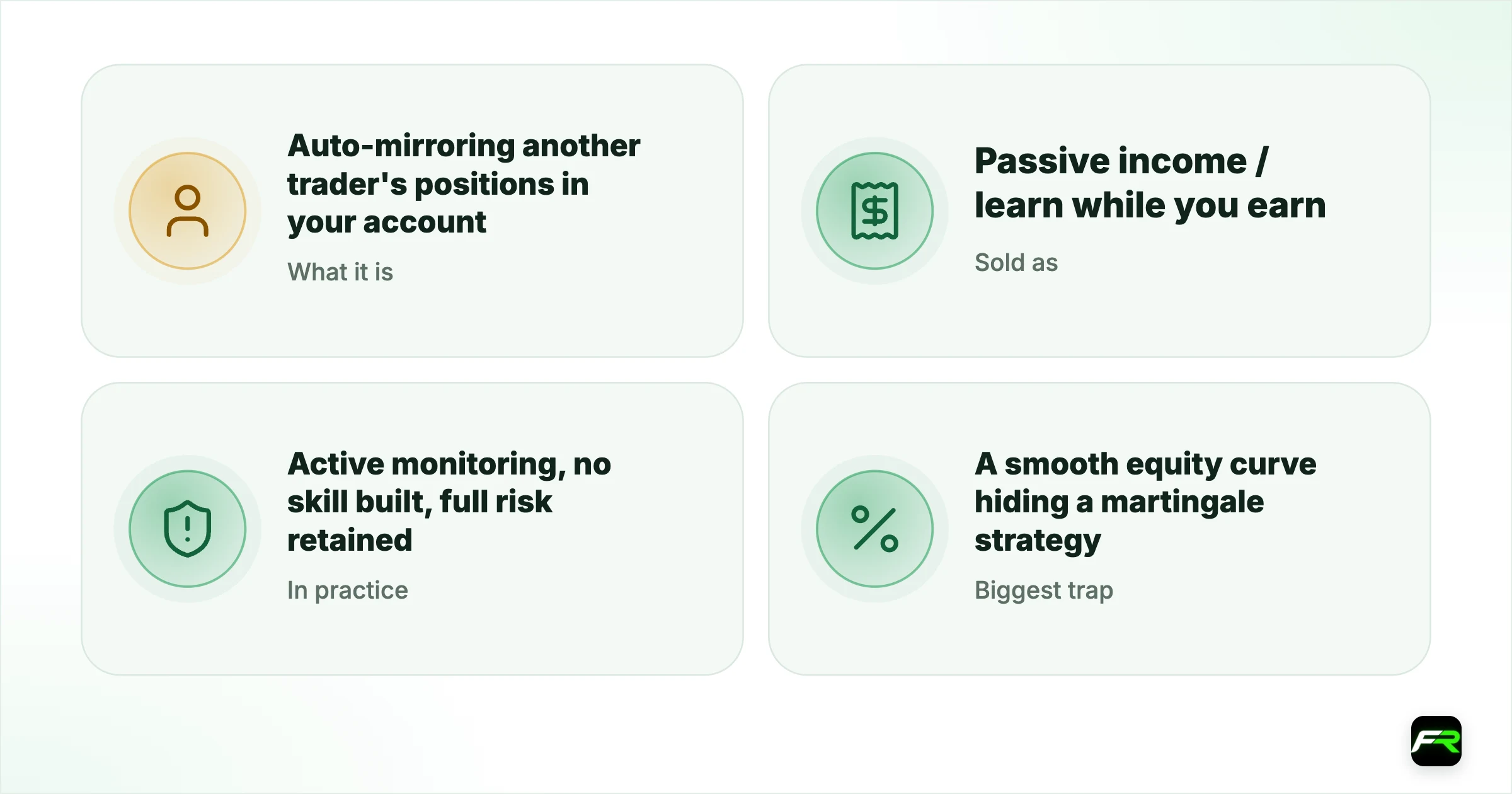
| What it is | Auto-mirroring another trader’s positions in your account |
|---|---|
| Sold as | Passive income / learn while you earn |
| In practice | Active monitoring, no skill built, full risk retained |
| Biggest trap | A smooth equity curve hiding a martingale strategy |
| Sensible use | A small, losable allocation with your own exit rule |
“Low maximum drawdown” on a copy-trading provider means the strategy has not had a bad day yet, not that it cannot. Judge the style, not the chart.
Copy trading vs. the alternatives
| Copy trading | Provider's trades open and close in your account automatically. You retain full control to stop at any time, but no input into individual trades. |
|---|---|
| Signal-following | You receive the provider's entry, stop and target, and place the trade yourself. Slower and more manual, but you can filter which signals you actually take. |
| Fully managed account | You hand trading authority (often via a power of attorney) to a person or firm, with no per-trade visibility. Generally used with regulated money managers, not the retail Telegram/app version of copy trading. |
Frequently asked
Is copy trading a good way for beginners to start?
It is not the shortcut it is marketed as. You still have to vet and monitor them, you build no trading skill, and you carry every loss in full. If you use it, treat a small allocation as tuition and set your own exit rule.
Why do copy-trading providers show such good returns?
Survivorship. You see the ones who did well recently, not the many who blew up. And smooth equity curves are often produced by strategies that never close losers, which look perfect until they lose everything at once.
Do I still lose money if the provider I copy loses?
Yes, in full, scaled to your allocation. Copy trading does not transfer or reduce your risk. Every trade they take happens in your account.
How do I choose a copy-trading provider?
Look for a long track record (18 months or more) spanning a difficult market period, a realistic return, and a trading style you understand. Avoid suspiciously smooth equity curves, which usually indicate a martingale strategy that has not failed yet.
Is copy trading legal where I live in Asia?
It follows the same rules as trading forex generally in your country. In most of the region, that means an offshore-regulated broker (FCA, ASIC, CySEC) rather than a locally licensed one, since few regulators in this region licence retail copy trading directly. Where trading itself is restricted, copy trading is too.
What is a martingale strategy in copy trading?
One that adds to losing positions to average down, so small wins accumulate smoothly and losses are deferred. It produces an attractive chart until a sustained move against it wipes the account out in one stretch.
The team behind this guide
Researched, checked and approved by five forex specialists
Every guide is written, fact-checked and edited before it goes live, and updated when the facts change. Spotted an error? Tell us.