 IC Markets





































Non-Farm Payroll (NFP) Trading
Non-Farm Payroll, the monthly US jobs report, is one of forex's biggest movers. What it shows, how it moves the dollar, and how to trade it.
 WriterAbir KhanWriterWrites the guides · checks every figure against primary sources View profileAbout Abir →
 Market analysisTanbir Habib RiyadForex & Crypto AnalystForex and crypto analyst · technical and fundamental analysis View profileAbout Tanbir →
 Fact-checking & riskJannatul FerdaushFact-Checker & Risk AnalystFact-checks every figure · risk analysis · Applied Statistics, University of Dhaka View profileAbout Jannatul →
 Trading reviewJowel RanaCo-Founder & Forex TraderCo-founder · forex trader · reviews guides from a trader's view View profileAbout Jowel →
 Final approvalRanjan NiskrityFounder, Owner & Forex TraderFounder and owner · forex trader · signs off every guide View profileAbout Ranjan →

Non-Farm Payrolls (NFP) is the monthly US employment report released by the Bureau of Labor Statistics on the first Friday of most months at 8:30 AM Eastern, and it remains one of the highest-volatility scheduled events in forex, regularly moving EUR/USD 50 to 100 pips in the first hour, with larger surprises producing considerably more.
Trading it well comes down to two separate skills: managing the position you already hold going into the release, and having a defined plan for how you’ll act on the number once it’s out, rather than deciding either in the moment.
What’s in the NFP Report
NFP isn’t a single number. It’s a composite release, officially called the Employment Situation report, with three figures that matter most to forex.
• The headline payroll number: net jobs added or lost across non-farm sectors that month.
• The unemployment rate: the percentage of the labor force actively seeking work.
• Average hourly earnings: wage growth, month over month and year over year.
Average hourly earnings has taken on outsized importance in recent years, since wage growth feeds directly into inflation, and inflation feeds directly into Fed policy. A market expecting steady payroll growth can still react sharply to a surprise in wages alone, even if the headline number itself matches the forecast almost exactly.
There’s No Universal Good Number
A print of 180,000 jobs is dollar-positive against a forecast of 120,000 and dollar-negative against a forecast of 250,000, despite both being the same actual number. What moves price is the surprise relative to consensus, not whether the headline figure looks strong or weak in isolation. Reacting to a number because it sounds like a lot, without checking what the market expected going in, is one of the more common reasons traders misjudge the initial direction.
The Revisions That Change the Real Picture
Every NFP release revises the prior two months’ figures alongside the new one. A current month that misses the forecast by a wide margin can still produce dollar strength if the two prior months get revised meaningfully higher at the same time, since the combined trend across three months matters more than any single headline in isolation. Reading the revisions next to the current figure, rather than reacting to the headline number alone, gives a more complete read of where employment actually stands.
Release Time and Schedule
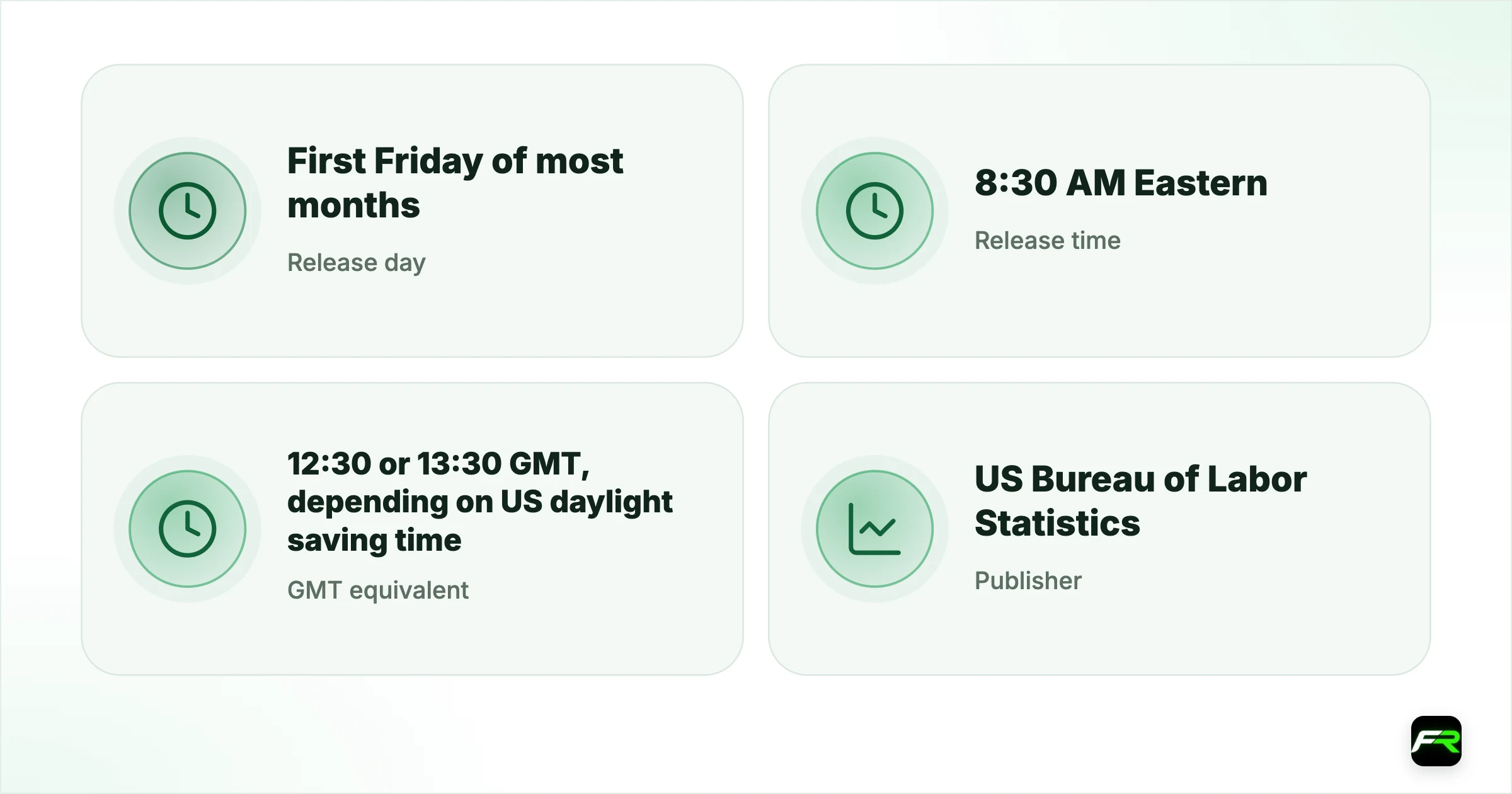
| Detail | Value |
| Release day | First Friday of most months (occasionally the second Friday) |
| Release time | 8:30 AM Eastern |
| GMT equivalent | 12:30 or 13:30 GMT, depending on US daylight saving time |
| Publisher | US Bureau of Labor Statistics |
| Typical EUR/USD reaction | 50 to 100 pips in the first hour; 150+ on larger surprises |
Three Ways to Approach NFP
• Stay flat entirely: many institutional desks close or avoid opening new USD exposure ahead of the release, treating the pre-NFP hours as a period to sit out rather than a period to predict.
• Trade the reaction after the initial spike settles: wait roughly 15 to 30 minutes for the first algorithmic-driven spike to pass and spreads to normalize, then trade the confirmed direction.
• Fade the knee-jerk move: some traders specifically look to trade against the first, sharpest reaction, on the theory that the initial algorithmic response often overshoots before a more considered, human-driven reaction corrects it partway back.
A Pre-Release Checklist
| Timing | Action |
| T-24 hours | Confirm the exact release date and time, including any daylight saving conversion, and note the consensus forecast for the headline number, unemployment rate, and average hourly earnings. |
| T-1 hour | Decide in advance which approach you’re using, and write it down rather than deciding live. Check what any open positions would cost on a 50 to 100 pip adverse move. |
| T-15 minutes | Close or reduce positions as already planned, and cancel any pending orders sitting close to the current price. |
| T-0 to T+5 minutes | Avoid entering anything new. This window is dominated by algorithmic reaction to the headline number alone, before the fuller picture gets priced in. |
NFP and Gold
NFP doesn’t just move forex. Gold routinely moves several dollars within minutes of the release, since payroll data shifts rate expectations, and rate expectations move real yields, which gold prices track closely. A trader holding a XAU/USD position through NFP without adjusting size is often taking on far more risk than they’d accept on a standard forex pair, given how sharply gold can react to the same data.
A Worked Example
Say the market expects 180,000 jobs added, a 4.1 percent unemployment rate, and 0.3 percent month-over-month wage growth. The actual report shows 120,000 jobs added, a miss of 60,000 against consensus, alongside unemployment ticking up to 4.3 percent and wage growth coming in soft at 0.2 percent. All three components missing in the same direction, weak jobs, higher unemployment, softer wages, paints a consistently weak picture, and EUR/USD would typically see a sharp initial move higher, meaning a weaker dollar, as traders price in higher odds of a more dovish Fed.
Now change one detail: the same 120,000 miss on the headline, but average hourly earnings comes in hot at 0.5 percent month over month. That mixed picture, weak jobs alongside strong wage growth, tends to produce a choppier, less directional reaction, since it points toward a genuinely mixed signal for the Fed rather than a clean case for either a more hawkish or more dovish stance.
Not Every NFP Is Worth Trading
Skipping a month with an ambiguous headline number, mixed sub-components, or a print sitting close enough to consensus that there’s little real surprise to trade is a legitimate risk management decision, not a missed opportunity. Forcing a trade on every single release regardless of how clean the setup looks is a common way traders turn a monthly high-probability event into a monthly source of unnecessary losses.
People’s Most Asked
What time does NFP come out?
8:30 AM Eastern Time on the first Friday of most months, which converts to either 12:30 PM or 1:30 PM GMT depending on whether US daylight saving time is currently in effect.
How much does NFP typically move EUR/USD?
Commonly 50 to 100 pips within the first hour after release, with larger-than-expected surprises against the forecast producing considerably more, sometimes upward of 150 pips.
What is the most important part of the NFP report?
The headline payroll number gets the most attention, but the unemployment rate and average hourly earnings are read alongside it, and a mixed picture across all three, plus the revisions to the prior two months, often matters more to the market’s reaction than the headline figure alone.
Should I hold open positions through NFP?
Many traders close or reduce open positions ahead of the release specifically to avoid unplanned exposure to the volatility, spread widening, and slippage that reliably follow. Holding through it without a plan is a common way an otherwise fine trade gets caught by unrelated event risk.
Is it better to trade the initial spike or wait?
Both approaches exist, but waiting 15 to 30 minutes for the initial algorithmic reaction to settle and spreads to normalize is generally considered the lower-risk approach, particularly for traders newer to event-based trading.
Does NFP affect assets other than forex?
Yes. Gold in particular reacts sharply to NFP, since payroll data shifts interest rate expectations and rate expectations move real yields, which gold prices track closely. Equity indices and bond yields also react, often within the same first few minutes.
Final Word
NFP is scheduled and telegraphed well in advance, which makes it one of the more preparable events on the entire forex calendar rather than a source of pure unpredictability. The traders who handle it well aren’t the ones who guess the number correctly. They’re the ones who decided their approach the day before, sized their risk for the volatility they knew was coming, and read the full report, headline, unemployment rate, wages, and revisions, rather than reacting to a single figure in isolation.
The team behind this guide
Researched, checked and approved by five forex specialists
Every guide is written, fact-checked and edited before it goes live, and updated when the facts change. Spotted an error? Tell us.
Related Articles
 Education
10 min read
Education
10 min read

 Education
12 min read
Education
12 min read
 Education
8 min read
Education
8 min read
 Education
8 min read
Education
8 min read
 Education
9 min read
Education
9 min read
 Education
7 min read
Education
7 min read