IC Markets





































Best Currency Pairs to Trade in the Asian Session
The movement is concentrated in the yen and Aussie pairs, plus a few China-linked ones. Trade a flat major during Asian hours and the spread will take most of what little you make.
 WriterAbir KhanWriterWrites the guides · checks every figure against primary sources View profileAbout Abir →
 Market analysisTanbir Habib RiyadForex & Crypto AnalystForex and crypto analyst · technical and fundamental analysis View profileAbout Tanbir →
 Fact-checking & riskJannatul FerdaushFact-Checker & Risk AnalystFact-checks every figure · risk analysis · Applied Statistics, University of Dhaka View profileAbout Jannatul →
 Trading reviewJowel RanaCo-Founder & Forex TraderCo-founder · forex trader · reviews guides from a trader's view View profileAbout Jowel →
 Final approvalRanjan NiskrityFounder, Owner & Forex TraderFounder and owner · forex trader · signs off every guide View profileAbout Ranjan →
Key takeaways
- The best Asian-session pairs are tied to markets that are open: USD/JPY, AUD/USD, AUD/JPY and NZD/USD.
- USD/JPY is the pair of the session, with tight spreads and clear drivers in BoJ comments and Japanese data.
- AUD pairs react to RBA decisions and Chinese data; AUD/JPY gives range traders clean swings.
- The first hour or two after the Tokyo open is the busiest; late Asian hours thin out.
During Asian hours, most of the trading activity, and therefore most of the movement, sits in a handful of pairs tied to the markets that are open: Japan, Australia, New Zealand, and China’s influence on the offshore yuan. Trade one of those and you have a fighting chance of a move worth the spread. Trade EUR/GBP at 03:00 GMT and you are paying to watch paint dry.
The core pairs
USD/JPY
The pair of the session. Volume is high through Tokyo hours, it responds to Bank of Japan comments, Japanese CPI and Tankan data, and moves around the 09:55 Tokyo fix. Spreads are tight even in Asian hours. If you learn one pair for these hours, learn this one.
AUD/USD
Australia is open and the Reserve Bank of Australia’s rate decisions and minutes land during the session. AUD is also a proxy for Chinese demand and commodity prices, so Chinese data moves it too. Ranges tend to be moderate in size and relatively easy to read.
AUD/JPY
A favourite for range traders in these hours. It combines two currencies that are both active during Asian hours, and it tends to produce clean swings between a session high and low rather than choppy noise. It is more volatile than AUD/USD, which cuts both ways.
NZD/USD
Thinner than the Aussie, but tradable, and it moves sharply on Reserve Bank of New Zealand announcements and New Zealand data. Its wider spreads mean a trade needs a larger move to clear the cost, so it suits a slightly bigger target than the majors above.
Why late Asian hours feel different
The first hour or two after the Tokyo open is the busiest part of the session. By the middle and late Asian hours, that initial flow has settled, Sydney and early Tokyo activity has thinned, and London has not opened yet. Ranges can narrow further and moves that looked clean earlier in the session can turn choppier, which is worth knowing before assuming the whole session behaves like its opening hour.
The China-linked pairs
USD/CNH (the offshore yuan) and USD/SGD carry a regional flavour and react to Chinese releases such as the Caixin manufacturing and services PMIs, the trade balance, and the daily yuan fixing set by the People’s Bank of China. These are less commonly offered with tight spreads at retail brokers, so check pricing before you commit to them, but they can move meaningfully on a China data surprise when the majors are asleep.
The pairs to avoid during Asian hours
- EUR/USD, GBP/USD, EUR/GBP: the European market is closed, these often sit in a tight range, and the spread is a large share of the available move.
- EUR/JPY, GBP/JPY: the yen leg gives some life, but the euro and pound legs are inactive, so moves are erratic rather than clean.
- Exotic crosses: spreads widen dramatically outside their home hours. A major cross can easily cost several times its usual spread outside its home session, the 2-versus-8 figures here are illustrative of the scale of the gap, not a sourced average for any specific pair.
Aiko started by trading EUR/USD in her evening because it was the pair every YouTube video used. Over a month she was slightly down, and when she looked at her trades she realised almost all the losses were spread and tiny adverse moves on a pair that barely budged during her hours. She switched to USD/JPY and AUD/JPY, the same strategy, and her results improved without changing anything about how she traded. She was simply trading pairs that were awake when she was.
Spread reality check: core pairs side by side
Exact spreads vary by broker and by moment, but the relative pattern during Asian hours is consistent: USD/JPY typically holds the tightest spread of the group, since it is the most heavily traded pair in the session; AUD/JPY and AUD/USD sit a little wider; NZD/USD wider again given thinner volume; and USD/CNH or USD/SGD can be markedly wider still, since fewer retail brokers make an active market in them outside their home hours. Check your own broker's live spread on each pair during your actual trading window before assuming the ranking above holds exactly.
Correlation risk with commodity currencies
AUD, NZD and, to a lesser extent, the yuan-linked pairs move together more than a beginner might expect, since all three respond to the same underlying driver: Chinese demand and broader risk sentiment. Holding AUD/USD and AUD/JPY at the same time is not really two independent positions; a single China-demand shock can move both against you together. The same applies to combining AUD/USD with NZD/USD. If you hold more than one of these at once, size each position with that overlap in mind rather than treating them as unrelated bets.
How news timing works in this session
Part of what makes the yen and Aussie pairs tradable in Asian hours is that their news lands in Asian hours. A Reserve Bank of Australia decision is announced early afternoon Sydney time, the middle of the Tokyo session. Japanese CPI and the Tankan survey come out in the Tokyo morning. Chinese data does not all land in one window: the Caixin manufacturing PMI is released around 01:45 GMT and GDP/retail-sales data clusters near 02:00 GMT, but trade-balance figures are not published on a fixed clock time and can appear on irregular dates, so treat 01:00-03:00 GMT as a rough guide for PMI and GDP rather than a rule for every release. So if you trade this session, these are the releases that can turn a quiet range into a fast move, and the ones to check the calendar for before you sit down.
By contrast, the news that moves EUR/USD and GBP/USD, meaning ECB and Bank of England decisions, eurozone and UK data, and US releases, almost all lands during the London and New York sessions, which is your night. That is the deeper reason those pairs are flat for you: not just that Europe is closed, but that nothing is scheduled to move them while you are watching.
A practical shortlist
- Learn USD/JPY first. It has the tightest spreads, the most volume, and the clearest news drivers in these hours.
- Add AUD/JPY for range trading once you are comfortable.
- Use AUD/USD around Reserve Bank of Australia events and Chinese data.
- Leave the euro and pound majors for London hours, when they move.
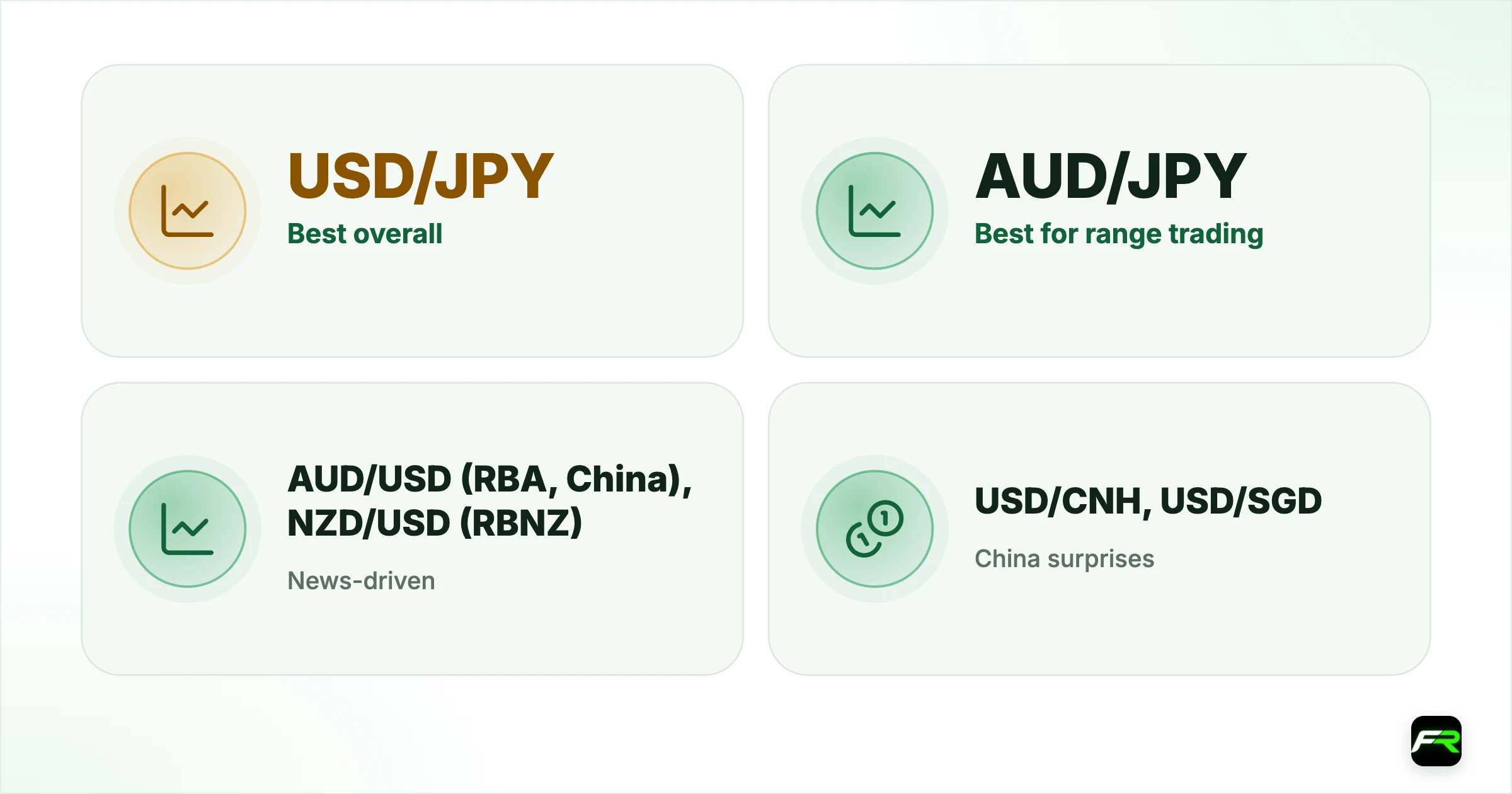
| Best overall | USD/JPY |
|---|---|
| Best for range trading | AUD/JPY |
| News-driven | AUD/USD (RBA, China), NZD/USD (RBNZ) |
| China surprises | USD/CNH, USD/SGD (check spreads first) |
| Avoid in Asian hours | EUR/USD, GBP/USD, exotic crosses |
A pair’s spread is not fixed. Check what your broker charges on your chosen pair during your actual trading hours, not the headline number from peak London time.
Sources and where to check it yourself
- Bank of Japan: monetary policy: policy statements that move USD/JPY in Tokyo hours
- Reserve Bank of Australia: monetary policy: RBA decisions and minutes that land in the Asian session
Frequently asked
What are the best forex pairs for the Asian session?
USD/JPY, AUD/USD, AUD/JPY and NZD/USD, because Japan, Australia and New Zealand are open and generating volume. USD/CNH and USD/SGD can move on Chinese data. The euro and pound majors are usually flat during Asian hours.
Why is USD/JPY the best pair for the Asian session?
Volume is highest through Tokyo hours, spreads stay tight, and it has clear news drivers you can follow: Bank of Japan commentary, Japanese data, and the 09:55 Tokyo fix.
Can I trade EUR/USD in the Asian session?
You can, but it is often range-bound and quiet because Europe is closed, so the spread takes a large share of any move. The yen and Aussie pairs offer better risk-to-reward during these hours.
What Chinese data moves currencies during Asian hours?
The Caixin manufacturing and services PMIs, the trade balance, GDP, and the daily yuan fixing from the People’s Bank of China. These move AUD, NZD, USD/CNH and USD/SGD most directly.
Is AUD/JPY good for beginners?
It is popular for Asian-session range trading because both currencies are active and it tends to swing cleanly between a session high and low. It is more volatile than AUD/USD, so size positions accordingly.
Do spreads change during the Asian session?
Yes. Spreads on pairs whose home markets are closed, and on exotic crosses, widen during Asian hours. The yen and Aussie pairs stay reasonable. Always check your broker’s live spread during your trading window.
When is Australian and Chinese data released?
The Reserve Bank of Australia announces early afternoon Sydney time, in the middle of the Tokyo session. Chinese data such as the Caixin PMIs is released around 01:00 to 03:00 GMT. Check the calendar for these before trading AUD, NZD or the China-linked pairs.
Can I trade GBP/JPY in the Asian session?
The yen leg gives it some life, but the pound leg is inactive, so moves tend to be erratic rather than clean. It is more volatile than the pure yen and Aussie pairs, which makes it harder for a beginner in this session.
The team behind this guide
Researched, checked and approved by five forex specialists
Every guide is written, fact-checked and edited before it goes live, and updated when the facts change. Spotted an error? Tell us.