IC Markets





































Is Forex Trading Legal in India?
Partly. Trading INR pairs on an Indian exchange is fine. Using an overseas broker for other pairs is not permitted under FEMA, whatever the ads say. Here is the full breakdown.
 WriterAbir KhanWriterWrites the guides · checks every figure against primary sources View profileAbout Abir →
 Market analysisTanbir Habib RiyadForex & Crypto AnalystForex and crypto analyst · technical and fundamental analysis View profileAbout Tanbir →
 Fact-checking & riskJannatul FerdaushFact-Checker & Risk AnalystFact-checks every figure · risk analysis · Applied Statistics, University of Dhaka View profileAbout Jannatul →
 Trading reviewJowel RanaCo-Founder & Forex TraderCo-founder · forex trader · reviews guides from a trader's view View profileAbout Jowel →
 Final approvalRanjan NiskrityFounder, Owner & Forex TraderFounder and owner · forex trader · signs off every guide View profileAbout Ranjan →
Key takeaways
- Rupee currency derivatives (USD/INR, EUR/INR, GBP/INR, JPY/INR) are legal on the NSE and BSE through a SEBI-registered broker.
- Margin forex with an offshore broker is not permitted for residents: the LRS doesn't cover margin trading.
- The RBI keeps a public Alert List of unauthorised trading platforms, and most well-known offshore brokers are on it.
- Enforcement mostly lands on payment routes, so deposits get blocked even when individuals aren't prosecuted.
The honest answer is it depends what you trade and where you trade it. Currency derivatives involving the rupee, meaning USD/INR, EUR/INR, GBP/INR and JPY/INR, are legal to trade on recognised Indian exchanges (NSE and BSE) through a SEBI-registered broker. Trading EUR/USD, gold, indices or anything else with a broker based outside India is a different matter, and the ads that call it “100% legal” are not telling you the whole story.
This matters because the offshore brokers advertise to Indian traders more aggressively than almost anywhere else in the world, and a lot of that marketing is misleading by omission. Knowing exactly what is allowed protects you from both the regulator and the broker. One disclosure up front: broker rankings elsewhere on this site, including our best forex brokers in India guide, compare firms for a global audience. They are not a suggestion to fund a margin account through LRS, read the rest of this page first if you are an Indian resident.
What is clearly allowed
SEBI-regulated currency futures and options on the four rupee pairs listed above. You trade them in a normal demat and trading account, the same way you trade equity derivatives. The contracts are cash-settled, position limits apply, and you cannot take delivery of the currency.
For most retail traders this market is quiet. Volumes concentrate in USD/INR, the spreads are wider than the global majors, and the moves are smaller because the rupee is managed within a band. It is legal, it is regulated, and it is largely ignored, which is exactly why the offshore brokers advertise so hard against it.
What is not allowed, and why
Retail margin forex with a broker based outside India, meaning the ASIC and CySEC brokers you see advertised heavily, is not permitted for residents. Two rules do the work:
- FEMA. The Foreign Exchange Management Act governs sending money abroad. The Liberalised Remittance Scheme (LRS) lets a resident send up to USD 250,000 a year overseas, but only for permitted purposes. Margin trading and leveraged products are not on that list. Funding an offshore forex account through LRS is outside its permitted uses.
- The RBI Alert List. The Reserve Bank publishes and updates a public list of electronic trading platforms not authorised to deal in forex or offer forex transactions to residents. Most of the well-known offshore brokers appear on it. Check it yourself: open the current Alert List (PDF) on rbi.org.in and search for your broker’s name. Being absent is not proof of authorisation (the RBI says explicitly that the list is not exhaustive) but being on it is a hard stop.
There is also the way the pairs are framed. Indian rules generally restrict residents to currency pairs involving the rupee for exchange-traded derivatives. Pairs that do not involve the rupee are not part of the permitted retail product set.
This does not mean every Indian who has used an offshore broker has been prosecuted. Enforcement against individual retail traders has been light and mostly indirect. It does mean you are operating outside the rules, your bank can freeze a transfer it flags as forex-related, the RBI and ED have acted against platforms and payment intermediaries, and you have no recourse if the money goes missing.
The money trail is the real risk
Because a direct bank transfer for forex can be blocked, traders route money through third-party UPI processors, e-wallets, or crypto. Each hop adds cost and, more importantly, adds a step that is hard to reconstruct later if anyone asks where the money went or came back from. The trade itself rarely causes the problem. The deposit and the withdrawal do.
Two things surface a transfer even when the deposit itself clears fine. Banks send an SMS or email alert for large or unusual outward transactions, routine fraud monitoring, not anything forex-specific, but it puts the transfer on record either way. And any LRS remittance for a permitted purpose above ₹10 lakh in a financial year attracts 20% tax collected at source, deducted by the bank at the time of transfer. Margin trading is not a permitted purpose in the first place, so a remittance correctly labelled for it should not go through LRS at all, which is exactly why traders route around their own bank instead of through it.
Arjun funded an offshore account with USD 300 through a third-party UPI processor. The deposit worked instantly. Six weeks later his withdrawal was held for “additional verification” and the broker asked for a utility bill, a selfie with ID, and a bank statement showing the original deposit, which he could not produce cleanly, because the money had gone out through a processor rather than his own bank account. He was paid three weeks late after several rounds of documents. His conclusion was that the informal funding route is fine right up until you need to prove where the money came from, and then it is a serious problem.
Legal ways to trade currency movement
- Trade the rupee currency derivatives on NSE or BSE through a SEBI-registered broker.
- Some Indian brokers offer exchange-traded products that give indirect exposure to major-currency moves; liquidity is limited.
- If you are a non-resident Indian, the rules that apply are those of your country of residence, not FEMA. An NRI in Dubai or Singapore trades under local law.
Tax, if you do trade
Whatever route you use, trading gains are taxable for a resident. Exchange-traded currency derivative gains are typically treated as business income and taxed at your slab rate, with turnover and audit thresholds that can apply if you trade actively. Keep a full record of trades, deposits and withdrawals from day one. Our India tax guide goes into the detail, including how a tax audit is triggered and what counts as turnover for derivatives.
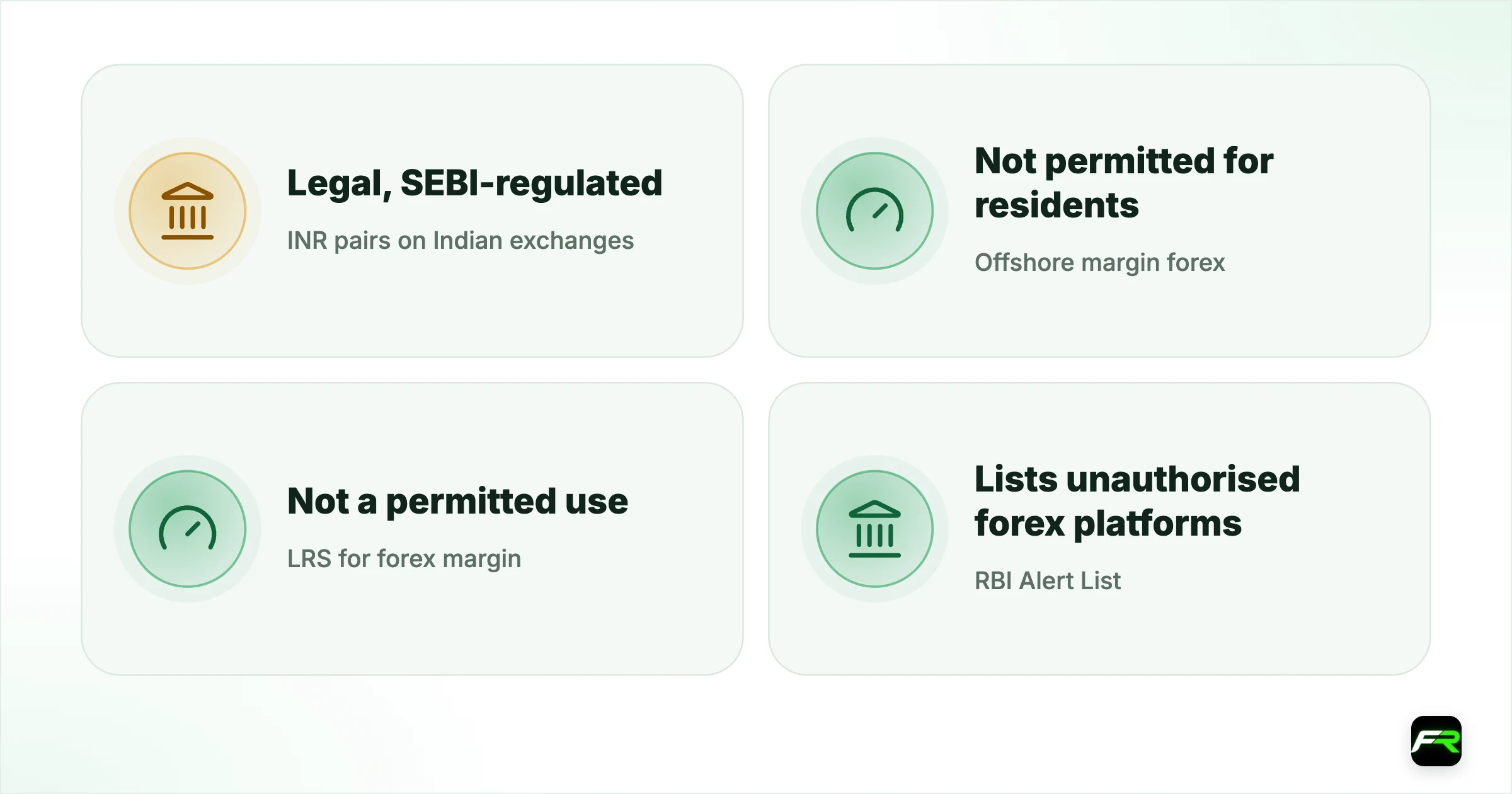
| INR pairs on Indian exchanges | Legal, SEBI-regulated |
|---|---|
| Offshore margin forex | Not permitted for residents |
| LRS for forex margin | Not a permitted use |
| RBI Alert List | Lists unauthorised forex platforms |
| Enforcement on individuals | Historically light, not zero |
| Tax on gains | Yes, typically business income |
Any ad that says “forex trading is 100% legal in India” is selling you an account. The accurate version: INR derivatives on an exchange are legal, offshore margin trading is not, and the funding route is where the real exposure sits.
Frequently asked
Can I use an international forex broker from India?
It is not permitted under FEMA, and most well-known offshore brokers appear on the RBI’s Alert List. Enforcement against individual retail traders has been light, but you have no legal protection, your bank can block forex-related transfers, and the RBI has acted against platforms and payment intermediaries.
Is forex trading on the NSE legal?
Yes. Currency derivatives on USD/INR, EUR/INR, GBP/INR and JPY/INR are legal to trade on recognised exchanges through a SEBI-registered broker. They are cash-settled and subject to position limits.
Can I fund a forex account using the LRS limit?
No. The Liberalised Remittance Scheme allows up to USD 250,000 a year abroad for permitted purposes, and margin or leveraged trading is not one of them.
Do NRIs have to follow FEMA forex rules?
A non-resident Indian trades under the law of their country of residence. FEMA’s restrictions on residents do not apply in the same way, though the rules of your local regulator do.
What is the RBI Alert List?
A public, regularly updated list of electronic platforms not authorised to deal in forex or facilitate forex transactions for Indian residents. If your broker is on it, you are trading with an entity the RBI has flagged.
I already have money with an offshore broker, should I withdraw it?
There is no rule that forces an immediate withdrawal, and holding the account is not itself illegal. The exposure sits on the funding and withdrawal side: if your bank ever asks you to explain the transaction, or the broker’s own KYC process wants a source-of-funds document, you need a clean paper trail back to your own account. If you cannot produce one, the safer path is moving smaller amounts out first, keeping every screenshot and statement, and stopping new deposits through informal channels.
The team behind this guide
Researched, checked and approved by five forex specialists
Every guide is written, fact-checked and edited before it goes live, and updated when the facts change. Spotted an error? Tell us.