IC Markets




































Depositing to a Forex Broker from Vietnam
Domestic VND transfer through a payment partner is the usual route. E-wallets and USDT fill the gaps. Direct international transfers labelled for forex tend to be declined.
 WriterAbir KhanWriterWrites the guides · checks every figure against primary sources View profileAbout Abir →
 Market analysisTanbir Habib RiyadForex & Crypto AnalystForex and crypto analyst · technical and fundamental analysis View profileAbout Tanbir →
 Fact-checking & riskJannatul FerdaushFact-Checker & Risk AnalystFact-checks every figure · risk analysis · Applied Statistics, University of Dhaka View profileAbout Jannatul →
 Trading reviewJowel RanaCo-Founder & Forex TraderCo-founder · forex trader · reviews guides from a trader's view View profileAbout Jowel →
 Final approvalRanjan NiskrityFounder, Owner & Forex TraderFounder and owner · forex trader · signs off every guide View profileAbout Ranjan →
In Vietnam, retail forex has no legal framework and the local trading floors are treated as illegal, so the traders who use brokers abroad fund them through workarounds. The main one is a domestic VND bank transfer handled by the broker’s local payment partner, which keeps the money inside Vietnam’s banking system until the last step. Our best forex brokers in Vietnam guide lists the firms and their payment methods.
Two terms matter here, and it is easy to blur them. A broker’s official payment partner is a company named on the broker’s own deposit page, one the broker has vetted and is willing to put its name behind. An unlicensed personal agent who offers to handle the transfer for you outside that page is not the same thing, however similar the process looks.
The domestic transfer route
- Choose “local bank transfer (VND)” in the deposit page.
- Enter the VND amount; the broker shows the USD credit.
- You get an account number at a Vietnamese bank (the payment partner’s) and a reference.
- Transfer from your banking app. The trading balance usually updates within an hour.
Because you are paying a domestic account rather than sending money overseas, the bank processes it as an ordinary VND transfer between two Vietnamese accounts, governed by the same domestic rules the State Bank of Vietnam (SBV) applies to any VND-to-VND payment, rather than its separate rules for outward remittances.
E-wallets
Some brokers accept Momo or ZaloPay. Convenient for small amounts, sometimes with a small fee, and withdrawals return to the same wallet.
USDT
Buy USDT locally, send it to the broker. Faster and it avoids the banking layer entirely, but you carry crypto price and network risk while the transfer is in flight, and buying USDT from a local seller has its own counterparty risk.
First deposit small. Confirm the money arrives, and that the name on your trading account matches your bank account, before sending anything meaningful.
After losing money on a local forex floor years ago, Huy now trades a small account with an ASIC broker. He funds it by domestic VND transfer to the broker’s payment partner, with money in within 40 minutes, and withdraws the same way, which takes one to two business days. He keeps every transfer receipt. His rule is that he never lets an “agent” sit between him and the broker, because that is where his first losses came from.
If the Payment Partner Account Itself Fails
The domestic transfer route works because the broker’s payment partner is a business with its own bank account in Vietnam, standing between you and the broker abroad. That account is also the weak point. If the payment partner’s business is shut down, investigated, or has its account frozen while your transfer is mid-flight, the money can be stuck or lost with neither your bank nor the broker directly responsible for it, you paid a domestic company, not the broker itself, and the broker’s own funds were never in that account. Confirm any payment partner is one the broker actually names on its own deposit page before sending anything, and keep the payment reference and a screenshot of every transfer as your only real record if a dispute follows.
There is a second, quieter risk on the trader’s side. A personal bank account that sends the same size of transfer to the same third-party company every week or two, month after month, is exactly the pattern banks’ anti-money-laundering systems are built to flag, and Vietnamese banks periodically freeze accounts pending a name-matching check when the sender and the ultimate beneficiary look unrelated. Varying nothing about a repeated transfer is the surest way to trigger one; sticking to a broker’s own named payment partner, using a consistent stated purpose, and not resuming immediately after a hold are the practical ways traders avoid it.
What it costs
The domestic transfer itself is usually free, or carries a tiny inter-bank fee. The cost that matters is the broker’s VND-to-USD conversion, typically 0.3 to 0.8% worse than the interbank rate, charged when you deposit and again when you withdraw. On a VND 5,000,000 deposit that is roughly VND 15,000 to 40,000 each way. E-wallets can add a small percentage on top, and the USDT route adds an exchange spread plus a network fee at both ends, which usually makes it more expensive than the bank route unless the bank route is not working for you at all.
Because the conversion is charged both directions, the round-trip cost of putting money in and taking it back out is double the one-way figure. A trader who withdraws every time they are up a little pays that spread far more often than one who lets the account run and draws down monthly. In a market with no local recourse, the case for keeping the working balance small is strong, but there is a genuine tension with the conversion cost of frequent movement. A monthly rhythm is the usual compromise.
Why the middleman risk is worse here
Vietnam’s specific danger is not the trade or the conversion cost. It is the local “forex floor” and the individual “agent” who offers to handle your deposit. Because retail forex has no legal framework, these operations fill the vacuum, and the losses that make the news are almost always people who paid a floor or an agent rather than a broker. The floor shows you a balance on its own screen; there is no segregated account, no real broker, and when it is raided or simply closes, the money is gone.
The test is simple. If there is a Vietnamese person or company between you and an account you can log into yourself and withdraw from to your own bank, you are not using a broker, you are using a middleman. A real broker serving Vietnam is a website you deal with directly, licensed abroad, with your money in an account in your name.
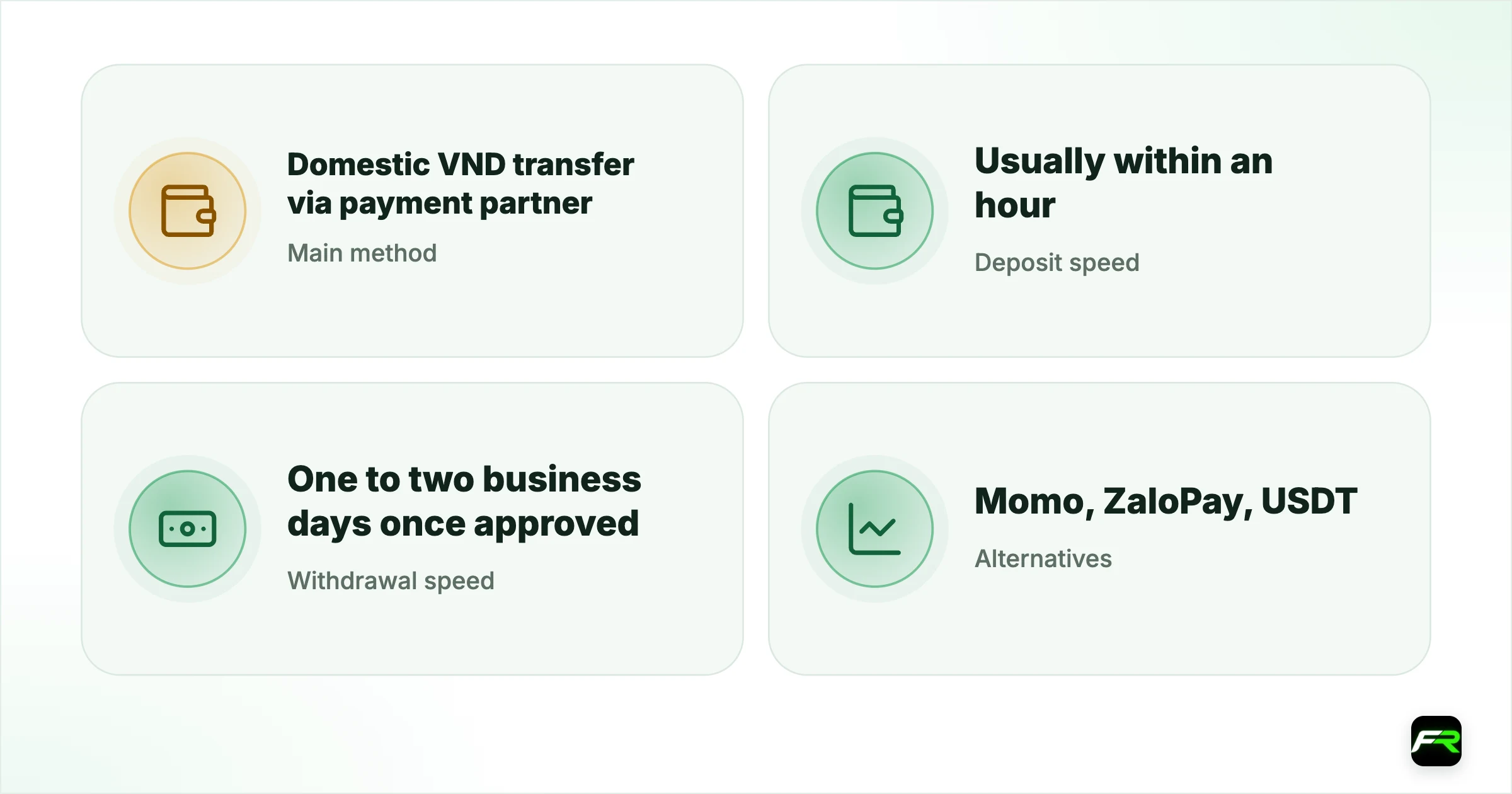
| Main method | Domestic VND transfer via payment partner |
|---|---|
| Deposit speed | Usually within an hour |
| Withdrawal speed | One to two business days once approved |
| Alternatives | Momo, ZaloPay, USDT |
| Avoid | Any ‘agent’ between you and the broker |
A local person who takes your VND and “credits your MT4” is not a payment method, it is a middleman who can disappear with the money. Deal with the broker’s own deposit page only.
Frequently asked
Can I transfer money directly to a forex broker from a Vietnamese bank?
A direct international transfer labelled for forex is likely to be questioned or declined. Brokers get around this with a local payment partner, so you pay a domestic VND account and the broker credits your trading balance.
How long does a VND deposit take?
Usually under an hour through a payment partner. Withdrawals back to a Vietnamese bank take one to two business days once the broker approves them.
What do I do if my transfer to the payment partner doesn’t show up in my trading account?
Wait out the usual hour first; most delays are just the payment partner processing on their end. If it still has not credited, contact the broker’s own support with your bank transfer reference and timestamp rather than the payment partner directly, the broker is who can check the payment partner’s account and credit your balance. Keep the transfer receipt until the balance shows up, and treat any “agent” who wants to handle the follow-up for you as a warning sign.
Is it safe to use Momo or ZaloPay for forex deposits?
The wallets themselves are fine. The risk is the broker on the other end. Use them with a broker that has a verifiable licence, and expect withdrawals to return to the same wallet.
Should I use USDT to fund from Vietnam?
It removes the banking layer but adds crypto price risk in transit and counterparty risk when buying USDT locally. Only worth it if the domestic transfer route is not working for you.
What happens to my money if the broker fails?
With a broker regulated only offshore and no local framework in Vietnam, you have no local recourse. Choosing a broker on a strong regulator (FCA, ASIC, CySEC) is the main protection available.
How do I know if I am using a real broker or a local floor?
If a Vietnamese person or company sits between you and an account you can log into and withdraw from to your own bank, it is a middleman, not a broker. A real broker is a website you deal with directly, licensed abroad, with your money held in your own name.
How often should I move money in and out?
As rarely as your plan allows. The broker’s VND-to-USD conversion is charged both ways, so frequent round trips add up. A monthly withdrawal of a consistent amount also clears faster than erratic in-and-out movements.
The team behind this guide
Researched, checked and approved by five forex specialists
Every guide is written, fact-checked and edited before it goes live, and updated when the facts change. Spotted an error? Tell us.