IC Markets





































Forex Trading Tax in India: What Residents Owe
Currency-derivative gains are usually business income at your slab rate. Turnover thresholds decide whether you need a tax audit. Offshore gains are taxable too, whatever the funding route.
 WriterAbir KhanWriterWrites the guides · checks every figure against primary sources View profileAbout Abir →
 Market analysisTanbir Habib RiyadForex & Crypto AnalystForex and crypto analyst · technical and fundamental analysis View profileAbout Tanbir →
 Fact-checking & riskJannatul FerdaushFact-Checker & Risk AnalystFact-checks every figure · risk analysis · Applied Statistics, University of Dhaka View profileAbout Jannatul →
 Trading reviewJowel RanaCo-Founder & Forex TraderCo-founder · forex trader · reviews guides from a trader's view View profileAbout Jowel →
 Final approvalRanjan NiskrityFounder, Owner & Forex TraderFounder and owner · forex trader · signs off every guide View profileAbout Ranjan →
For an Indian resident, profit from trading currencies is taxable income, and the two questions that follow are how it is classified and whether you cross the thresholds that require a tax audit. This applies whether you trade SEBI-regulated currency derivatives on an exchange or use an offshore broker.
This is a general overview, not tax advice. Tax rules change, they depend on your personal circumstances, and the treatment of offshore trading is an area where enforcement and interpretation both evolve. Speak to a qualified local accountant before you file, ideally before you have a large gain to explain.
Tax vs. FEMA: two separate questions
Everything above answers one question: if you have forex trading profit, how is it taxed. It does not answer a separate one: is it permitted to send money to an offshore broker in the first place. That second question sits with the Foreign Exchange Management Act (FEMA) and the RBI, not the Income Tax Department, and the two frameworks do not defer to each other.
Under FEMA, an Indian resident’s permitted use of foreign exchange for trading is largely limited to exchange-traded currency derivatives on recognised Indian exchanges. Margin forex and CFD trading through an offshore broker generally falls outside the activities the RBI has authorised under the Liberalised Remittance Scheme, regardless of how well regulated the broker is elsewhere. Paying tax on the resulting profit does not change that: the Income Tax Department taxing an income stream is not the same as the RBI treating the underlying transaction as permitted.
In practice, declaring and paying tax on offshore trading profit, as this article describes, is the right move regardless, since undeclared income carries its own separate risk. But it does not resolve the FEMA question, and that is worth understanding as a distinct compliance issue rather than assuming a filed tax return settles it.
How the income is classified
Exchange-traded currency futures and options are generally treated as non-speculative business income, because they are settled through recognised exchanges. That income is added to your total and taxed at your applicable slab rate. Losses can usually be set off against other non-speculative business income and carried forward for up to eight years, subject to filing on time.
Intraday equity trades are speculative; currency derivatives through an exchange are not. If you also use an offshore broker for spot or CFD forex, the gains remain taxable income for a resident, and given that the activity itself sits outside FEMA’s permitted uses, the classification is best discussed with an accountant who can see your full situation.
Turnover and the tax audit threshold
“Turnover” for derivatives is not your total contract value. It is broadly the sum of absolute profits and losses on each trade, plus premium on options sold. That figure decides whether a tax audit under section 44AB applies. The thresholds have moved in recent years and depend on the proportion of your receipts and payments made digitally, so the practical point is: track your absolute profit and loss per trade from day one, because you cannot reconstruct turnover later from a year-end statement.
Ritika traded USD/INR futures actively for a year and assumed her small net profit meant a simple return. Her accountant calculated turnover from the sum of absolute profits and losses across roughly 400 trades and found it was well into the range that required a tax audit, which meant additional compliance and cost she had not planned for. Her lesson was that turnover for derivatives has almost nothing to do with the net result, and that the trade log is what the accountant needs.
If you used an offshore broker
- The gains are still taxable income for a resident.
- The broker withholds nothing and reports nothing to Indian authorities, so the entire record is your responsibility.
- If you funded through crypto, the purchase and sale of USDT has its own tax treatment in India, currently a flat rate on gains plus a withholding on transfers.
- Keep every deposit, withdrawal, and trading statement, matched to your own bank account.
Practical record-keeping
- Export your full trade history at least quarterly, because platforms sometimes limit how far back you can pull.
- Keep a running total of absolute profit and loss per trade for the turnover calculation.
- Keep bank and payment records for every deposit and withdrawal.
- Pay advance tax in instalments if your liability is significant, to avoid interest.
- File ITR-3 (the form for business income) unless your accountant advises otherwise.
A worked example
Suppose you have a salary that puts you in the 30% slab, and you make a net profit of INR 180,000 over the year trading USD/INR futures, from about 250 trades. The INR 180,000 is added to your income and taxed at 30%, so roughly INR 54,000 in tax, plus cess. Separately, your turnover, meaning the sum of absolute profits and losses across those 250 trades, might be INR 900,000 or more, and that figure, not the INR 180,000, is what your accountant checks against the section 44AB thresholds to decide whether a tax audit is required. The tax you owe is small; the compliance question is the one that costs time and fees if you are not prepared for it.
When to pay
If your total tax liability for the year is expected to exceed the advance-tax threshold, you are meant to pay it in instalments through the year rather than in a lump sum at filing. Missing the instalments attracts interest. A trader with a salaried job and modest trading profit often finds the salary TDS covers most of it, but a good year of trading can push you into advance-tax territory, so estimate it mid-year rather than being surprised.
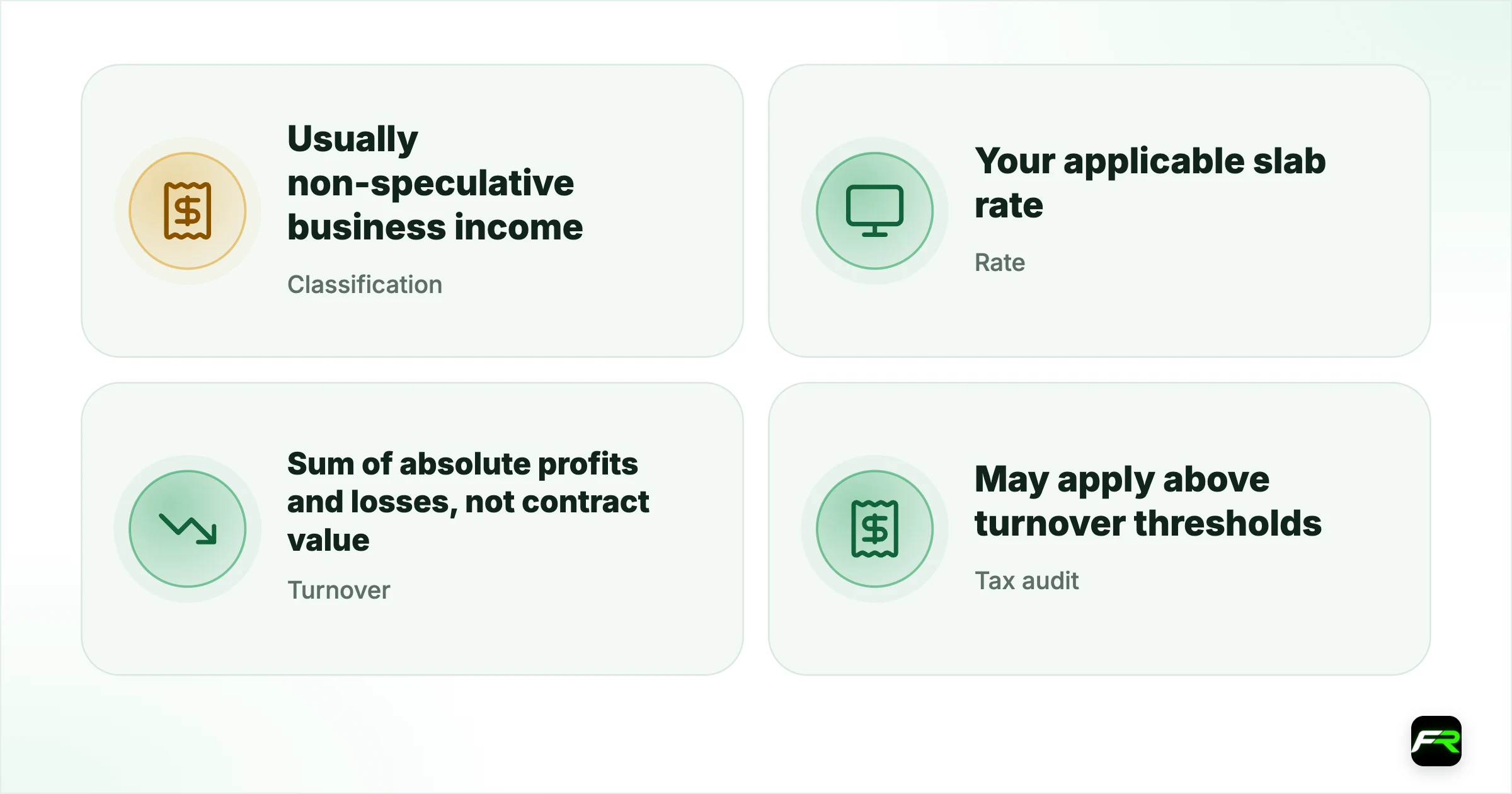
| Classification | Usually non-speculative business income |
|---|---|
| Rate | Your applicable slab rate |
| Turnover | Sum of absolute profits and losses, not contract value |
| Tax audit | May apply above turnover thresholds (section 44AB) |
| Offshore gains | Still taxable; nothing withheld or reported for you |
| Form | Typically ITR-3 |
The most expensive mistake is not keeping a per-trade log. Turnover for derivatives cannot be worked out from a year-end summary, and an accountant cannot audit what was never recorded.
Comparing rules across the region, or funding an account for the first time? See how the same question plays out in Indonesia, in Pakistan, how to spot a fake forex broker.
For the rules and brokers that apply where you live, see our guide to legal forex brokers in India.
Frequently asked
How is forex trading taxed in India?
Gains from exchange-traded currency derivatives are usually non-speculative business income, taxed at your slab rate. Losses can be set off and carried forward for up to eight years if you file on time. Offshore forex gains are also taxable income for a resident.
Do I need a tax audit for currency trading?
It depends on turnover, calculated as the sum of absolute profits and losses across your trades plus premium on options sold, and on the proportion of digital transactions. Track per-trade profit and loss from the start so your accountant can determine this.
Are profits from an offshore forex broker taxable in India?
Yes. They are taxable income for a resident regardless of how the money was funded or withdrawn. The broker reports nothing to Indian authorities, so the record-keeping is entirely yours.
What if I funded my account with USDT?
The purchase and sale of USDT has its own tax treatment in India, currently a flat rate on gains plus a withholding on transfers. That is separate from, and additional to, the tax on your trading result.
Which ITR form do I use for forex trading?
Business income from trading is generally reported on ITR-3. Confirm with an accountant, as the right form depends on your full income situation.
Can I carry forward forex trading losses?
Non-speculative business losses can generally be carried forward for up to eight years and set off against non-speculative business income, provided you file your return by the due date.
The team behind this guide
Researched, checked and approved by five forex specialists
Every guide is written, fact-checked and edited before it goes live, and updated when the facts change. Spotted an error? Tell us.