IC Markets





































How to Deposit to a Forex Broker from India
The trade is the easy part. Getting rupees to an offshore broker runs into FEMA, the LRS, and a bank that may simply decline. Here is how money moves, and where it gets stuck.
 WriterAbir KhanWriterWrites the guides · checks every figure against primary sources View profileAbout Abir →
 Market analysisTanbir Habib RiyadForex & Crypto AnalystForex and crypto analyst · technical and fundamental analysis View profileAbout Tanbir →
 Fact-checking & riskJannatul FerdaushFact-Checker & Risk AnalystFact-checks every figure · risk analysis · Applied Statistics, University of Dhaka View profileAbout Jannatul →
 Trading reviewJowel RanaCo-Founder & Forex TraderCo-founder · forex trader · reviews guides from a trader's view View profileAbout Jowel →
 Final approvalRanjan NiskrityFounder, Owner & Forex TraderFounder and owner · forex trader · signs off every guide View profileAbout Ranjan →
Before the how, the important context: funding an offshore margin-forex account is not a permitted use of the Liberalised Remittance Scheme, and most well-known offshore brokers are on the RBI’s Alert List. A direct bank transfer for forex can be declined, and payment channels are periodically cut off. This guide describes what people do and where it breaks, not a recommendation to do it. For the firms themselves, see our best forex brokers in India guide.
The routes people use
Third-party UPI and IMPS processors
The broker partners with a local payment processor. You pay by UPI or IMPS to the processor, which credits your trading account in USD. Deposits are usually fast. The weakness is that the money leaves your account as a payment to a processor, not to a broker, so if a withdrawal later needs a bank statement showing the original deposit, you cannot produce a clean one.
Cards
International debit and credit cards sometimes work, but Indian banks increasingly decline card payments flagged as foreign trading, and the RBI has tightened rules on cross-border card use for such purposes. When a card works today, there is no guarantee it works next month.
Crypto
Buy USDT on an Indian exchange, send it to the broker. This sidesteps the banking friction but adds crypto price and network risk while the money is in transit, and buying and selling USDT has its own spread and tax treatment in India.
Whatever route you use, the pattern is the same: deposits tend to work, and the friction shows up on withdrawal, when the broker’s compliance team or the payment processor wants to match the money to you and your original funding method.
Arjun funded USD 300 through a third-party UPI processor. It credited instantly. Six weeks later his withdrawal was held for verification: the broker wanted a bank statement showing the original deposit, which he could not produce because the money had gone to a processor. It took three weeks and several document rounds to get paid. His conclusion: the informal funding route is fine until you need to prove where the money came from.
Why the channels keep breaking
If you have traded with an offshore broker for any length of time from India, you will have seen a deposit method stop working with no notice. This is not the broker being unreliable in isolation. When the RBI or the Enforcement Directorate acts against a payment aggregator that routes money to trading platforms, every broker using that aggregator loses its India channel at once. A new one appears a few weeks later under a different name, the cycle repeats, and each time there is a window where deposits fail and, worse, withdrawals stall because the same rail handles both.
The legal exposure here sits under the Foreign Exchange Management Act (FEMA), and a violation is technically a civil contravention that can carry a monetary penalty of up to three times the amount involved, pursued by the Enforcement Directorate. In practice, the ED’s public actions to date have overwhelmingly targeted the payment aggregators and platforms moving money at scale, not individual retail traders sending a few hundred dollars, but that is an enforcement priority, not a legal exemption, and it can change without notice.
The practical consequence is that you should never keep more in an offshore account than you would be comfortable being unable to touch for a month. Traders who treat the account as a place to park a growing balance are the ones who get caught when a channel closes with their money on the wrong side of it. Withdraw profits regularly, keep the working balance small, and do not let the account become a savings pot.
If you want to keep it clean
- Trade the SEBI-regulated exchange-traded currency derivatives instead, where funding is a normal domestic transfer and there is no cross-border issue.
- If you are a non-resident Indian, fund from your account in your country of residence, under its rules.
- If you do use an offshore broker, keep every deposit and withdrawal screenshot, and always withdraw to the exact method and account you deposited from.
- Withdraw profit regularly and keep the account balance small, so a channel closure cannot trap a large sum.
The cost stack
- Payment processor fee: often 1–3% on UPI or card deposits.
- Broker INR-to-USD conversion: roughly 0.5–1% each way.
- If routing through crypto: exchange spread on buying USDT, network fee, and spread again on the broker’s side.
- Withdrawal delays that can run into weeks when compliance gets involved.
None of this changes the tax position. Profit from trading currencies is taxable income for an Indian resident whichever route you funded through, and using an informal channel does not create a grey area on the tax side even though it does on the FEMA side. Our India tax guide covers how the income is classified and what records to keep.
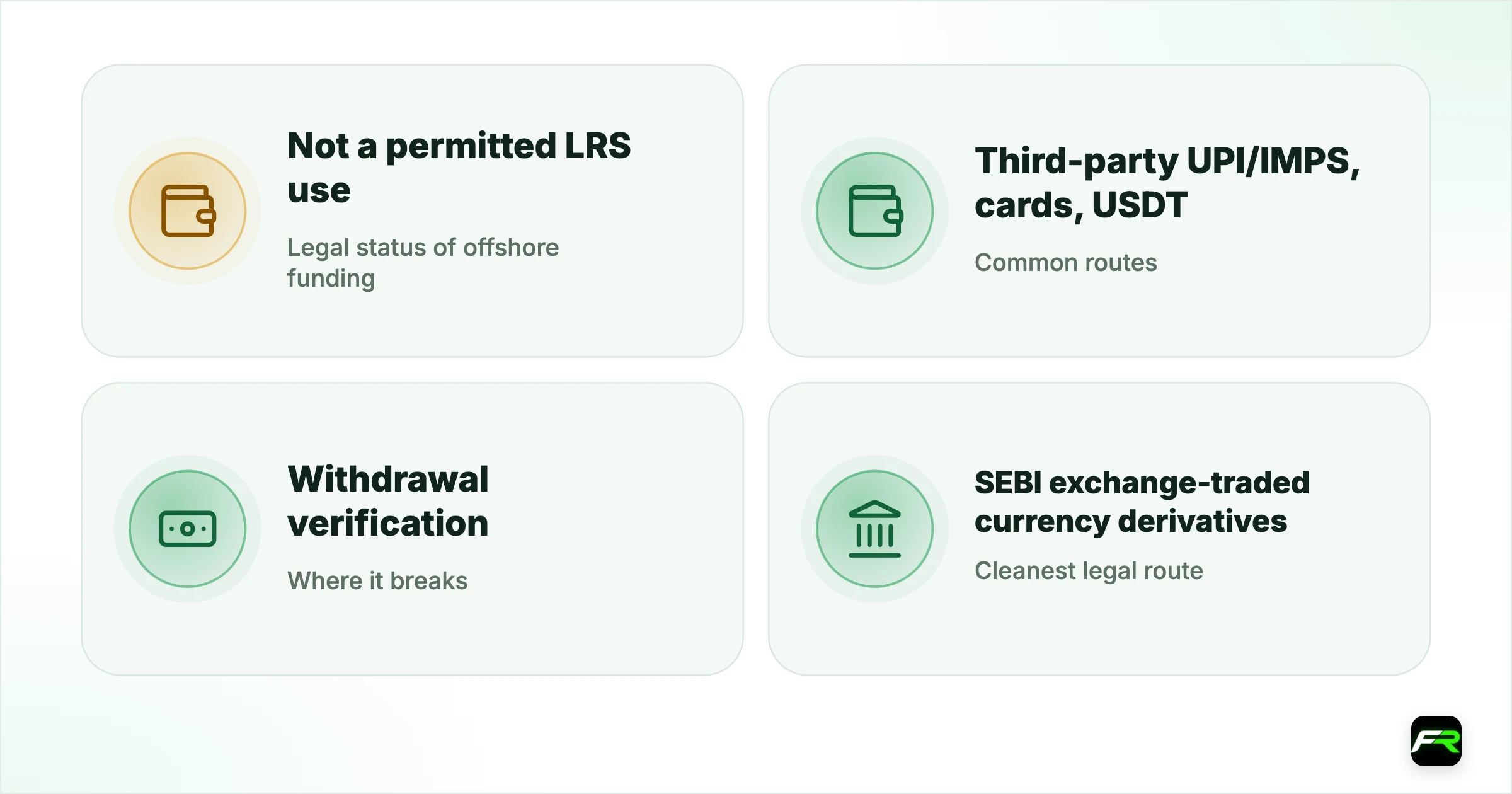
| Legal status of offshore funding | Not a permitted LRS use |
|---|---|
| Common routes | Third-party UPI/IMPS, cards, USDT |
| Where it breaks | Withdrawal verification |
| Cleanest legal route | SEBI exchange-traded currency derivatives |
| Golden rule | Withdraw only to the method you deposited with |
A payment page that asks you to pay a person’s UPI ID or a random current account, rather than a named payment processor, is a red flag. That is how deposit scams and “agent” fraud work.
Frequently asked
Can I use UPI to fund a forex account?
Brokers often route UPI deposits through a third-party processor. It usually works, but the money leaves your account as a payment to the processor, which creates problems if a withdrawal later needs proof of the original deposit.
Is it legal to send money to an offshore forex broker from India?
Funding a margin-trading account is not a permitted use of the Liberalised Remittance Scheme, and most offshore brokers are on the RBI Alert List. Enforcement against individuals has been light, but your bank can decline the transfer and channels get cut off.
Why do offshore brokers stop accepting Indian deposits?
When the RBI or Enforcement Directorate acts against a payment intermediary, the brokers using it lose their Indian deposit channel, sometimes overnight. This is a recurring pattern rather than a one-off.
How do I fund SEBI currency derivatives?
Through a normal domestic bank transfer or UPI to your SEBI-registered broker, exactly like funding an equity trading account. There is no cross-border step and no FEMA issue.
Is USDT a safer way to fund from India?
It avoids the banking friction but adds crypto price risk in transit, exchange spreads on both conversions, and its own tax treatment in India. It is a different set of risks, not fewer.
How much should I keep in an offshore trading account?
Only what you would be comfortable being unable to withdraw for a month. Payment channels close periodically when the RBI acts against an aggregator, and a large parked balance is what gets trapped. Withdraw profit regularly.
Can my bank penalise me for a forex-related transfer?
A bank can decline or reverse a transfer it flags as being for margin trading, and repeated flagged activity can draw questions. It is more disruption than penalty for most individuals, but it is a reason the informal routes exist.
The team behind this guide
Researched, checked and approved by five forex specialists
Every guide is written, fact-checked and edited before it goes live, and updated when the facts change. Spotted an error? Tell us.