IC Markets





































USD/JPY: A Beginner’s Guide
The headline pair of the Asian session. Here is what moves it, how it behaves through the day, and why it is a sensible first pair for a trader in this region.
 WriterAbir KhanWriterWrites the guides · checks every figure against primary sources View profileAbout Abir →
 Market analysisTanbir Habib RiyadForex & Crypto AnalystForex and crypto analyst · technical and fundamental analysis View profileAbout Tanbir →
 Fact-checking & riskJannatul FerdaushFact-Checker & Risk AnalystFact-checks every figure · risk analysis · Applied Statistics, University of Dhaka View profileAbout Jannatul →
 Trading reviewJowel RanaCo-Founder & Forex TraderCo-founder · forex trader · reviews guides from a trader's view View profileAbout Jowel →
 Final approvalRanjan NiskrityFounder, Owner & Forex TraderFounder and owner · forex trader · signs off every guide View profileAbout Ranjan →
Key takeaways
- USD/JPY shows how many yen one dollar buys; it is the most traded pair in Asian hours, with tight spreads.
- The US-Japan interest-rate gap drives the big multi-month trends.
- BoJ meetings and Ministry of Finance intervention can move it sharply, especially at high levels.
- US CPI, jobs data and risk sentiment move it too; in a panic the yen often rises as a safe haven.
USD/JPY is how many yen one dollar buys, so a quote of 150.00 means one US dollar is worth 150 yen. It is the most traded pair during Asian hours, it has tight spreads, and its news drivers are clear enough to follow, which makes it a reasonable first pair for a trader in this region.
What moves it
The interest-rate gap
The single biggest driver over months and years is the difference between US and Japanese interest rates. When the Federal Reserve raises rates and the Bank of Japan holds near zero, the gap widens, holding dollars pays more than holding yen, and USD/JPY tends to rise. When that gap narrows, with the Fed cutting or the Bank of Japan tightening, it tends to fall. Most of the big multi-month trends in USD/JPY are this story.
Bank of Japan policy and intervention
Bank of Japan meetings, and comments from its officials, move the pair sharply. Japan has also intervened directly in the currency market when the yen weakened past levels the Ministry of Finance considered disorderly, buying yen to push USD/JPY down suddenly. Those interventions produce fast, large moves, and the risk of one increases as it pushes into territory that has drawn intervention before.
US data and risk sentiment
US inflation (CPI), jobs (non-farm payrolls), and Fed commentary move the dollar leg. USD/JPY is also a “risk” barometer: in a market panic, money often flows into yen as a safe haven, pushing it down even without any Japan-specific news.
Why intervention targets high USD/JPY levels
A weaker yen (a higher USD/JPY number) makes imports more expensive for Japanese households and businesses, since Japan imports most of its energy and a large share of its food. When it rises quickly toward levels last seen before a period of yen weakness, that import-cost pressure becomes politically visible, which is what tends to draw the Ministry of Finance's attention rather than any fixed number written into law. A stronger yen is rarely what triggers intervention, since a cheaper yen benefits Japanese exporters and is not treated as the same kind of problem.
This is why levels that previously drew intervention become watched again: the underlying pressure, import costs and the pace of the move, tends to recur at similar levels rather than because the level itself is a rule.
How it behaves through the day
During the Asian session, USD/JPY sees steady, liquid two-way flow, with a burst of activity around the 09:55 Tokyo fix. It often trades a defined range through Tokyo hours, then can extend or reverse when London arrives. Volatility is highest during the London-New York overlap and around US data releases, which for most Asian traders is the middle of the night.
Kenji chose USD/JPY as his first pair because he could follow the news: he understood that a strong US jobs number tended to lift it and that Bank of Japan meetings were dates to be careful around. He traded a simple range approach during his evening, staying flat over Bank of Japan meetings and US CPI. His first intervention scare, a 300-pip drop in an hour, happened while he was flat, precisely because he had a rule about not holding through obvious risk events.
Reading a USD/JPY quote and P&L
Because the yen is worth so little per unit, USD/JPY is quoted to two decimal places for the main number and a third for the fractional pip, so 150.25 means ¥150.25 per dollar. A pip is a move of 0.01, so from 150.25 to 150.35 is 10 pips. On a standard lot (100,000 units) each pip is worth roughly USD 6 to 7, so that 10-pip move is about USD 65. On a micro lot (1,000 units) the same move is about USD 0.65. If you are used to EUR/USD where a pip is the fourth decimal, USD/JPY takes a session or two to get comfortable with.
This matters for stops. A “20-pip stop” on USD/JPY is a move of 0.20 in the price, which during a calm Asian session is a meaningful buffer but during a Bank of Japan surprise is nothing. Size the position so that if the stop is hit you lose the fixed small percentage of your account you decided on, and check what 20 pips is worth on your lot size before you place the trade.
Why it suits a beginner in Asia
- It is liquid and tight-spread during your trading hours.
- Its drivers are followable: two central banks, US data, risk sentiment.
- It trades clean ranges often enough to practise range strategies on.
- There is an enormous amount of free analysis and education focused on it.
The risks to respect
- Intervention. Japan can and does step into the market. Be cautious near levels that have drawn intervention before, and keep stops in place.
- Bank of Japan surprises. A shift in yield-curve policy or rates can move the pair hundreds of pips. Be flat over meetings until you know how you handle that volatility.
- US data at night. If a release lands while you are asleep with an open position, you can wake up to a very different price. Use stops, or be flat.
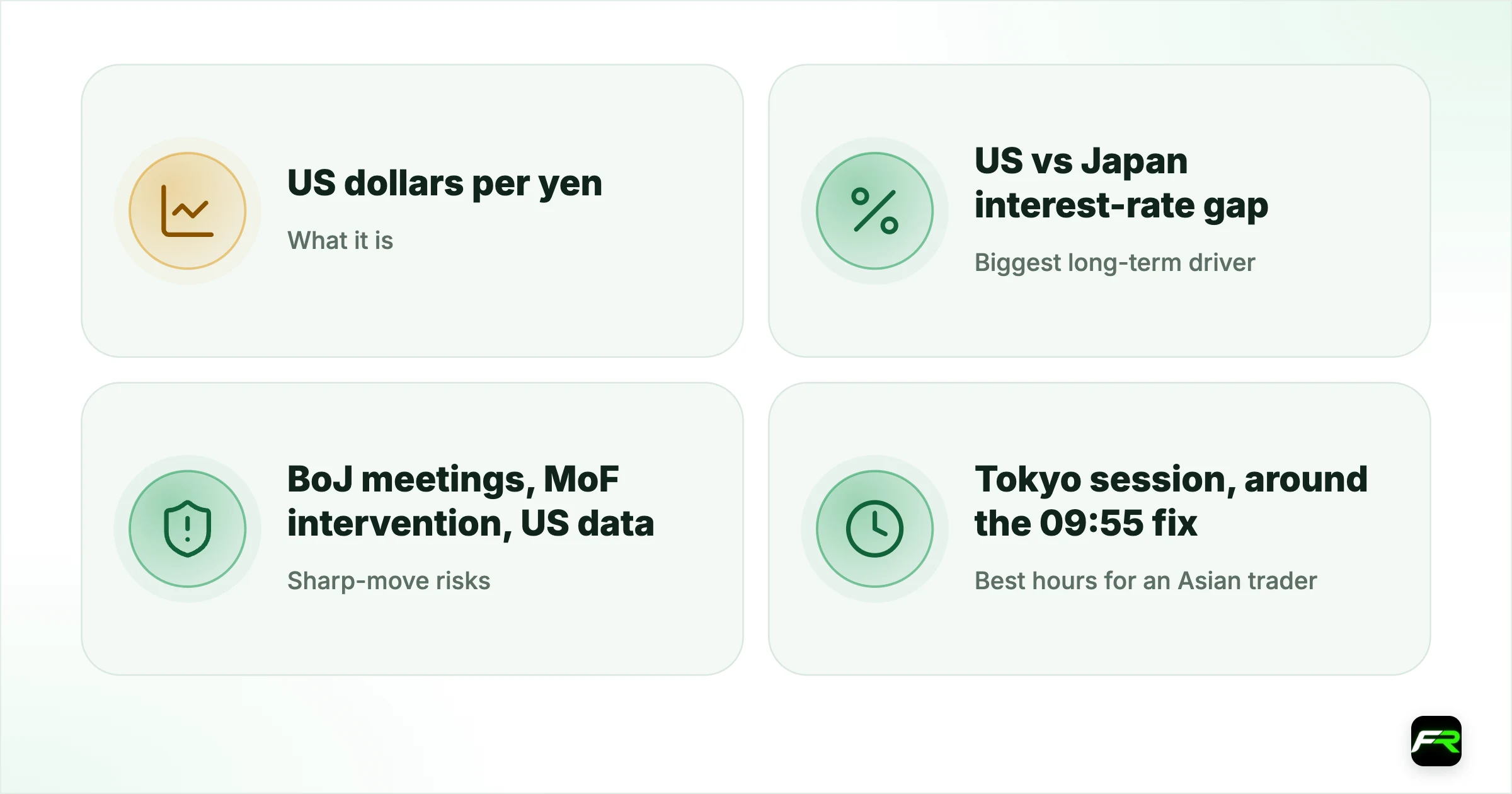
| What it is | US dollars per yen (150.00 = ¥150 per $1) |
|---|---|
| Biggest long-term driver | US vs Japan interest-rate gap |
| Sharp-move risks | BoJ meetings, MoF intervention, US data |
| Best hours for an Asian trader | Tokyo session, around the 09:55 fix |
| Why start here | Liquid, tight, followable news, clean ranges |
Do not hold a USD/JPY position through a Bank of Japan meeting or a US inflation release while you are learning. The moves are large, fast, and not something to discover with real money on the line.
Sources and where to check it yourself
- Bank of Japan: monetary policy: policy decisions and statements
- Japan Ministry of Finance: intervention operations: confirmed intervention dates and amounts
For the rules and brokers that apply where you live, see our guide to forex brokers in Japan.
Frequently asked
Is USD/JPY good for beginners?
Yes, particularly for traders in Asia. It is liquid and tight-spread during Asian hours, its drivers are clear enough to follow, and it trades clean ranges often enough to practise on. Respect the sharp-move risks around Bank of Japan meetings and US data.
What makes USD/JPY go up or down?
Over the long term, the gap between US and Japanese interest rates. Over days and hours: Bank of Japan policy, US inflation and jobs data, Fed commentary, and risk sentiment, since yen strengthens as a safe haven in market stress.
What is Japanese intervention in USD/JPY?
When the yen weakens to a level Japan’s Ministry of Finance considers disorderly, it can buy yen directly in the market to push USD/JPY down. These moves are sudden and large, sometimes hundreds of pips in an hour.
What time is USD/JPY most active?
It is active through the Tokyo session with a flow burst around the 09:55 Tokyo fix, and most volatile during the London-New York overlap and US data releases, which is overnight for most Asian traders.
Should I trade USD/JPY around the Bank of Japan meeting?
Not while you are learning. Policy surprises can move it hundreds of pips. Be flat over the meeting and resume trading once the direction is clear.
How much is a pip worth in USD/JPY?
A pip in USD/JPY is 0.01 of the price. On a standard lot it is worth about USD 6 to 7 depending on the exchange rate; on a micro lot, roughly USD 0.06 to 0.07.
The team behind this guide
Researched, checked and approved by five forex specialists
Every guide is written, fact-checked and edited before it goes live, and updated when the facts change. Spotted an error? Tell us.