 IC Markets

 3:09
 2:39
 2:10
 2:18
 3:43
 8:42
Trailing Drawdown, Explained With Numbers
A trailing drawdown moves up with your profit and then stops. Miss how it works and you can breach it while still in profit.
 WriterAbir KhanWriterWrites the guides · checks every figure against primary sources View profileAbout Abir →

 Market analysisTanbir Habib RiyadForex & Crypto AnalystForex and crypto analyst · technical and fundamental analysis View profileAbout Tanbir →

 Fact-checking & riskJannatul FerdaushFact-Checker & Risk AnalystFact-checks every figure · risk analysis · Applied Statistics, University of Dhaka View profileAbout Jannatul →

 Trading reviewJowel RanaForex TraderForex trader · reviews guides from a trader's view View profileAbout Jowel →

 Final approvalRanjan N. MondolForex TraderForex trader · signs off every guide View profileAbout Ranjan →

Every prop firm sets a maximum drawdown, the lowest your account can fall before it is closed. The catch is how that floor is measured. A fixed drawdown is anchored to your starting balance. A trailing drawdown follows your account up as it makes money, which sounds generous and is the stricter of the two.
How a fixed drawdown works
On a $100,000 account with a 10 per cent fixed drawdown, the floor is $90,000 and it never moves. Make $8,000 and your buffer is now $18,000. Simple, and forgiving once you are ahead.
Watch this on video
Trailing Drawdown, Explained, in 3:06
A trailing floor rises with your highs, so you can breach it while still in profit. Know today's floor before you trade.
How a trailing drawdown works
On the same account with a 10 per cent trailing drawdown, the floor starts at $90,000 but rises with your highest balance, or on some firms your highest equity including open trades. Reach $105,000 and the floor is now $95,000. Reach $108,000 and it is $98,000.
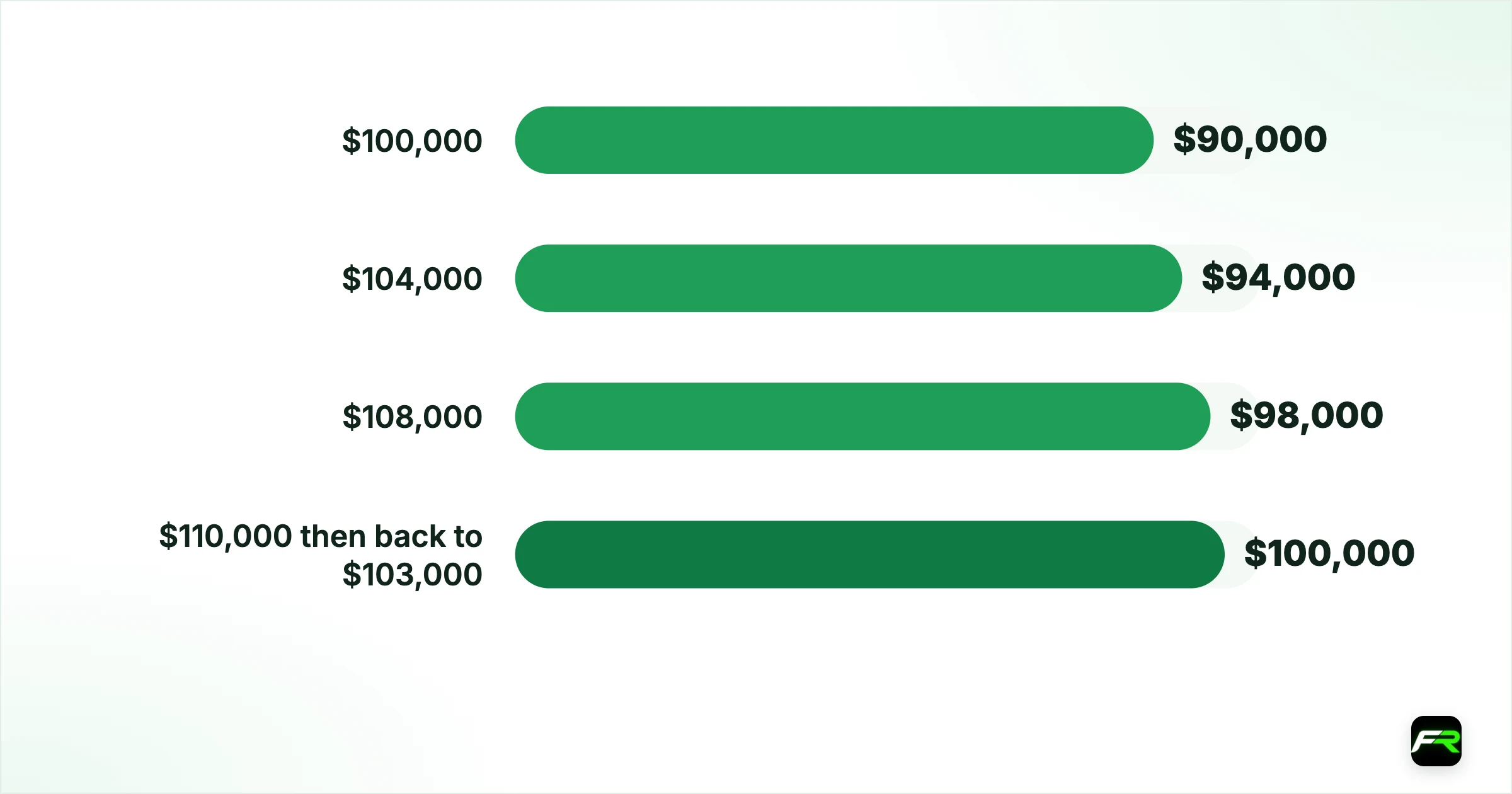
| Account high | Trailing floor (10%) | Room below the high |
|---|---|---|
| $100,000 (start) | $90,000 | $10,000 |
| $104,000 | $94,000 | $10,000 |
| $108,000 | $98,000 | $10,000 |
| $110,000 then back to $103,000 | $100,000 | you are $3,000 from a breach while $3,000 in profit |
The last row is where traders get caught. You pushed to $110,000, gave back $7,000, and you are still up $3,000 on the challenge, but the trailing floor sits at $100,000 and one more bad trade closes the account.
Equity trailing vs balance trailing
The harsher version trails your highest equity, meaning an open trade that is briefly $4,000 in profit pulls the floor up by $4,000 even if you close that trade at breakeven. The gentler version trails only your closed balance. Read the terms to see which one applies, because it changes how you manage a winning trade.
Many firms freeze the trailing floor once it reaches your starting balance plus the drawdown amount, or once you are funded. On a $100,000 account with a $10,000 trailing drawdown, the floor often stops rising at $100,000. After that it behaves like a fixed drawdown at the starting balance.
How to trade around it
- Bank partial profit rather than letting a big winner balloon your equity high and drag the floor up with it.
- Know your current floor before every session. It is not the number you started with.
- On an equity-trailing account, be wary of holding several open winners at once, because their combined unrealised profit sets a floor you then have to stay above.
- Once the floor freezes, you can trade with the room you have earned. Before that, treat every new equity high as a new, higher risk line.
Marco was up 6 per cent on a $50,000 equity-trailing account. One trade ran to +$1,900 unrealised, pulling his floor up, then reversed, and he closed it at +$200. Two more small losses left his balance at $51,400, up 2.8 per cent on the challenge, but below the trailing floor of $51,500. Account closed. Had the floor been balance-trailing, the spike to +$1,900 would not have counted.
Traders read the profit target and the daily loss limit carefully and skim the drawdown line. On a trailing account the drawdown is the rule that ends most funded accounts, and usually while the trader still thinks they are winning.
Where firms lock the floor
Most trailing floors stop rising at some point, which turns them into a static floor from then on. Examples from firms we have checked:
| Firm and plan | How the floor trails | When it stops |
|---|---|---|
| FTMO 1-Step | Highest end-of-day balance minus 10% of the start | It can only rise; it never falls |
| FTMO Instant | Intraday trailing, 10% | Per its rules |
| Topstep Trading Combine | End-of-day balance high minus the maximum loss | Locks once it reaches the starting balance |
| FundedNext Stellar Instant | Trails profit, 6% | Stops once it reaches the initial balance |
| FundedNext Futures | Highest end-of-day balance | Locks once it reaches the initial balance |
A floor that locks at the starting balance is much more forgiving once you are well in profit, because from then on you can never lose more than your gains. Reaching that lock point early, with payouts and banked profit, is the main strategy on trailing plans.
End-of-day vs intraday trailing: a worked example
On a $50,000 account with a $2,000 trailing loss, a trade runs to +$1,500 during the day and is closed at +$200. On an end-of-day plan, only the +$200 close matters, so the floor rises to $48,200. On an intraday plan, the +$1,500 peak counts, so the floor rises to $49,500, leaving $700 of room instead of $2,000.
Strategies that suit trailing plans
- Small, frequent profits banked quickly rather than large runs given back.
- Partial exits as trades move in your favour.
- One position at a time on intraday-trailing plans.
- Regular payouts to reach the lock point sooner on plans that lock.
If your method needs room to breathe and often gives back part of a winning run, choose a plan with a static maximum loss instead.
Key terms
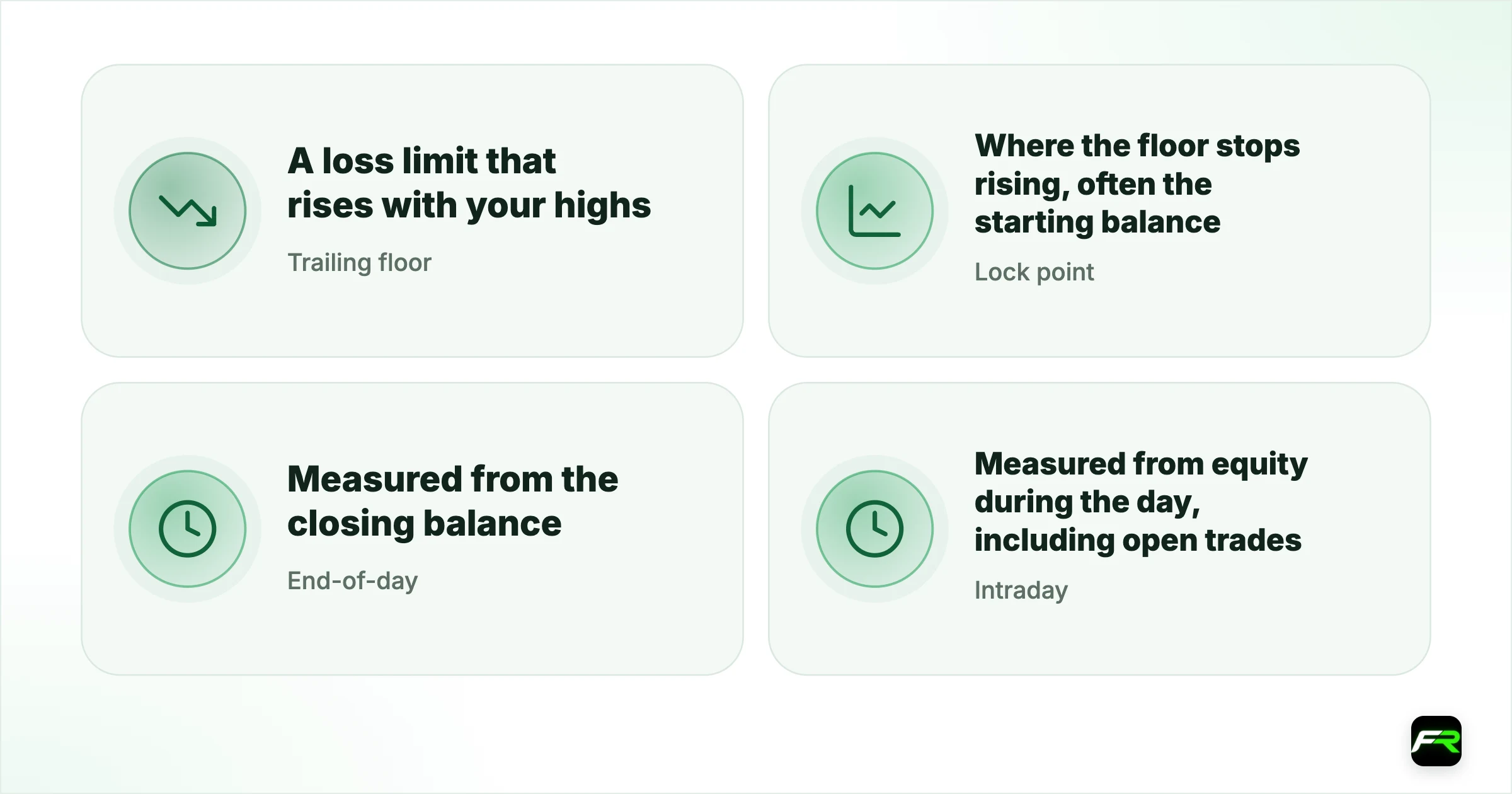
| Term | Meaning |
|---|---|
| Trailing floor | A loss limit that rises with your highs |
| Lock point | Where the floor stops rising, often the starting balance |
| End-of-day | Measured from the closing balance |
| Intraday | Measured from equity during the day, including open trades |
Related guides
For the related rules and plans, see these guides.
- Maximum drawdown, explained: static and trailing floors side by side.
- Instant funding: what you gain by skipping the evaluation, and what you give up.
- Topstep review: the futures benchmark, from its own pages.
- Futures prop firms compared: Topstep, FundedNext Futures, MyFundedFutures and Tradeify.
One account, three drawdown rules, day by day
The fastest way to see why the type of drawdown matters more than the percentage is to run one account through all three rules. Below, the same $100,000 account makes the same trades for eight days. Only the rule that sets the floor changes.
| Rule | Where the floor sits on day 7 | Day 7 dip to $98,400 |
|---|---|---|
| Static 6% | $94,000, fixed from the start | Safe, $4,400 above the floor |
| End-of-day trailing | $97,800 (best close $103,800, less $6,000) | Safe, $600 above the floor |
| Intraday trailing | $98,600 (best intraday peak $104,600, less $6,000) | Breached |
The account on day 7 is only $800 below where it started, and the trader closed every trade with discipline. What ended it was an open profit of $800 on day 4 that was never banked: the intraday rule recorded that peak, and every dollar of it raised the floor. This is the situation most "I was in profit and still failed" stories describe.
How to work out your own floor before every session
- Find your peak: the highest closing balance for end-of-day plans, or the highest equity reading, including open profit, for intraday plans.
- Subtract the drawdown amount in dollars, not per cent, unless the firm says the percentage applies to the peak.
- If the firm locks the floor at the starting balance, cap the result at that figure.
- Write the number on a note next to your platform, and set alerts a little above it.
On intraday plans, every open profit you let run raises the floor even if you never close the trade. Taking partial profits early, or using a plan with end-of-day trailing, keeps more room under you.
Cite this guide
FX Recap, "Trailing Drawdown, Explained With Numbers", updated 9 September 2026, https://fxrecap.com/prop-trading/trailing-drawdown-explained
Free to quote with a link. Journalists: data and comment in our press room.
Frequently asked questions
What is a trailing drawdown on a prop firm account?
It is a maximum-loss floor that rises as your account makes new highs, then stops. Starting on a $100,000 account with a 10 per cent trailing drawdown, the floor is $90,000, but reach $105,000 and it becomes $95,000. It is stricter than a fixed drawdown because giving back profit can breach it even while you are still up on the challenge.
Does trailing drawdown use balance or equity?
It depends on the firm. Balance-trailing follows only your highest closed balance. Equity-trailing follows your highest equity including open trades, so a trade that is briefly deep in profit pulls the floor up even if you close it flat. Equity-trailing is harsher and changes how you should manage a winning position.
When does the trailing drawdown stop moving?
On most plans the floor stops rising once it reaches your starting balance, which happens when your account peaks at the starting balance plus the drawdown. On a $100,000 account with a $10,000 trailing drawdown, the floor stops at $100,000 once the account has reached $110,000, and from then on it behaves like a fixed drawdown. Topstep's Combine and FundedNext's Instant and futures plans work this way, while FTMO's 1-Step floor only ever rises.
Can I breach the drawdown while still in profit?
Yes, on a trailing account. If you hit a high, then give back enough that your balance falls below the trailed floor, the account closes even if you are still up on the challenge overall. Banking partial profit and knowing your current floor before each session are the defences.
Is intraday or end-of-day trailing better for traders?
End-of-day is more forgiving, because only the closing balance moves the floor. Intraday trailing counts open-trade peaks, so a winner closed at breakeven still raises the floor.
Is trailing drawdown calculated from balance or equity?
It depends on the plan. Intraday trailing rules usually follow equity, including open profit, while end-of-day rules follow the closing balance. Check the firm's rule wording before you trade.
Why did my trailing drawdown move when I did not close a trade?
On an intraday trailing plan the floor follows your highest equity, so an open profit raises it even if you later give that profit back.
Related reading
The team behind this guide
Researched, checked and approved by five forex specialists
Every guide is written, fact-checked and edited before it goes live, and updated when the facts change. Spotted an error? Tell us.