 IC Markets




































The Best-Known Futures Prop Firms, Compared
Topstep, FundedNext Futures, MyFundedFutures and Tradeify side by side: evaluations, drawdowns, consistency rules, payouts and pricing models.
 WriterAbir KhanWriterWrites the guides · checks every figure against primary sources View profileAbout Abir →
 Market analysisTanbir Habib RiyadForex & Crypto AnalystForex and crypto analyst · technical and fundamental analysis View profileAbout Tanbir →
 Fact-checking & riskJannatul FerdaushFact-Checker & Risk AnalystFact-checks every figure · risk analysis · Applied Statistics, University of Dhaka View profileAbout Jannatul →
 Trading reviewJowel RanaCo-Founder & Forex TraderCo-founder · forex trader · reviews guides from a trader's view View profileAbout Jowel →
 Final approvalRanjan NiskrityFounder, Owner & Forex TraderFounder and owner · forex trader · signs off every guide View profileAbout Ranjan →
Futures prop firms let you trade exchange-listed contracts, such as index and commodity futures, in a simulated evaluation and then a funded account. Their rules look alike on the surface, but the details that decide outcomes, the drawdown type, consistency rules and payout schedules, differ. Here are four well-known firms. This is a comparison, not a ranking.
Side by side
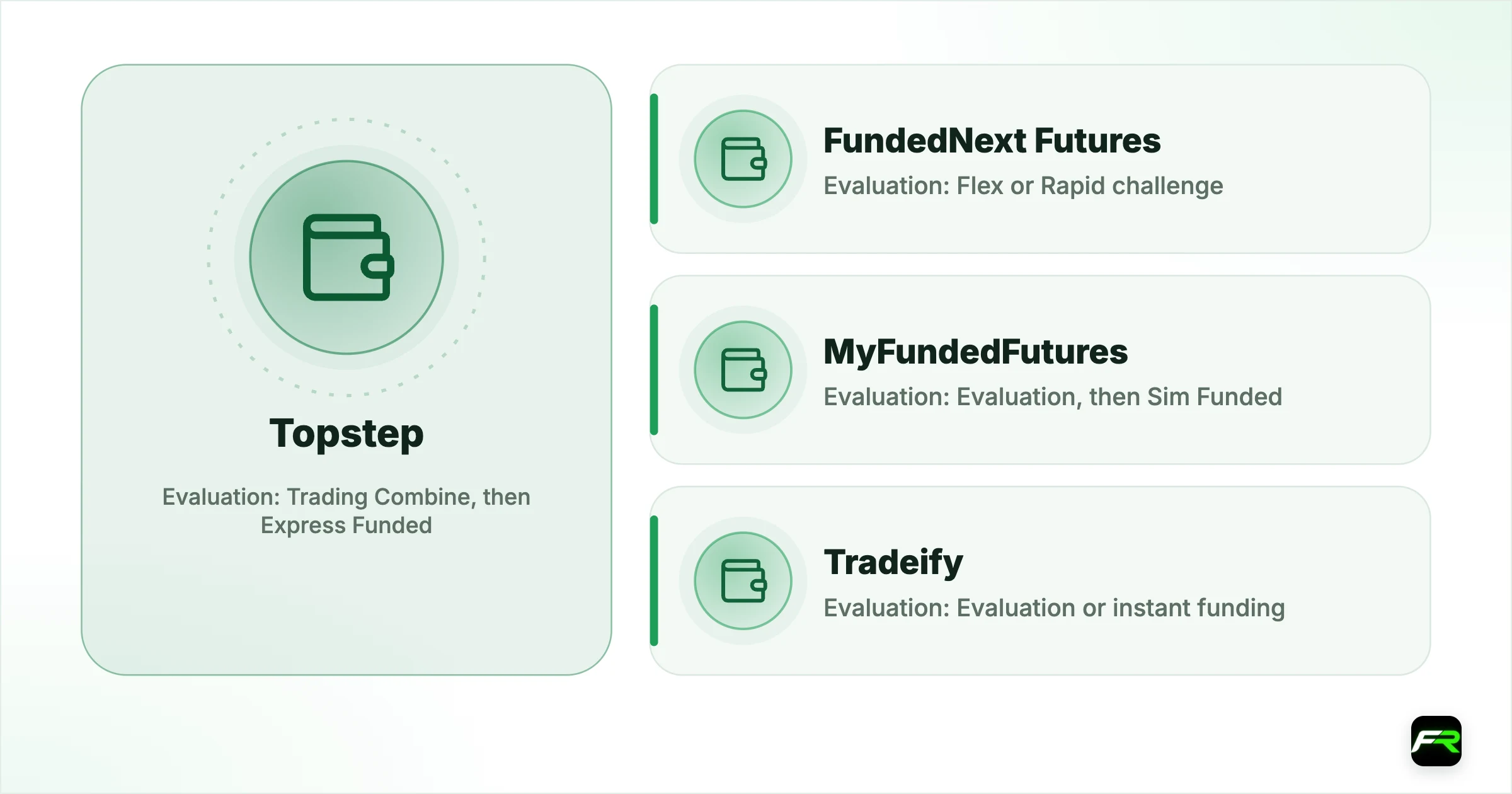
| Topstep | FundedNext Futures | MyFundedFutures | Tradeify | |
|---|---|---|---|---|
| Evaluation | Trading Combine, then Express Funded | Flex or Rapid challenge; Direct funded | Evaluation, then Sim Funded | Evaluation or instant funding |
| Drawdown | Trails end-of-day balance, locks at start | Trails end-of-day balance, locks at start | End-of-day trailing; intraday on Rapid | End-of-day trailing |
| Consistency | 55% in the Combine; 40% on one payout path | 40% in the Flex challenge; 20% on Direct | None on Pro once funded; 50% on some plans | 40–50% on evaluation; none once funded |
| Payouts | 5 winning days of $150+, or 3 days on the Consistency path | Per model | Every 48 hours, or daily on Rapid | Daily or every 5 days, by plan |
| Pricing | Monthly subscription | Flex from $74.99 | One-time payment | One-time payment |
| Share | 90% | 95% Flex; 90% Rapid and Direct | 80% or 90% by plan | Check the plan |
How to read the differences
- Drawdown: all four use some form of trailing loss limit. End-of-day trailing is gentler than intraday, because a trade that is briefly in profit does not move the floor. See trailing drawdown.
- Consistency: a 40 or 55 per cent best-day rule changes how fast you can pass after a big day. At Topstep and FundedNext Flex a breach raises the target rather than failing the account.
- Pricing model: a monthly subscription keeps charging while you try; a one-time fee does not, but usually costs more up front.
- Payout schedule: how often you can be paid matters less than the conditions for each payout.
Topstep’s published outcomes
Topstep is the only one of the four we know of that publishes annual outcomes. For 2025 it reports that 16.8 per cent of Trading Combines were passed and 33.3 per cent of funded participants received a payout. Expect broadly similar odds elsewhere; nothing in the futures model makes passing easier.
Choosing between them
- Decide whether your trading suits an end-of-day trailing floor; if you let winners run and give some back, it will bite.
- Check the consistency rule against your best days on demo.
- Compare the full cost: subscription months or one-time fee, plus activation and resets.
- Read the payout conditions, not only the frequency.
- Prefer firms with a long payout record. Topstep’s is the longest of the four.
Futures rules and prices change often. Check each firm’s rule page on the day you buy; ours were read in October 2026.
In futures prop the drawdown rule is the product. Pick the firm whose drawdown fits how you manage a winning trade, then compare prices.
Futures contracts traders use most
Futures prop accounts trade exchange-listed contracts, most often equity index, energy and metal futures on CME Group exchanges, in standard and micro sizes. Micro contracts are a fraction of the standard contract’s size and are the usual way to manage risk on a smaller account. Check which contracts each firm allows and its maximum position size; Topstep, for example, caps the Trading Combine at 5, 10 or 15 contracts depending on account size.
Questions to compare on any futures firm
- Is the maximum loss end-of-day or intraday trailing, and where does it lock?
- Is there a daily loss limit, and is breaching it a soft pause or a failure?
- What consistency rule applies in the evaluation and for payouts?
- Is the price a monthly subscription or a one-time fee, and what does activation cost?
- How many winning days, and what minimum, does each payout need?
- Which platforms are supported?
FundedNext’s futures rules show how much these vary within one firm: Flex has no daily loss limit, Rapid Daily has one that pauses trading for the session, and Direct has a 20 per cent consistency rule across withdrawals.
Soft and hard daily limits
Futures firms often use a soft daily loss limit: hitting it stops trading for the rest of the session rather than failing the account. FundedNext describes its Rapid and Direct limits this way, and Topstep’s Live Funded account deactivates for the trading day when its daily limit is breached. A soft limit is more forgiving than a hard one, but the maximum loss limit underneath is still final.
A futures trader on a plan with a $1,000 soft daily limit loses $1,000 by midday on a volatile session. Trading pauses until the next session. Their maximum loss floor is still $800 below their balance, so the account survives to trade tomorrow, which a hard limit at the same level would not have allowed.
Futures sessions run on US Central Time at most firms. Convert the daily reset and any closing times into your own time zone before you start.
Related guides
For the firms in this comparison and the rules that differ most, see these guides.
- Topstep review: the futures benchmark, from its own pages.
- FundedNext review: four CFD routes, futures and rewards.
- Forex vs futures prop: instruments, sizing, costs and drawdown types compared.
- Trailing drawdown, with numbers: how a trailing floor follows your profit and when it stops.
The short version
Pick a futures prop firm by its drawdown rule first, its consistency and payout conditions second, and its price model third. Topstep has the longest record and publishes its outcomes; FundedNext Futures offers several models with different daily-limit designs; MyFundedFutures and Tradeify use one-time payments. Read each plan’s rules on the firm’s own site on the day you buy.
Key terms
| Term | Meaning |
|---|---|
| Micro contract | A smaller futures contract used to size risk precisely |
| End-of-day trailing | A loss floor updated from the closing balance once a day |
| Soft daily limit | A daily loss cap that pauses trading for the session rather than failing the account |
| Activation fee | A charge to start the funded stage, such as Topstep’s $149 on the Standard route |
Frequently asked
What are the best-known futures prop firms?
Topstep, FundedNext Futures, MyFundedFutures and Tradeify are among the best known. They differ mainly in drawdown type, consistency rules, payout conditions and pricing model.
Which futures prop firm has the best profit split?
On the published plans, FundedNext Flex offers 95 per cent, Topstep 90 per cent, and MyFundedFutures 80 or 90 per cent by plan. The split matters less than the drawdown and payout rules.
Do futures prop firms use trailing drawdown?
Yes, usually. Topstep and FundedNext Futures trail the end-of-day balance and lock it at the starting balance; MyFundedFutures uses end-of-day trailing, or intraday on its Rapid plan.
Is a monthly subscription or one-time fee better?
A one-time fee suits traders who may take weeks to pass, since a subscription keeps charging. A subscription can be cheaper if you pass quickly.
What is a soft daily loss limit?
A daily limit that pauses trading for the rest of the session when hit, rather than failing the account. Some futures plans use it; the maximum loss limit remains a hard rule.
Can I trade micro futures at prop firms?
Usually yes. Micro contracts are common on futures prop accounts and help size risk on smaller accounts, within each firm's maximum position limits.
Related reading
The team behind this guide
Researched, checked and approved by five forex specialists
Every guide is written, fact-checked and edited before it goes live, and updated when the facts change. Spotted an error? Tell us.