 IC Markets




































Maximum Drawdown on a Prop Account, Explained
The maximum loss limit is the floor your account can never go below. Whether that floor is static or trailing changes how you should trade.
 WriterAbir KhanWriterWrites the guides · checks every figure against primary sources View profileAbout Abir →
 Market analysisTanbir Habib RiyadForex & Crypto AnalystForex and crypto analyst · technical and fundamental analysis View profileAbout Tanbir →
 Fact-checking & riskJannatul FerdaushFact-Checker & Risk AnalystFact-checks every figure · risk analysis · Applied Statistics, University of Dhaka View profileAbout Jannatul →
 Trading reviewJowel RanaCo-Founder & Forex TraderCo-founder · forex trader · reviews guides from a trader's view View profileAbout Jowel →
 Final approvalRanjan NiskrityFounder, Owner & Forex TraderFounder and owner · forex trader · signs off every guide View profileAbout Ranjan →
Alongside the daily loss limit, every prop account has an overall floor: the lowest your account may fall, at any time, before it is closed. Firms call it the maximum loss, maximum drawdown or overall loss limit. Where the daily limit protects the firm from one bad day, this one protects it from a slow slide.
Static: a fixed floor
A static maximum loss is set once, from the starting account, and never moves. FTMO’s 2-Step Challenge works this way: the Maximum Loss is 10 per cent of the starting account, so on $100,000 the floor is $90,000 for the life of the account. Make $6,000 and your room to the floor is now $16,000. A static floor gets more forgiving as you make money.
Trailing: a floor that follows you up
A trailing maximum loss rises as your account makes new highs. FTMO’s 1-Step Challenge uses an end-of-day version: the floor is 10 per cent of the starting account below the highest balance recorded at midnight (00:00 CE(S)T) on any earlier day, and it can only rise, never fall. Because it trails the end-of-day balance, a trade that is briefly in profit during the day does not move it.
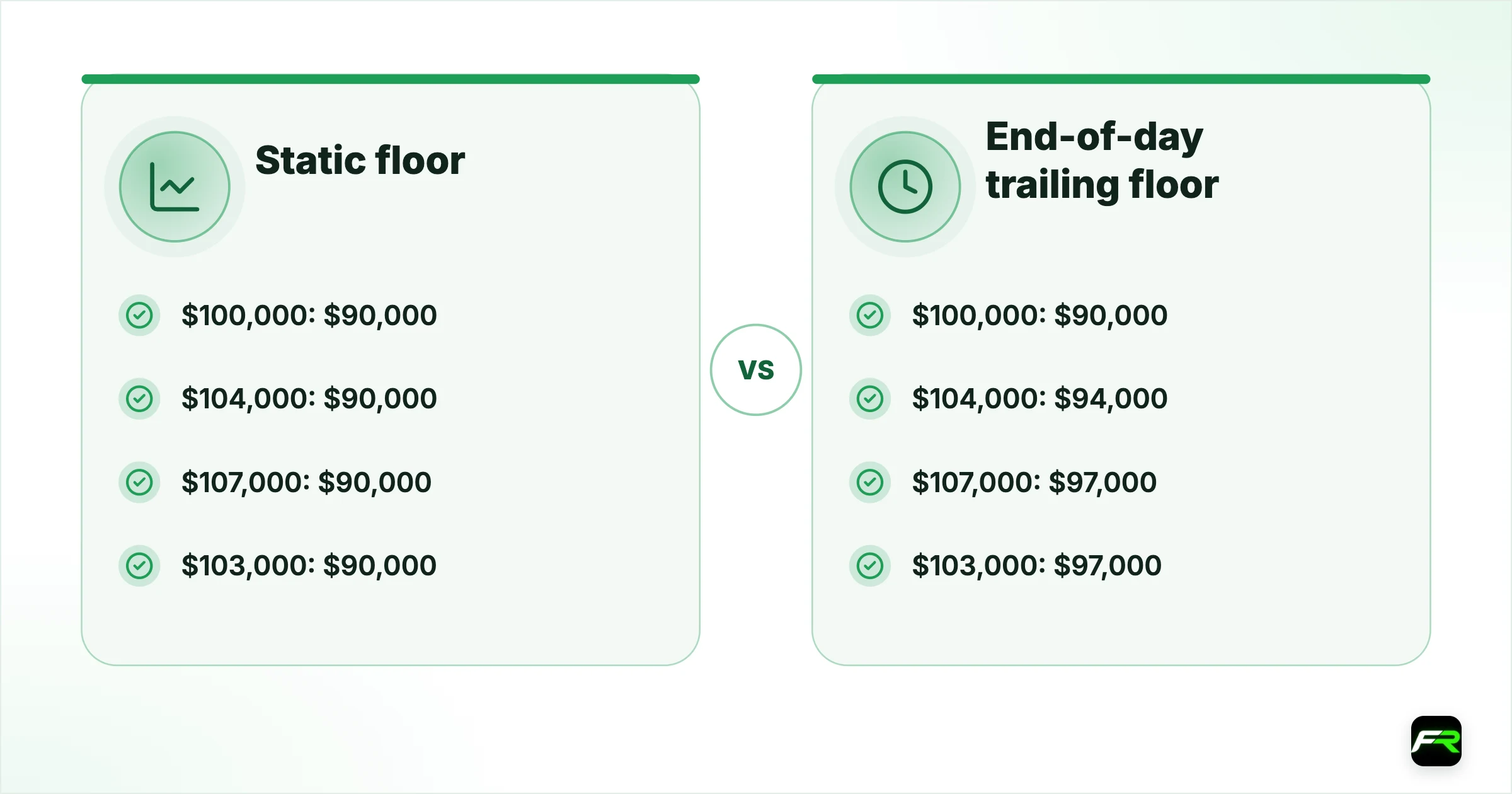
| Balance at midnight | Static floor (2-Step) | End-of-day trailing floor (1-Step) |
|---|---|---|
| $100,000 (start) | $90,000 | $90,000 |
| $104,000 | $90,000 | $94,000 |
| $107,000 | $90,000 | $97,000 |
| $103,000 (after giving some back) | $90,000 | $97,000 (it does not fall) |
The last row is the difference in one line. After a run to $107,000 and a pullback to $103,000, the static account has $13,000 of room; the trailing account has $6,000. Some firms trail intraday equity instead of the closing balance, which is stricter still: our trailing drawdown guide works through that version.
How it interacts with the daily limit
The two rules run at the same time, and whichever floor is higher at a given moment is the one that closes you. Early in a static account, the daily limit is usually the binding rule. Late in a trailing account, after a good run, the maximum loss floor can sit closer than the daily one.
On a $100,000 FTMO 2-Step account at a $92,000 balance, the daily floor for the day is $87,000 (5 per cent below the morning balance) but the static maximum floor is $90,000. Here the overall floor is the one that would close the account, after just a $2,000 loss.
Trading with a maximum loss in mind
- Know your distance to the floor before every session, not just your daily allowance.
- On a trailing account, bank profit steadily rather than letting one big run raise the floor a long way.
- When you are close to the floor, cut position size: a smaller account needs smaller trades to survive the same losing streak.
- Read whether the floor trails balance or equity, and whether it ever stops rising. That one sentence in the terms changes your risk.
Rules differ by firm and by plan, and they change. The figures here are FTMO’s published rules, checked in October 2026; confirm the current terms on the firm’s site before you buy a challenge.
Frequently asked
What is maximum drawdown on a prop firm account?
It is the lowest your account may fall, at any time, before it is closed. At FTMO it is 10 per cent of the starting account: a static floor on the 2-Step Challenge and an end-of-day trailing floor on the 1-Step.
What is the difference between static and trailing drawdown?
A static floor is fixed from the starting account and never moves, so it becomes more forgiving as you profit. A trailing floor rises with your account's highs and never falls, so giving back profit brings you closer to it.
Does FTMO use trailing drawdown?
On the 1-Step Challenge, yes: an end-of-day trailing limit 10 per cent below the highest midnight balance, which only rises. The 2-Step Challenge uses a static 10 per cent limit from the starting account.
Which is stricter, the daily limit or the maximum loss?
Whichever floor is higher at the time. Early on the daily limit usually bites first; after losses on a static account, or after a run on a trailing account, the maximum loss floor can be the closer one.
Related reading
The team behind this guide
Researched, checked and approved by five forex specialists
Every guide is written, fact-checked and edited before it goes live, and updated when the facts change. Spotted an error? Tell us.