 IC Markets




































Exness Account Types 2026
Exness offers five account types divided into Standard and Professional categories. Standard and Standard Cent accounts offer lower minimum deposits and commission-free trading. Pro, Raw Spread, and Zero accounts offer different spread, execution, and commission models for experienced traders. The most suitable account depends on your trading experience, strategy, and available capital.
 WriterAbir KhanWriterWrites the guides · checks every figure against primary sources View profileAbout Abir →
 Market analysisTanbir Habib RiyadForex & Crypto AnalystForex and crypto analyst · technical and fundamental analysis View profileAbout Tanbir →
 Fact-checking & riskJannatul FerdaushFact-Checker & Risk AnalystFact-checks every figure · risk analysis · Applied Statistics, University of Dhaka View profileAbout Jannatul →
 Trading reviewJowel RanaCo-Founder & Forex TraderCo-founder · forex trader · reviews guides from a trader's view View profileAbout Jowel →
 Final approvalRanjan NiskrityFounder, Owner & Forex TraderFounder and owner · forex trader · signs off every guide View profileAbout Ranjan →
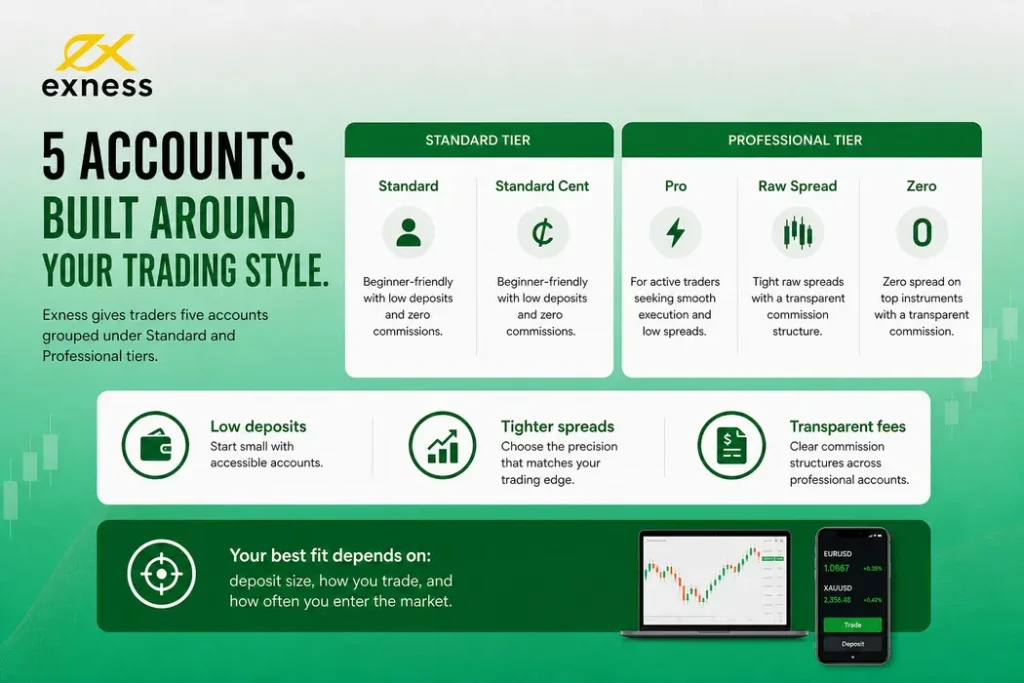
Exness organizes its accounts into two tiers: Standard and Professional. The Standard tier (Standard and Standard Cent) suits traders early in their journey or those who prefer simplicity. The Professional tier (Pro, Raw Spread and Zero) offers different pricing and execution options.
Each account type has its own spread model, execution type, commission and minimum deposit, so your choice directly affects what you pay per trade and how your orders are filled. The figures below come from Exness’s own account pages, checked on 30 September 2026. For a broader look at the broker itself, see our full Exness review.
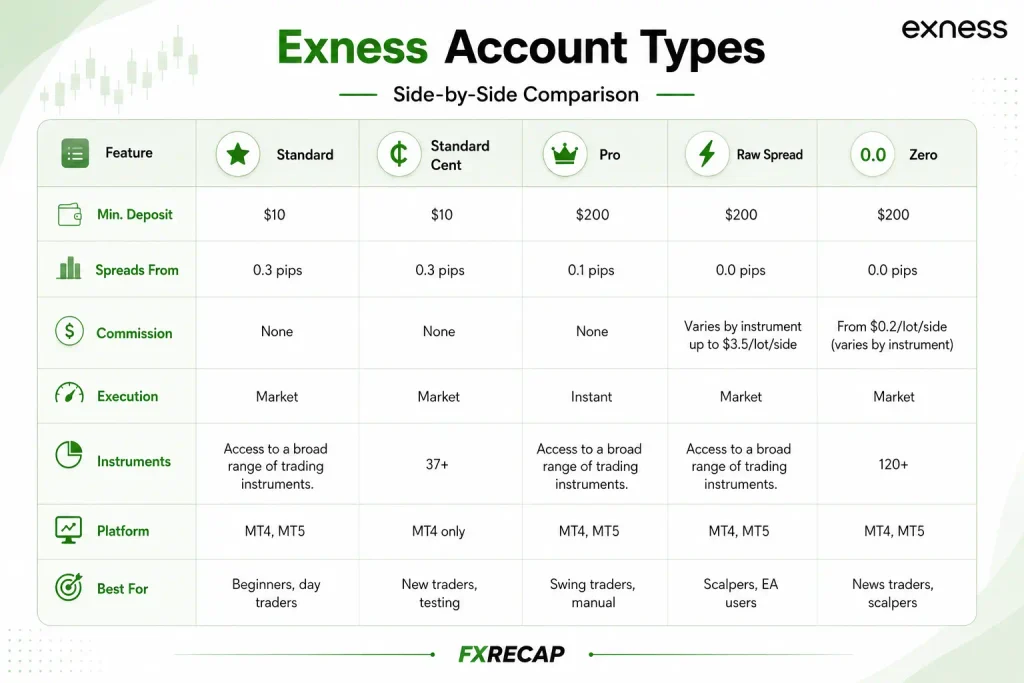
Account Types Comparison
| Feature | Standard | Standard Cent | Pro | Raw Spread | Zero |
| Min. Deposit* | $10 | $10 | $200 | $200 | $200 |
| Spreads From | 0.2 pips | 0.3 pips | 0.1 pips | 0.0 pips | 0.0 pips (top 30 instruments) |
| Commission | None | None | None | Up to $3.50 per side per lot | From $0.05 per side per lot |
| Execution | Market | Market | Instant (market for crypto) | Market | Market |
| Instruments | Forex, metals, crypto, energies, stocks, indices | 26 FX pairs, gold, silver, BTC, ETH | Forex, metals, crypto, energies, stocks, indices | Forex, metals, crypto, energies, stocks, indices | Forex, metals, crypto, energies, stocks, indices |
| Max Leverage | Unlimited | Unlimited | Unlimited | Unlimited | Unlimited |
| Margin Call / Stop Out | 60% / 0% | 60% / 0% | 30% / 0% | 30% / 0% | 30% / 0% |
| Demo Available | Yes | No | Yes | Yes | Yes |
| Best For | Beginners, day traders | New traders, testing | Swing traders, manual | Scalpers, EA users | News traders, scalpers |
*Note: Standard and Standard Cent accounts have no fixed minimum beyond your payment method’s own minimum, which varies by region ($10 is the figure on Exness’s South African site). Pro, Raw Spread and Zero need a first deposit from $200, depending on region. For a detailed breakdown, check our guide on Exness minimum deposit.
1. Standard Account
Exness calls the Standard account its most popular account. It charges no commission, spreads start from 0.2 pips, and it covers forex, metals, cryptocurrencies, energies, stocks and indices. We break down spread data across all tiers in our Exness spreads guide.
Exness says the Standard account offers more than 120 currency pairs and instruments. Orders use market execution, so there are no requotes, although slippage can occur. The margin call level is 60% and the stop-out level is 0%, and swap-free status applies to the listed instruments.
Works well for: Beginners moving beyond demo, day traders who prefer simple cost structures, and anyone who wants broad instrument access without worrying about separate fees.
2. Standard Cent Account
The Standard Cent account is the only Exness account that uses cent lots: 1 cent lot equals 0.01 of a standard lot, and the balance is shown in cents, so a $5 deposit appears as 500 USC. Spreads start from 0.3 pips, there is no commission and orders use market execution.
The instrument range is narrower than on the Standard account: 26 currency pairs, gold, silver, and BTC and ETH (MT5 only). It runs on MT4 and MT5, the margin call level is 60%, and it is the only Exness account type without a demo version.
Commonly used by traders who want to practise live trading with smaller position sizes, people testing new strategies under real conditions, and anyone with a small starting balance who wants to limit the downside while still trading with real money.
3. Pro Account
The Pro account is part of the Professional tier. It charges no commission and spreads start from 0.1 pips.
The main difference is execution. The Pro uses instant execution for forex, metals, energies, stocks and indices: your order fills at the price you requested, or you receive a requote if the price has moved. Cryptocurrencies, and a selection of currencies, use market execution instead.
You need $200 to open it, and it covers forex, metals, cryptocurrencies, energies, stocks and indices. If gold is part of your strategy, our guide to trading gold on Exness covers the specifics.
Often chosen by traders who want commission-free pricing with tighter spreads and price certainty on each fill.
4. Raw Spread Account
Exness describes the Raw Spread account as its lowest-spread account with a fixed commission per lot. Spreads start from 0.0 pips.
The commission is up to $3.50 per side per lot (up to $7 round trip), depending on the instrument. For scalpers and algorithmic systems that open and close many positions, paying a commission on tight spreads can cost less than paying through wider spreads, depending on volume. Orders use market execution, so there are no requotes.
The minimum deposit is $200, the margin call level is 30% and the stop-out level is 0%.
Suitable for traders who prefer raw spreads with a transparent commission, high-frequency and algorithmic traders, and EA developers.
5. Zero Account
The Zero account offers zero spreads on its top 30 instruments 95% of the day, and on its other instruments 50% of the day, according to Exness; spreads can rise above zero during high volatility, news and rollovers. For a deeper look, see our Exness zero spread account breakdown.
Instead of a spread markup, there is a commission from $0.05 per side per lot, varying by instrument. Orders use market execution with no requotes. The minimum deposit is $200, and swap-free trading is available.
Ideal for: Traders who want predictable zero spreads on the most traded instruments and are comfortable paying a per-lot commission.
How to Pick the Right One
Choosing the right account mainly depends on three factors: how much capital you are starting with, your trading strategy, and whether you prefer paying through spreads or through a separate commission.
| Your Situation | Best Match | Reason |
| Limited live trading experience, small budget | Standard Cent | Micro lots, $10 entry |
| A standard live account with low capital | Standard | No commission, $10 entry, full instrument range |
| Experienced, trades manually | Pro | Tight pricing, no commission, instant execution |
| Scalps or runs automated systems | Raw Spread | Spreads from 0.0 pips, market execution |
| Trades the most active instruments around volatile events | Zero | 0.0 pips on the top 30 instruments 95% of the time |
Details That Most Guides Leave Out
Running More Than One Account
Exness lets you open more trading accounts from your Personal Area, so you could run a Raw Spread account for scalping and a Pro account for longer-term trades at the same time. Keeping strategies in separate accounts makes each one easier to track. If you have not set up your first account yet, our step-by-step guide to opening an Exness account walks through the process.
Demo Access Across All Tiers
Demo accounts are available for every account type except Standard Cent. When you register, Exness gives you an MT5 demo account with $10,000 in virtual funds by default, and you can change the balance with ‘Set Balance’ in your Personal Area or the Exness Trade app. MetaTrader demo accounts are deleted after a period of inactivity. We cover the full setup in our Exness demo account guide.
Swap-Free (Islamic) Status
Swap-free status applies to your whole Personal Area, so every account type shares it. It covers the FX majors, 21 minors, USDZAR, USDTHB, gold, silver, platinum, oil, and all cryptocurrencies and indices, and Exness can remove it if you regularly hold large positions overnight. Clients registered in Islamic countries get swap-free status on all instruments automatically. Our detailed Exness Islamic account guide explains how it works.
Leverage and Stop Out Levels
All five account types can use unlimited leverage, but only on forex majors and minors and gold and silver, and only on accounts with equity under $5,000 that have closed at least 10 orders totalling 5 lots. Otherwise the maximum is 1:2000 below $30,000 of equity, 1:1000 below $100,000 and 1:500 above that, and other instruments have fixed caps, such as 1:400 on US30 and 1:20 on most stock CFDs. Margin call is at 60% on Standard and 30% on the Professional accounts, and the stop-out level is 0% (it can rise to 100% on stocks when market risk increases, and it is 20% for clients of the Kenyan and Jordanian companies). For more, read our Exness unlimited leverage breakdown.
Funding and Withdrawals
Exness charges no deposit or withdrawal fees of its own, though third-party fees may apply. It offers global and local payment methods that vary by country, and the methods, limits and processing times for your country are shown in your Personal Area. Exness says over 98% of withdrawals are processed automatically, 24/7. We test withdrawal speeds in our Exness instant withdrawal review.
Regulation: Where Your Account Actually Sits
Exness’s group companies hold licences from 11 regulators, including the FSA (Seychelles), FSCA (South Africa), CMA (Kenya), CySEC (Cyprus) and the FCA (UK). The CySEC and FCA companies do not serve retail clients, so the company that holds your account depends on where you live; on Exness’s South African site, for example, accounts are registered with Exness (SC) Ltd in Seychelles. We dig into what this means for your funds in our is Exness a legit broker analysis.
This matters because investor protection differs between regulators. Negative Balance Protection applies, but compensation and dispute resolution differ: Exness is a member of the Financial Commission, whose fund covers its judgments up to €20,000 per client. Check which company holds your account before depositing.
FAQs
How many accounts does Exness offer?
Five: Standard, Standard Cent, Pro, Raw Spread and Zero, plus demo accounts.
What is the smallest deposit to get started?
Standard and Standard Cent have no fixed minimum beyond your payment method’s own minimum ($10 on Exness’s South African site). The Professional tier (Pro, Raw Spread, Zero) needs a first deposit from $200, depending on region.
Which account may have lower trading costs?
That depends on volume. Low-volume traders may prefer the Pro (no commission, spreads from 0.1 pips). High-volume traders and scalpers may pay less on Raw Spread (from 0.0 pips plus up to $3.50 per side per lot) or Zero.
Can I change my account to a different type?
You can open additional accounts of any type from your Exness Personal Area, so the simplest way to switch is to open a new account of the type you want.
Does Exness provide ECN accounts?
No. Exness says it does not provide ECN accounts. Raw Spread and Zero are its raw-pricing accounts with a per-lot commission.
Can I open a Standard Cent demo account?
No. Exness offers demo accounts for every account type except Standard Cent.
Do any accounts produce requotes?
Only the Pro, which uses instant execution for most instruments. If the price moves before your order is filled, you may get a requote. The other four account types use market execution, so there are no requotes, though slippage is possible.
Does Exness support social or copy trading?
Not any more. Exness closed its Copy Trading service on 25 June 2026, when all existing strategies and investments were closed. We cover the details in our Exness social trading guide.
Should beginners open a Professional tier account?
Beginners may prefer to start on Standard or Standard Cent before moving to a Professional account. The Professional tier assumes you understand commissions, leverage settings and how different execution models affect your trades.
Final Word from FX Recap
There is no single “best” account on Exness. The right pick lines up with where you are right now: your capital, your skill level, and the strategy you are running. If you are still learning, Standard or Cent keeps the experience simple and the costs low. If you trade actively and every fraction of a pip counts, Pro, Raw Spread, or Zero gives you the pricing and execution precision that directly impacts your results.
Start with a demo. Run your strategy on it. See how it feels under that specific set of conditions. Then fund a live account once you are confident in the fit.
The team behind this guide
Researched, checked and approved by five forex specialists
Every guide is written, fact-checked and edited before it goes live, and updated when the facts change. Spotted an error? Tell us.
Related Articles
 Brokers
10 min read
Brokers
10 min read

 Brokers
10 min read
Brokers
10 min read
 Brokers
10 min read
Brokers
10 min read
 Brokers
11 min read
Brokers
11 min read
 Brokers
15 min read
Brokers
15 min read
 Brokers
9 min read
Brokers
9 min read