

 EUR/USD
  GBP/USD
  USD/ZAR
  EUR/INR
  EUR/GBP
  XAU/USD (Gold)
  XAG/USD (Silver)
  XM Global
  AvaTrade
  RoboForex
  IC Markets
  LiteFinance
  IUX Markets
  FP Markets
  South Africa
  Thailand
  Singapore
  Japan
Japan  Pakistan
  Malaysia
  Philippines
  Brazil
  Bangladesh
  Vietnam
  India
India 
Exness Minimum Deposit
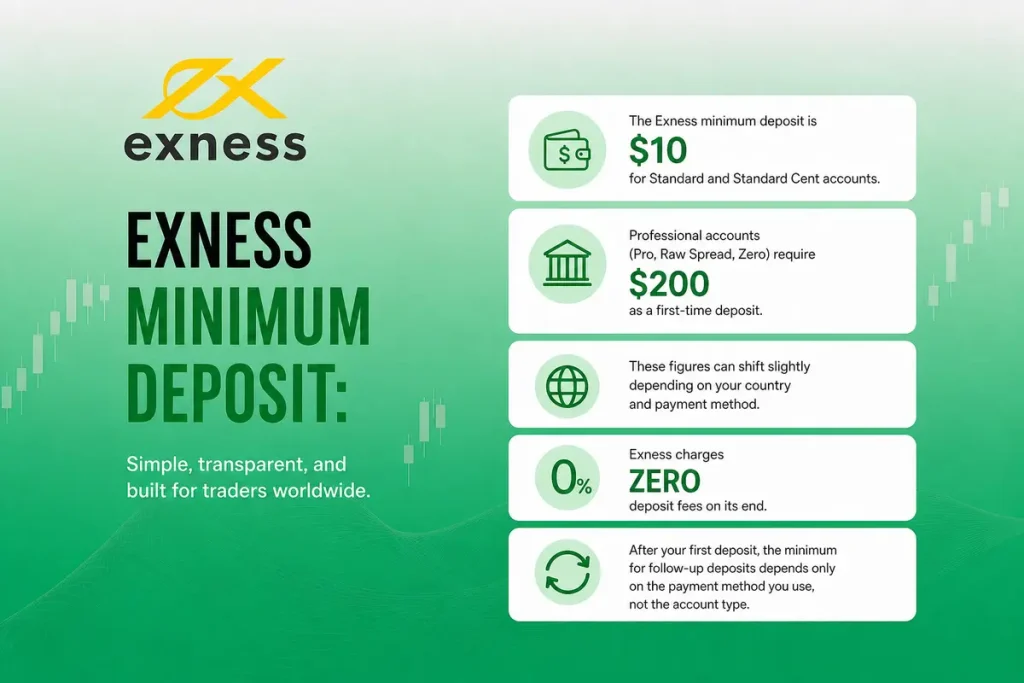
The Exness minimum deposit is $10 for Standard and Standard Cent accounts. Professional accounts (Pro, Raw Spread, Zero) require $200 as a first-time deposit. These figures can shift slightly depending on your country and payment method. Exness charges zero deposit fees on its end. After your first deposit, the minimum for follow-up deposits depends only on the payment method you use, not the account type.




The minimum deposit is often the first number traders look at when picking a broker, and for good reason. It determines whether you can even get started. Exness keeps the barrier low for beginners and sets a higher floor for professional accounts where tighter spreads and faster execution justify the difference. This article breaks down the exact deposit requirements for every account type, how payment methods affect the minimum, what changes by region, and how much you realistically need to trade properly. For a broader look at the broker, see our full Exness review.
Minimum Deposit by Account Type
Exness offers five account types across two tiers: Standard and Professional. Each carries a different first-time deposit requirement. We cover the full feature comparison in our Exness account types guide. Here is the deposit-specific breakdown.
| Account | First Deposit | Spreads From | Commission | Target Trader |
| Standard | $10 | 0.3 pips | None | Beginners, day traders |
| Standard Cent | $10 | 0.3 pips | None | New traders, micro-lots |
| Pro | $200 | 0.1 pips | None | Swing/day traders |
| Raw Spread | $200 | 0.0 pips | Up to $3.5/lot | Scalpers, EA users |
| Zero | $200 | 0.0 pips | From $0.2/lot | News/volatility traders |
A few important details from the Exness Help Center that most articles miss. The first deposit must be made in a single transaction. You cannot make several smaller deposits that add up to the minimum. However, after the first deposit is completed, follow-up deposits only need to meet the payment method minimum, which is often much lower. Also, internal transfers between your Exness accounts count toward meeting the first deposit requirement. So if you already have a funded Standard account and want to open a Pro account, you can transfer $200 internally without making a new external deposit.
First Deposit vs. Follow-Up Deposits
This distinction catches many new traders off guard. The $10 or $200 figure only applies to the very first deposit into a specific account type. Once that threshold is met, every deposit after it follows the payment method minimum instead.
For example, if you open a Standard account and deposit $10 through a bank card to meet the first deposit requirement, your second deposit through the same card could be as low as $3 to $5 depending on the card provider and your region. E-wallet deposits after the first one can go as low as $1 in some cases.
This means the initial barrier is a one-time hurdle, not a recurring one. After your first deposit, you have flexibility to add smaller amounts whenever you want.
How Payment Methods Affect the Minimum
The deposit minimum is not just about the account type. Each payment method available in your Exness Personal Area carries its own floor, and you must meet whichever is higher: the account minimum or the payment method minimum.
| Payment Method | Typical Minimum | Processing Time | Fees (Exness Side) |
| Bank Card (Visa/MC) | $10 to $20 | Instant | None |
| E-wallets (Skrill, Neteller) | $1 to $10 | Instant | None |
| Perfect Money | $1 to $10 | Instant | None |
| Crypto (BTC, USDT, ETH) | $10 to $50 | 5 to 60 minutes | None (network fees apply) |
| Local Bank Transfer | Varies by country | 1 to 3 business days | None |
| Binance Pay | $1 to $10 | Near instant | None |
These are typical ranges. The exact figures depend on your country, the currency you deposit in, and the specific provider. Exness displays the applicable minimum for each method directly in your Personal Area when you click “Deposit.”
Does the Minimum Change by Country?
Yes. Exness adjusts first-time deposit requirements by region. In most countries, the $10 Standard and $200 Professional thresholds apply. But in some regions, the numbers shift.
In India, local options like UPI and Netbanking can accept deposits as low as the equivalent of $1 (around 100 INR). In Nigeria, Flutterwave and local bank transfers often start from 500 NGN. In Kenya, MPesa deposits begin at around 150 KES. In Vietnam and Indonesia, internet banking and local e-wallets support deposits from the equivalent of roughly $1. In the UAE and Qatar, international wire transfers may require higher minimums.
The professional tier ($200 for Pro, Raw Spread, and Zero) remains consistent across most regions, though currency equivalents fluctuate with exchange rates. Always check the exact amount in your Personal Area, as Exness displays it in your local currency based on your registered country.
How Much Should You Actually Deposit?
Meeting the minimum is one thing. Having enough to trade properly is another. The $10 Standard minimum gets your account open, but it does not give you much room for risk management.
For forex pairs: A 0.01 lot position on EUR/USD requires roughly $1 to $2 in margin at high leverage. Each pip movement equals about $0.10. A $10 balance gives you very little room for a stop loss before your account is at risk. Depositing $50 to $100 provides more breathing space for proper position management.
For gold (XAUUSD): A 0.01 lot gold position requires around $2 to $5 in margin at 1:1000 leverage, and each $1 move in gold price equals $1 in profit or loss. Gold regularly swings $20 to $50 per session, so even a micro lot can move your balance significantly. A $50 to $100 starting balance is more realistic. Our XAUUSD trading guide covers lot sizing in detail.
For professional accounts: The $200 minimum is enough to start, but traders using Raw Spread or Zero accounts typically deposit $500 to $1,000 to take full advantage of the tighter spreads and commission structures. The lower cost per trade only matters if your account is large enough to support multiple positions with proper stop losses.
How to Make Your First Deposit
The deposit process takes about two minutes once your account is verified. If you have not completed verification yet, our Exness account opening guide walks through every step.
Step 1: Log in to your Exness Personal Area on web or the Exness Trader App.
Step 2: Click “Deposit” next to the account you want to fund.
Step 3: Select your payment method from the list. Exness shows available options based on your country.
Step 4: Enter the amount (at or above the minimum for your account type and payment method).
Step 5: Confirm the transaction. Most methods process instantly. Your trading balance updates within seconds.
One tip that saves money: deposit in the same currency as your account base currency. If your account is set to BDT and you deposit in BDT, you avoid the conversion fee that Exness charges when currencies do not match. This fee is displayed on the deposit screen before you confirm, so you can always check before proceeding.
Not Ready to Deposit? Start with a Demo
If you want to explore the platform without committing any funds, Exness provides free demo accounts with $10,000 in virtual money. No deposit or verification is required. You can trade under live market conditions and test your strategy risk-free. Our Exness demo account guide explains how to set it up.
Does the Zero Spread Account Need a Higher Deposit?
No. All three professional accounts (Pro, Raw Spread, and Zero) share the same $200 first-time deposit requirement. Some older articles online list different figures, but the current threshold confirmed by the Exness Help Center is $200 across the board. The difference between these accounts is not the deposit but the spread model, commission structure, and execution type. We compare all three in our Exness zero spread account breakdown.
What About Withdrawals?
Exness charges zero fees on withdrawals. Over 98% of withdrawal requests are processed automatically, and most complete within seconds to a few minutes. The minimum withdrawal depends on the payment method (as low as $1 for some e-wallets). Withdrawals go back to the original deposit method first, up to the deposited amount. Profits above the deposit can be withdrawn through any available method. We test real withdrawal speeds in our Exness instant withdrawal review.
How Does Leverage Relate to Your Deposit?
Higher leverage means you need less margin per trade, which effectively stretches your deposit further. At 1:100 leverage, a 1 standard lot EUR/USD trade requires about $1,000 in margin. At 1:1000, the same trade requires roughly $100. Exness offers leverage up to 1:Unlimited for qualified traders. But higher leverage also amplifies losses. A $10 deposit at 1:2000 leverage gives you the ability to open positions your balance cannot absorb. This is why realistic deposit sizing matters more than the official minimum. For full eligibility details, see our Exness unlimited leverage guide.
Do Swap-Free Accounts Have Different Deposit Requirements?
No. The deposit requirements for swap-free (Islamic) accounts match the regular versions. A Standard Islamic account needs $10, and a Professional Islamic account needs $200. The swap-free feature simply removes overnight interest charges without affecting the deposit structure. More details are in our Exness Islamic account guide.
Frequently Asked Questions
What is the absolute minimum to start trading on Exness?
$10 on a Standard or Standard Cent account, deposited through a method that supports that threshold. Some e-wallets accept even lower amounts for follow-up deposits.
Can I deposit less than $200 on a Pro account?
No. The first deposit on Pro, Raw Spread, and Zero accounts must be at least $200 in a single transaction. After that, subsequent deposits follow the payment method minimum.
Does Exness charge deposit fees?
Exness charges zero fees on all deposits from its end. Your bank, card issuer, or e-wallet provider may apply their own charges. A currency conversion fee applies if your deposit currency does not match your account base currency.
Can I split my first deposit into multiple smaller payments?
No. The first deposit must meet the minimum in a single transaction. You cannot make three deposits of $70 to reach $200, for example.
What happens if I deposit less than the minimum?
Trading will remain disabled on that account until the first deposit requirement is met. You will see a “Trade is disabled” error if you try to open a position.
Can I transfer funds between accounts instead of depositing externally?
Yes. Internal transfers between Exness accounts count toward the first deposit requirement. If you already have $200 in a funded Standard account, you can transfer that amount to activate a new Pro account without making another external deposit.
Can I copy other traders with just $10?
Exness social trading requires a separate funded account. The minimum to join as a copier depends on the social trading terms, which may differ from regular trading accounts. See our Exness social trading guide for specifics.
Is Exness safe to deposit money with?
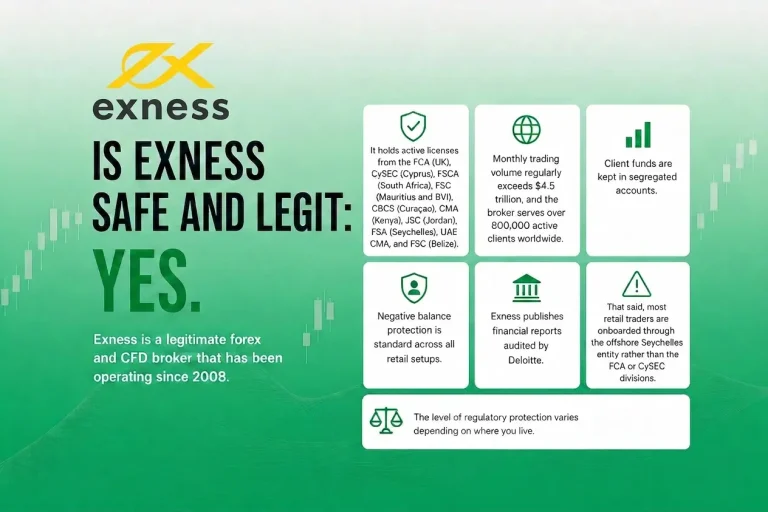
Exness is regulated by the FCA, CySEC, FSA (Seychelles), and FSCA (South Africa). Client funds are held in segregated accounts with negative balance protection across all tiers. We analyze what this means for your money in our is Exness legit review.
Final Word from FX Recap
The Exness minimum deposit is genuinely low. Ten dollars gets you into a Standard account, and $200 unlocks professional-grade pricing. But the minimum to open an account and the minimum to trade responsibly are two different numbers. A $10 balance on a live account barely covers a single stop loss on most instruments. If you are serious about learning and not just testing, $50 to $100 on a Standard account or $500 on a Pro or Raw Spread account gives you the margin to actually practice proper risk management.
Start with a demo if the deposit feels like a stretch. Exness makes that free with $10,000 in virtual funds. Once your demo results look consistent, fund a live account with an amount you can afford to lose entirely, and trade at the same lot sizes you practiced with. That is the straightforward path from minimum deposit to real trading.

FX Recap helps you find a trusted forex broker that keeps your trades secure and guides you through everything you need to know about FX instruments.

Ranjan Niskrity is a seasoned Crypto and Forex expert at FX Recap with over a decade of market experience. He specialises in verifying broker data, regulatory frameworks, and cryptocurrency trading insights. His rigorous fact-checking ensures every article meets the highest standards of accuracy.
Related Articles
 Brokers
14 min read
Brokers
14 min read

 Brokers
11 min read
Brokers
11 min read
 Brokers
11 min read
Brokers
11 min read
 Brokers
10 min read
Brokers
10 min read
