 IC Markets




































Exness Spreads Explained
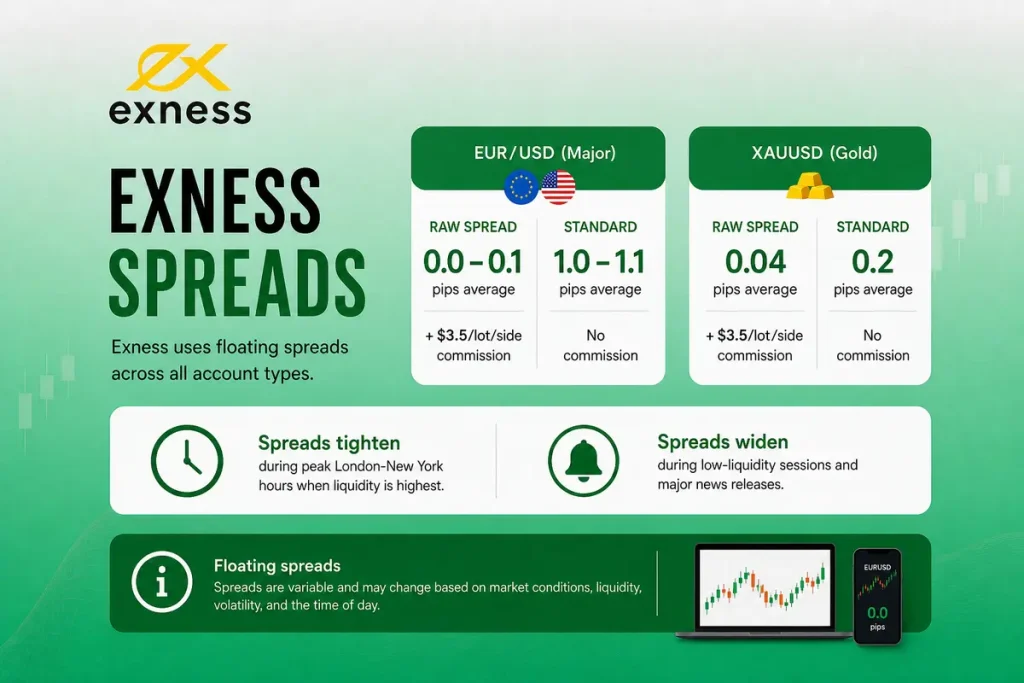
Exness uses floating spreads, with stable spreads nearly 90% of the time on ten major instruments outside volatile periods. Exness’s published previous-day averages on 30 September 2026 put EUR/USD at 0.8 pips on Standard, 0.6 pips on Pro and 0.0 pips on Raw Spread (plus $2.50 commission per side). Spreads usually narrow in liquid sessions and widen around news and at market open and close.
On the Standard account, the same pair sits around 1.0 to 1.1 pips with no commission. Gold spreads are generally lower on Raw Spread accounts than on Standard accounts, although actual averages vary with market conditions.
Spreads usually narrow during highly liquid trading sessions and may widen during major economic events or periods of lower market liquidity.
 WriterAbir KhanWriterWrites the guides · checks every figure against primary sources View profileAbout Abir →
 Market analysisTanbir Habib RiyadForex & Crypto AnalystForex and crypto analyst · technical and fundamental analysis View profileAbout Tanbir →
 Fact-checking & riskJannatul FerdaushFact-Checker & Risk AnalystFact-checks every figure · risk analysis · Applied Statistics, University of Dhaka View profileAbout Jannatul →
 Trading reviewJowel RanaCo-Founder & Forex TraderCo-founder · forex trader · reviews guides from a trader's view View profileAbout Jowel →
 Final approvalRanjan NiskrityFounder, Owner & Forex TraderFounder and owner · forex trader · signs off every guide View profileAbout Ranjan →
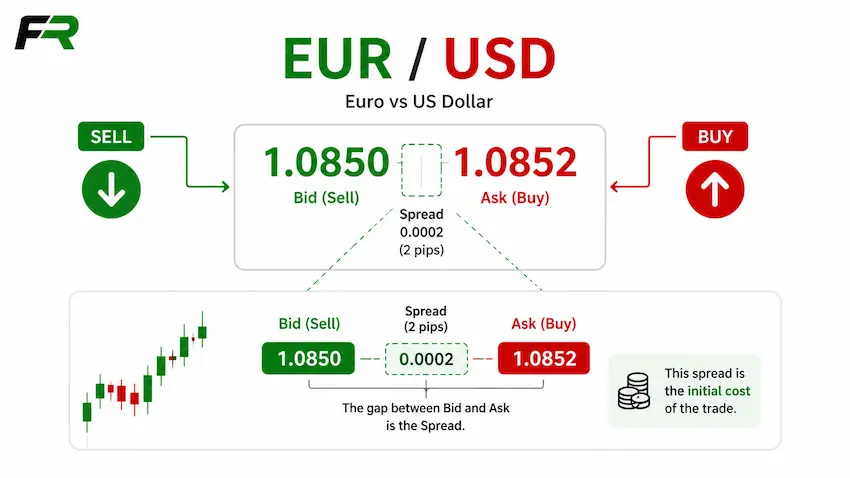
A spread is the gap between the price you can buy at (ask) and the price you can sell at (bid). If EUR/USD shows a bid of 1.10500 and an ask of 1.10510, the spread is 1 pip. Exness gives its own example: a bid of 1.11113 and an ask of 1.11125 is a spread of 1.2 pips.
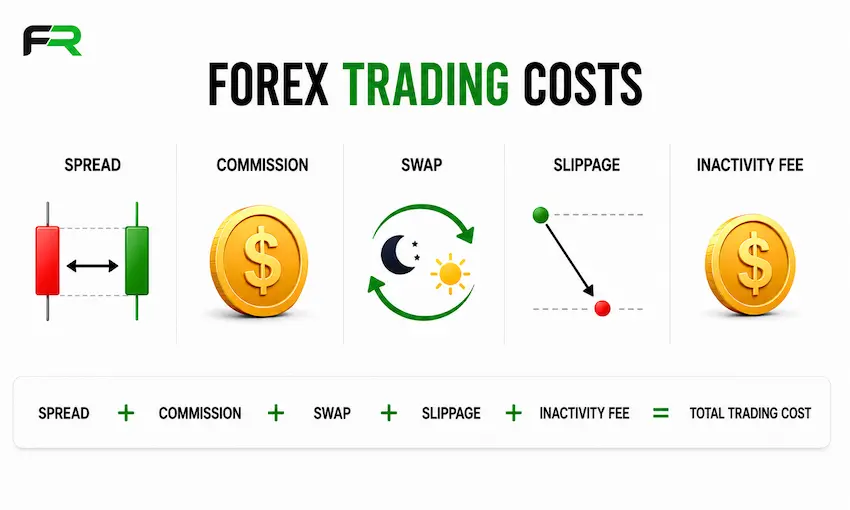
The spread is one of the main trading costs: every new trade starts with it already reflected in the profit or loss. On a 1 standard lot EUR/USD trade, a 1.0 pip spread costs $10 and a 0.1 pip spread costs $1. The difference looks small, but it adds up quickly if you trade often.
On Exness, the spread is either the only trading cost (Standard, Standard Cent and Pro accounts) or it sits alongside a per-lot commission (Raw Spread and Zero accounts). Your total cost per trade is the spread plus any commission, and the cheapest account depends on how often you trade, what you trade and your strategy.
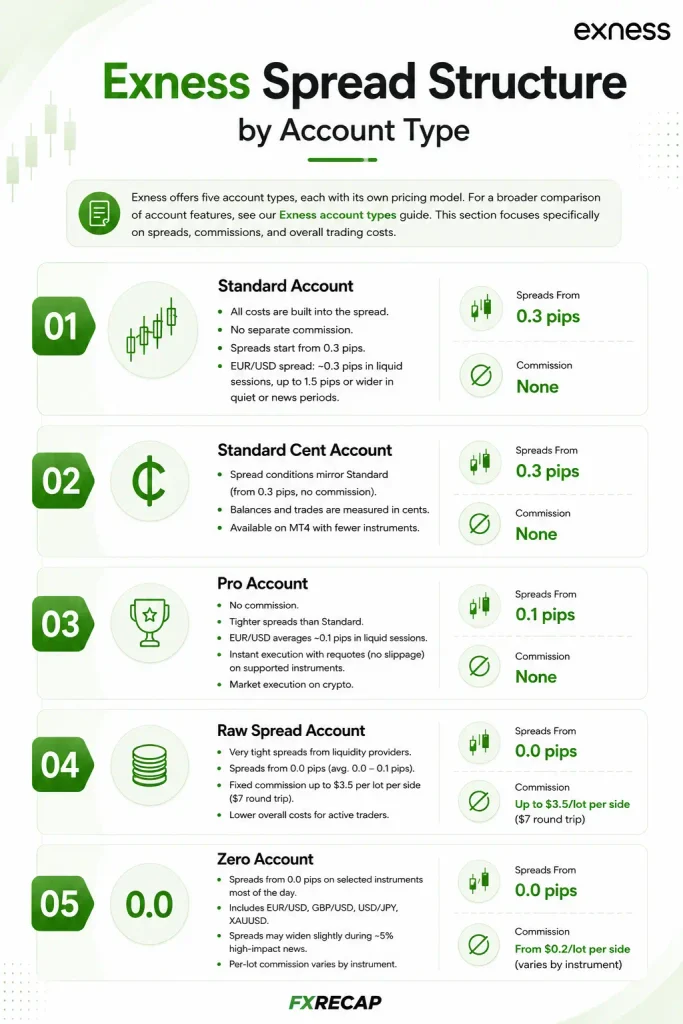
Exness Spread Structure by Account Type
Exness offers five account types, each with its own pricing model. For a full comparison of account features, see our Exness account types guide. This section focuses on spreads and commissions.
Standard Account
The Standard account builds all trading costs into the spread, with no separate commission. Spreads start from 0.2 pips. Exness’s published previous-day average for EUR/USD on 30 September 2026 was 0.8 pips, and spreads widen during quiet hours and around news.
Many beginners and occasional traders prefer this model because the cost is all in the spread, which makes it easy to work out. Active traders may find a commission-based account cheaper overall.
Standard Cent Account
Standard Cent also has no commission, with spreads from 0.3 pips. Balances and trades are in cents, so each pip is worth much less. It covers 26 currency pairs, gold, silver, and BTC and ETH, and runs on both MT4 and MT5 (BTC and ETH on MT5 only).
Pro Account
The Pro account charges no commission and has tighter spreads than Standard, from 0.1 pips; Exness’s previous-day average for EUR/USD on 30 September 2026 was 0.6 pips. It uses instant execution for forex, commodities, stocks and indices: if the price moves before your order is filled, you get a requote instead of a fill at a different price. Crypto uses market execution.
Raw Spread Account
The Raw Spread account starts from 0.0 pips and adds a fixed commission of up to $3.50 per side per lot, which varies by instrument. On 30 September 2026, Exness listed EUR/USD at a 0.0 pip previous-day average with a $2.50 commission per side, so a round-turn lot cost about $5 in commission.
Zero Account
The Zero account offers 0.0 pip spreads on its top 30 instruments 95% of the day, and on other instruments 50% of the day, according to Exness. Spreads can rise above zero during high volatility, news and rollovers. We go deeper in our Exness zero spread account breakdown.
Instead of a spread markup, Zero charges a commission that varies by instrument, from $0.05 per side per lot. Check the rate for your instrument before trading; on gold, for example, Exness listed $5.50 per side on 30 September 2026.
What Do Spreads Actually Look Like? Instrument-by-Instrument
The table shows Exness’s own published average spreads for the previous trading day, read on 30 September 2026. Live spreads change constantly, so treat these as a snapshot. Raw Spread figures are the spread plus the commission per side per lot.
| Instrument | Standard | Pro | Raw Spread |
| EUR/USD | 0.8 | 0.6 | 0.0 + $2.50 |
| GBP/USD | 1.0 | 0.7 | 0.1 + $2.50 |
| USD/JPY | 1.0 | 0.7 | 0.0 + $2.50 |
| AUD/USD | 0.9 | 0.6 | 0.1 + $2.50 |
| USD/CAD | 1.4 | 1.0 | 0.0 + $3.50 |
| EUR/GBP | 1.3 | 0.9 | 0.3 + $3.50 |
| GBP/JPY | 2.2 | 1.6 | 0.3 + $3.50 |
| XAU/USD (gold) | 24 | 16.8 | 8 + $3.50 |
Note: Spreads are in pips as Exness publishes them; for gold, Exness quotes spreads in its own pip units. On the Zero account, Exness’s gold average was 4 with a $5.50 commission per side. For gold-specific conditions, see our guide to trading gold on Exness.
How Does Exness Compare to the Industry?
We only use brokers’ own published figures, so here is what Exness itself claims, with its stated basis. Exness says its Pro account spreads were 50% lower than the average spreads of 15 other brokers on 28 FX majors and minors in the week of 5 to 10 April 2026, comparing the tightest spread-only accounts. These are Exness’s own measurements, so treat them as marketing claims rather than independent tests.
The fairest check is your own: compare the spread plus commission on the instruments you trade, together with swaps and payment fees, on each broker’s official site. Our full Exness review also covers execution, regulation, platforms and withdrawals.
Calculating Your Real Cost Per Trade
On commission accounts, the spread is only part of the cost. Here is the cost of one standard lot of EUR/USD on each account, using Exness’s previous-day averages from 30 September 2026.
| Account | EUR/USD Spread | Commission (round trip) | Spread Cost | Total per Lot |
| Standard | 0.8 pip | $0 | $8.00 | $8.00 |
| Pro | 0.6 pip | $0 | $6.00 | $6.00 |
| Raw Spread | 0.0 pip | $5.00 | $0.00 | $5.00 |
| Zero | 0.0 pip most of the day | Varies (from $0.10) | $0.00 | Depends on the instrument’s commission |
On these figures, Raw Spread was the cheapest for EUR/USD, with Pro close behind and no commission to track. Real costs change every day with market conditions, and spreads on Pro and Standard can widen more during volatile periods.
When and Why Exness Spreads Widen
Exness uses dynamic (floating) spreads, plus stable spreads on some currency pairs. Exness names market volatility, news releases, unexpected economic events and markets opening or closing as the main reasons spreads widen.
Major economic news. Releases such as Non-Farm Payrolls, US inflation data and central bank decisions cause sharp moves and thinner liquidity, so spreads widen temporarily, even on Raw Spread and Zero accounts. Exness recommends watching its economic calendar to anticipate these periods.
Market open, close and rollover. Liquidity is lower around the daily rollover and when markets open or close, including the weekly reopening, so spreads tend to be wider then.
Exotic pairs and less liquid instruments. Majors are traded in large volumes and have narrow spreads, while exotics usually have wide spreads, whatever the account type.
What About Stable Spreads?
Exness says some instruments have stable spreads, which it calculates from the weighted average of the spread and ticks over a period, to give more predictable costs. These instruments offer stable spreads nearly 90% of the time, excluding periods of market volatility: EURUSD, XAUUSD, GBPUSD, USDJPY, GBPJPY, USDCAD, AUDUSD, USDCHF, EURJPY and EURGBP.
A stable spread is not a fixed spread. It can still widen during news or low liquidity, so check the live spread before you trade.
How to Check Exness Spreads in Real Time?
MetaTrader 4: Open the Market Watch window, right-click inside it and select Spread to add a spread column.
MetaTrader 5: Right-click in Market Watch, choose Columns, then Spread.
Exness Terminal (web): In your Personal Area, click Trade on any MT5 account and choose Exness Terminal. Under Instruments, click the three-dot icon and turn on Spread.
Exness trading calculator: Enter the account type, instrument, lot size and leverage to estimate the spread cost, margin, commission and swap before you open a position.
Which Spread Model Saves You the Most?
The best account depends on your trading style, how often you trade and your capital. Standard accounts need only the payment method’s minimum deposit, while Professional accounts need at least $200 depending on region.
Low-volume traders: The Pro account suits traders who want tighter spreads without a separate commission. The occasional requote from instant execution is the trade-off.
Active day traders and scalpers: Raw Spread or Zero. The commission is predictable and the spread is close to zero, so over 50 or 100 trades a week the savings against Standard add up.
Beginners with small accounts: Standard or Standard Cent. No commission and a low deposit keep things simple while you learn.
News and event traders: Zero may appeal to traders who want zero spreads on the most traded instruments, though spreads can rise above zero during high volatility. If you also trade gold at these times, our XAUUSD trading guide has timing advice.
Other Costs to Consider In Addition to Spreads
Swap (Overnight Fees)
Exness applies swap at 21:00 GMT in summer and 22:00 GMT in winter, Monday to Friday. The rate depends on the instrument and on whether you are long or short, and forex positions held over Wednesday night are charged triple swap (Thursday for USDCAD). All accounts start with swap-free (Islamic) status on a list of popular instruments, and Exness reserves the right to charge an administration fee on overnight orders depending on your trading activity.
Deposit and Withdrawal Fees
Exness charges no deposit or withdrawal fees of its own, though third-party payment providers may. It says over 98% of withdrawals are processed automatically. We test processing times in our Exness instant withdrawal review.
Inactivity and Account Fees
Exness charges no fees for inactive accounts or for reactivating archived accounts, and no fee to create trading accounts.
Does Leverage Affect Spreads?
No. Leverage changes the margin you need to open a position, not the spread, which comes from market conditions. For how leverage works on Exness, including higher margin requirements around news, see our Exness unlimited leverage guide.
Frequently Asked Questions
Does Exness offer fixed spreads?
No. Spreads are dynamic, but Exness offers stable spreads nearly 90% of the time, outside volatile periods, on EURUSD, XAUUSD, GBPUSD, USDJPY, GBPJPY, USDCAD, AUDUSD, USDCHF, EURJPY and EURGBP.
Why is my spread higher than what the website shows?
Exness’s website shows averages for the previous trading day. Live spreads change with market conditions, the time of day and your account type, so always check the platform before you trade.
Which account has the lowest spread?
Raw Spread and Zero both start from 0.0 pips. Raw Spread charges up to $3.50 per side per lot, depending on the instrument; Zero charges a commission from $0.05 per side that varies by instrument.
Do spreads widen during NFP or FOMC?
Yes. Exness lists news releases and market volatility as the main causes of wider spreads, and this applies to Raw Spread and Zero accounts too.
Are gold spreads competitive on Exness?
Gold (XAUUSD) is one of Exness’s stable-spread instruments. Its published previous-day averages on 30 September 2026 were 24 on Standard, 16.8 on Pro, 8 on Raw Spread (plus $3.50 per side) and 4 on Zero (plus $5.50 per side), in Exness’s gold pip units.
Can I test spreads before depositing real money?
Yes. Exness says demo trading conditions are the same as on real accounts. You get a demo with $10,000 in virtual funds when you register, and you can open demos for every account type except Standard Cent. Our Exness demo account guide explains the setup.
Is Exness a trustworthy broker?
Exness’s group companies hold licences from 11 regulators, including the FSA (Seychelles), FSCA (South Africa) and CMA (Kenya); its FCA and CySEC companies do not serve retail clients. We analyze what this means for your funds in our Exness legit review.
Does Exness have a social trading option?
Not any more. Exness closed its Copy Trading service on 25 June 2026, when all existing strategies and investments were closed. Details are in our Exness social trading guide.
Key Takeaways from FX Recap
Spreads are one of the most consistent trading costs, because every trade starts with them. On Exness’s own published figures, its pricing is tight across the board, and Raw Spread and Zero are built for active traders.
The right choice comes down to how often you trade and how. If you trade a few times a week, the Pro keeps costs low without a commission. If you scalp or run automated systems, Raw Spread or Zero may cost less, depending on volume.
If you are still learning, the Standard account keeps pricing simple. Testing spreads on a demo first helps you see real costs, and if you haven’t opened an account yet, our step-by-step account opening guide walks you through it.
The team behind this guide
Researched, checked and approved by five forex specialists
Every guide is written, fact-checked and edited before it goes live, and updated when the facts change. Spotted an error? Tell us.
Related Articles
 Brokers
10 min read
Brokers
10 min read

 Brokers
12 min read
Brokers
12 min read
 Brokers
14 min read
Brokers
14 min read
 Brokers
11 min read
Brokers
11 min read
 Brokers
15 min read
Brokers
15 min read
 Brokers
9 min read
Brokers
9 min read