

 EUR/USD
  GBP/USD
  USD/ZAR
  EUR/INR
  EUR/GBP
  XAU/USD (Gold)
  XAG/USD (Silver)
  XM Global
  AvaTrade
  RoboForex
  IC Markets
  LiteFinance
  IUX Markets
  FP Markets
  South Africa
  Thailand
  Singapore
  Japan
Japan  Pakistan
  Malaysia
  Philippines
  Brazil
  Bangladesh
  Vietnam
  India
India 
Exness Spreads Explained: Trading Costs Across Every Account Type
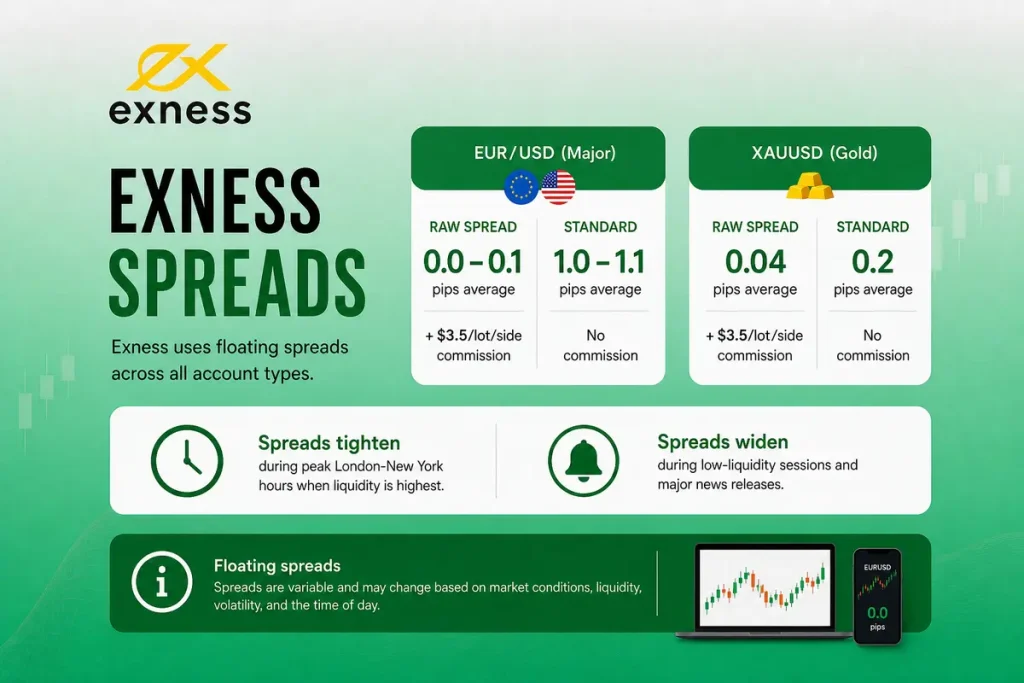
Exness primarily offers floating spreads, while selected instruments may benefit from its Stable Spread conditions under normal market circumstances. On the Raw Spread account, state that figures are typical examples or reference Exness published averages.
On the Standard account, the same pair sits around 1.0 to 1.1 pips with no commission. Gold spreads are generally lower on Raw Spread accounts than on Standard accounts, although actual averages vary with market conditions.
Spreads usually narrow during highly liquid trading sessions and may widen during major economic events or periods of lower market liquidity.




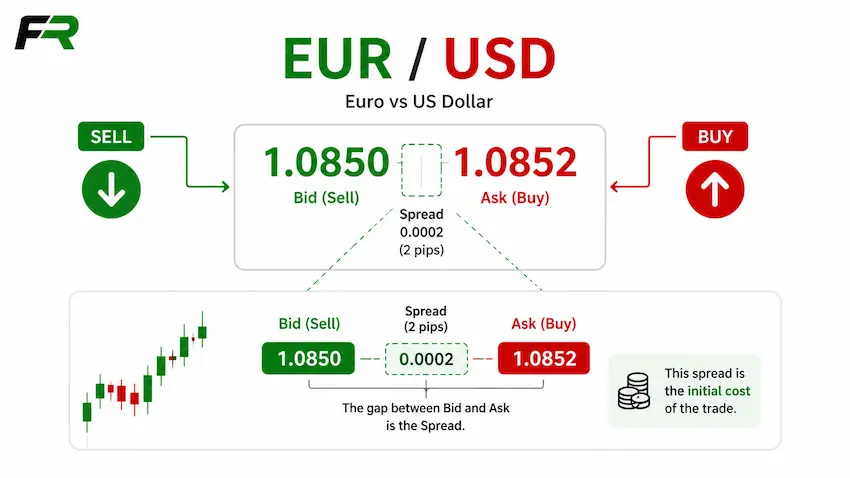
A spread is the gap between the price you can buy at (ask) and the price you can sell at (bid). If EUR/USD shows a bid of 1.1050 and an ask of 1.1051, the spread is 0.1 pips, or 0.00001 in price terms.
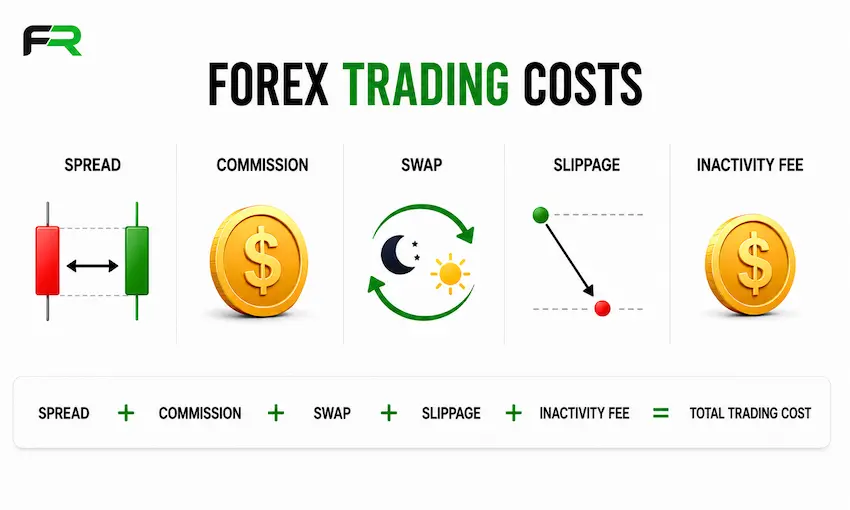
This difference represents one of the main trading costs. Every new trade begins with the spread already reflected in its profit or loss. On a 1 standard lot EUR/USD trade, a 1.0 pip spread costs you $10 upfront. A 0.1 pip spread costs $1. While the difference may appear small, frequent trading can significantly increase its overall impact.
On Exness, the spread is either the only trading cost (Standard and Pro accounts) or it sits alongside a separate per-lot commission (Raw Spread and Zero accounts). The total cost per trade is always spread plus commission and the most cost-effective account depends on your trading frequency, preferred instruments, and overall strategy.
Exness Spread Structure by Account Type
Exness offers five account types, each with its own pricing model. For a broader comparison of account features, see our detailed Exness account types guide. This section focuses specifically on spreads, commissions, and overall trading costs.
Standard Account
The Standard account embeds all trading costs into the spread. There is no separate commission. Spreads start from 0.3 pips and vary according to market conditions. The typical EUR/USD spread during active London-New York sessions hovers. During quieter Asian hours or around news releases, it can push to 1.5 pips or wider.
Many beginner and occasional traders prefer this pricing model because all trading costs are included in the spread. Since there is no separate commission, calculating trading costs is straightforward. However, active traders may find commission-based accounts more cost-effective under certain market conditions.
Standard Cent Account
Spread conditions mirror the Standard account (from 0.3 pips, no commission). The difference is that your balance and trades are measured in cents, so the dollar impact of each pip is much smaller. The Standard Cent account supports a smaller selection of instruments and is currently available on MT4.
Pro Account
The Pro account charges no commission either, but its spreads are noticeably tighter than Standard. EUR/USD typically averages around 0.1 pips during liquid sessions. The Pro account combines tighter spreads with instant execution on supported instruments. If the price moves before execution, you receive a requote instead of slippage. For crypto instruments, Exness applies market execution.
The Pro account may appeal to traders looking for tighter spreads without paying separate commissions.
Raw Spread Account
The Raw Spread account is designed to provide very tight spreads sourced from liquidity providers. The Raw Spread account is designed to offer very low spreads together with a fixed commission structure. Spreads start from 0.0 pips. The average sits around 0.0 to 0.1 pips across the full trading day.
The trade-off is a fixed commission of up to $3.5 per lot per side ($7 round trip). For a 1 lot EUR/USD trade with a 0.0 pip spread, your total cost is $7. Compared with spread-only accounts, commission-based pricing may reduce overall trading costs for active traders.
Zero Account
The Zero account is designed to provide spreads from 0.0 pips on selected instruments during much of the trading day. That includes EUR/USD, GBP/USD, USD/JPY, and XAUUSD. During the remaining 5% (typically around high-impact news), spreads may open up slightly. We go deeper on this account in our Exness zero spread account breakdown.
Instead of a spread markup, the Zero charges a per-lot commission that varies by instrument. For major forex pairs, it starts from $0.2 per side per lot. On other instruments, it can reach $3.5 or higher per side. Because commissions vary by instrument, traders should review the applicable rate before trading
What Do Spreads Actually Look Like? Instrument-by-Instrument
The figures below are representative examples based on published average spreads and may vary with market conditions. These examples are based on recent published spread data and independent broker comparisons. Live spreads fluctuate continuously as market liquidity changes throughout the trading day.
| Instrument | Standard | Pro | Raw Spread | Zero |
| EUR/USD | ~1.0 pip | ~0.1 pip | ~0.0 pip | 0.0 pip |
| GBP/USD | ~1.2 pips | ~0.2 pips | ~0.1 pip | 0.0 pip |
| USD/JPY | ~1.1 pips | ~0.1 pip | ~0.0 pip | 0.0 pip |
| AUD/USD | ~1.4 pips | ~0.3 pips | ~0.2 pips | ~0.1 pip |
| USD/CAD | ~2.1 pips | ~0.4 pips | ~0.3 pips | ~0.2 pips |
| XAU/USD (Gold) | ~0.2 pip | ~0.1 pip | ~0.04 pip | 0.0 pip |
| EUR/GBP | ~1.5 pips | ~0.3 pips | ~0.2 pips | ~0.1 pip |
| GBP/JPY | ~2.0 pips | ~0.5 pips | ~0.3 pips | ~0.2 pips |
Note: Spreads on the Zero account are 0.0 for the top 30 instruments about 95% of the time. Raw Spread and Pro figures are averages and can go lower or higher. Standard account spreads are the widest because all broker costs are baked in. For gold-specific conditions, see our guide to trading gold on Exness.
How Does Exness Compare to the Industry?
Independent comparisons provide additional context for evaluating Exness pricing. Traders Union reports that the average EUR/USD spread across 200+ brokers on ECN/Raw accounts is 0.17 pips. Published comparisons have shown Exness among the lower-spread brokers for major currency pairs during the measured period. BrokerChooser measured the XAUUSD spread at Exness at 0.04 pips versus a market average of 0.33 among 100+ brokers they track.
On Standard accounts, the comparison is closer to the middle of the pack. A 1.0 pip EUR/USD spread is competitive but not the lowest. Several brokers offer tighter Standard pricing, though they may charge in other ways (higher swap rates, deposit fees, or slower withdrawals). Overall trading costs should be evaluated by considering spreads, commissions, swaps, and other applicable fees.
If you want a broader assessment of the broker beyond just pricing, our full Exness review covers execution quality, regulation, platforms, and withdrawal speeds.
Calculating Your Real Cost Per Trade
Spread is only one component of total trading costs on commission-based accounts. Here is how to calculate the actual cost for a 1 standard lot trade on each account type.
| Account | EUR/USD Spread | Commission | Spread Cost | Total per Lot |
| Standard | 1.0 pip | $0 | $10.00 | $10.00 |
| Pro | 0.1 pip | $0 | $1.00 | $1.00 |
| Raw Spread | 0.0 pip | $7.00 RT | $0.00 | $7.00 |
| Zero | 0.0 pip | Varies | $0.00 | From ~$0.40 RT |
RT stands for round trip (open + close). Under the example shown, the Pro account has the lowest estimated trading cost. Actual costs vary with market conditions. However, these are ideal-condition numbers. In practice, Pro spreads can widen slightly more than Raw Spread during volatile periods because of the instant execution model. Many high-frequency traders prefer Raw Spread because of its pricing structure.
When and Why Exness Spreads Widen
Exness uses floating (dynamic) spreads on all accounts except certain stable-spread pairs. In practical terms the gap between bid and ask changes in real time based on what is happening in the market. Spreads commonly widen under the following market conditions.
Major economic news. Events like Non-Farm Payrolls (NFP), US CPI reports, and Federal Reserve interest rate decisions cause sharp price swings. Liquidity may decrease during major events, causing spreads to widen temporarily. Even on Raw Spread and Zero accounts, you will see a temporary spike during these moments. Exness provides an economic calendar that flags these events in advance.
Low-liquidity hours. The period after New York closes and before Asia fully opens (roughly 21:00 to 00:00 GMT) often have thinner order books. Spreads usually widen when fewer participants are quoting prices. Market liquidity is often lower around the daily rollover period, which may result in wider spreads.
Market open and weekend gaps. The first hour after forex markets reopen on Monday often shows wider spreads and potential gaps from weekend developments. Similarly, spreads tend to expand in the final hours of Friday trading as traders close positions before the weekend.
Exotic pairs and less liquid instruments. Major pairs like EUR/USD, GBP/USD, and USD/JPY generally provide the tightest pricing because they have the highest volume. Exotic pairs (USD/TRY, EUR/ZAR) and some crypto CFDs carry much wider spreads by nature, regardless of account type.
What About Stable Spreads?
Exness states that selected instruments benefit from Stable Spread conditions under normal market conditions. According to the broker, these pairs maintain consistent pricing close to 90% of the time, excluding periods of extreme volatility.
In practical terms the spread on EUR/USD will hover near the average more reliably than at brokers without this mechanism. It does not mean the spread is fixed. It can still widen during news or low-liquidity windows. But the return to typical levels often is faster, and the magnitude of the spike often is smaller. According to Exness, these conditions are designed to reduce spread fluctuations on selected instruments.
How to Check Exness Spreads in Real Time?
On MetaTrader 4: Open the Market Watch panel (Ctrl+M). Right-click inside the panel and select “Spread” to add a spread column. The number shown is in points (divide by 10 to get pips for 5-digit pairs).
On MetaTrader 5: Same method. Right-click in Market Watch, go to Columns, and enable Spread.
On Exness Terminal (Web): Log into your Personal Area, click “Trade” on any MT5 account, and select Exness Terminal. Under Instruments, click the three-dot icon and toggle “Spread” from the options.
Exness Trading Calculator: The Exness Trading Calculator is available through the broker’s official website. Enter your account type, instrument, lot size, and leverage to see estimated spread cost, margin, commission, and swap values. This is useful for planning trades before you open a position.
Which Spread Model Saves You the Most?
The most suitable account depends on your trading style, trading frequency, and available capital. The minimum deposit for Standard is $10 and $200 for professional accounts, so capital also plays a role.
Low-volume traders (fewer than 10 trades per week): The Pro account may suit traders who prefer lower spreads without separate commissions. You pay no commission, and the 0.1 pip average on EUR/USD is highly competitive at that frequency. The occasional requote from instant execution is a minor compromise.
Active day traders and scalpers: Raw Spread or Zero. The commission is predictable, and the near-zero spread means your orders fill closer to the market price. Over 50 or 100 trades per week, the savings compared to Standard add up fast.
Beginners with small accounts: Standard. The simplicity of no-commission pricing and the low deposit floor keep things straightforward while you learn.
News and event traders: The Zero account may appeal to traders seeking very low spreads on selected instruments. If you also trade gold during these sessions, our XAUUSD trading guide has specific timing advice.
Other Costs to Consider In Addition to Spreads
Swap (Overnight Fees)
If you hold a position past 22:00 GMT, Exness charges a swap. The rate depends on the instrument and whether your position is a buy or sell. Wednesdays carry a triple swap to cover the weekend. You can avoid swap charges entirely by activating swap-free (Islamic) status on your account.
Deposit and Withdrawal Fees
Exness does not generally charge deposit or withdrawal fees, although third-party payment providers may apply their own charges. According to Exness, most withdrawal requests are processed automatically. Third-party payment providers may apply their own charges. We test actual processing times in our Exness instant withdrawal review.
Inactivity and Account Fees
Exness does not charge inactivity fees. There are no monthly maintenance fees on any account type.
Does Leverage Affect Spreads?
No. Changing leverage does not directly affect the spread. Your leverage setting does not change the spread. The spread is determined by market conditions rather than the leverage selected on your account. Leverage only affects your margin requirement, which determines how much capital you need to open a position. For more on how leverage works on Exness, including temporary restrictions during news, see our Exness unlimited leverage guide.
Frequently Asked Questions
Does Exness offer fixed spreads?
Not in the traditional sense. All accounts use floating spreads that adjust with market conditions. However, Exness maintains a “stable spread” mechanism on major pairs (EUR/USD, GBP/USD, USD/JPY, GBP/JPY) that keeps pricing consistent roughly 90% of the time.
Why is my spread higher than what the website shows?
The Exness website displays previous-day averages. Live spreads can differ based on market conditions, time of day, and your account type. Always check real-time spreads on your platform before placing a trade.
Which account has the absolute lowest spread?
Raw Spread and Zero both start from 0.0 pips. The difference is how commissions are structured. Raw Spread charges a flat commission of up to $3.5 per lot per side. Zero charges a variable commission that changes by instrument.
Do spreads widen during NFP or FOMC?
Yes. Even on Raw Spread and Zero accounts, spreads temporarily spike during major US data releases. Liquidity providers adjust their quotes to manage risk during these moments. The expansion typically lasts a few minutes.
Are gold spreads competitive on Exness?
Very. BrokerChooser’s independent testing measured XAUUSD at 0.04 pips on Raw Spread accounts, well below the industry average of 0.33 across 100+ brokers.
Can I test spreads before depositing real money?
Yes. Exness demo accounts replicate live spread conditions with $10,000 in virtual funds. You can open demos for any account type. Our Exness demo account guide explains the setup.
Is Exness a trustworthy broker?
Exness holds licenses from the FCA, CySEC, FSA (Seychelles), and FSCA. Most retail traders are registered under offshore entities. We analyze what this means for your funds in our Exness legit review.
Does Exness have a social trading option?
Yes. You can follow and copy other traders through the Exness social trading platform. It operates independently from the five main account types. Details are in our Exness social trading guide.
Key Takeaways from FX Recap
For many traders, spreads represent one of the most consistent trading costs. Every new trade begins with the spread reflected in its opening price. Exness prices competitively across the board, with Raw Spread and Zero accounts are designed to provide very attractive pricing for active traders.
The right choice comes down to your trading frequency and style. If you trade a handful of times per week, the Pro provides the best total trading cost. If you scalp or run automated systems, Raw Spread may reduce trading costs for active traders depending on trading volume.
If you are still learning, the Standard account offers a straightforward pricing structure for newer traders. Testing spreads on a demo account before trading live can help you understand actual trading costs. If you have not set up an account yet, our step-by-step account opening guide walks you through it in minutes.

FX Recap helps you find a trusted forex broker that keeps your trades secure and guides you through everything you need to know about FX instruments.

Ranjan Niskrity is a seasoned Crypto and Forex expert at FX Recap with over a decade of market experience. He specialises in verifying broker data, regulatory frameworks, and cryptocurrency trading insights. His rigorous fact-checking ensures every article meets the highest standards of accuracy.
Related Articles

 Brokers
10 min read
Brokers
10 min read
 Brokers
10 min read
Brokers
10 min read
 Brokers
7 min read
Brokers
7 min read
