IC Markets



































Tickmill Withdrawal: $25 Minimum, No Fees and the Return-to-Source Rule
Tickmill charges no withdrawal fee and processes most requests within one working day. The minimum is 25, and money goes back to the method you deposited with, cards first. Here are the timings, the rules with worked examples, and how to avoid delays.
 WriterAbir KhanWriterWrites the guides · checks every figure against primary sources View profileAbout Abir →
 Market analysisTanbir Habib RiyadForex & Crypto AnalystForex and crypto analyst · technical and fundamental analysis View profileAbout Tanbir →
 Fact-checking & riskJannatul FerdaushFact-Checker & Risk AnalystFact-checks every figure · risk analysis · Applied Statistics, University of Dhaka View profileAbout Jannatul →
 Trading reviewJowel RanaCo-Founder & Forex TraderCo-founder · forex trader · reviews guides from a trader's view View profileAbout Jowel →
 Final approvalRanjan NiskrityFounder, Owner & Forex TraderFounder and owner · forex trader · signs off every guide View profileAbout Ranjan →
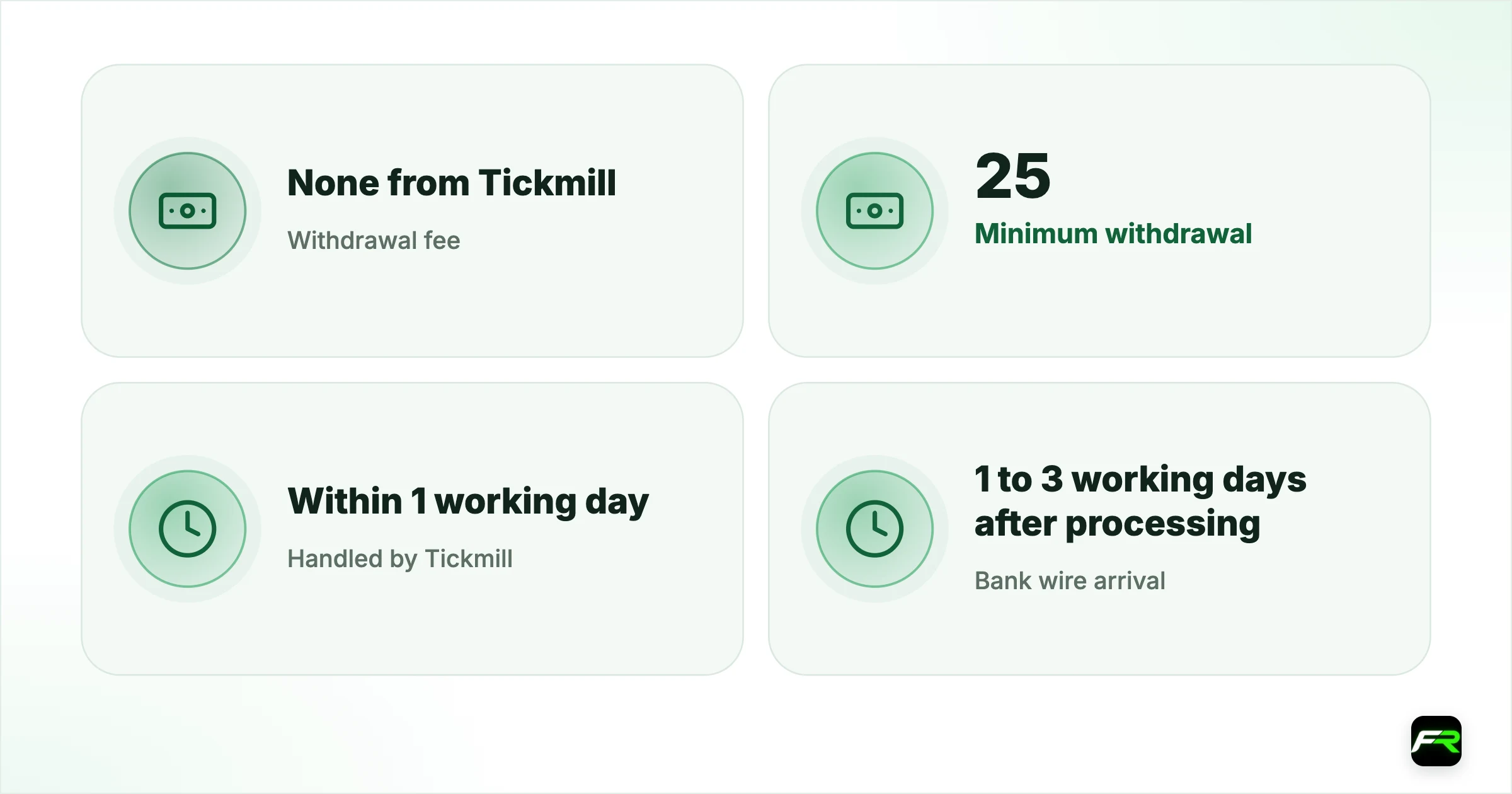
Tickmill charges zero withdrawal fees. The minimum withdrawal is 25 in your wallet currency, and most requests are processed within one working day. Bank wires can take a further one to three working days to reach you, depending on your bank.
Withdrawals are made from your wallet, in the wallet's base currency, and they return to the payment method you originally used to deposit. Tickmill says the policy protects both sides from fraud. It is the rule to understand before you fund the account, because the way in decides the way out.
| Withdrawal fee | None from Tickmill |
|---|---|
| Minimum withdrawal | 25 |
| Handled by Tickmill | Within 1 working day |
| Bank wire arrival | 1 to 3 working days after processing |
| Paid in | The wallet's base currency: USD, EUR, GBP or ZAR |
| Destination | The method used to deposit, cards first |
Timings by method
| Method | Tickmill processing | Arrival |
|---|---|---|
| Skrill | Within 1 working day | See the time shown in your Client Area |
| Neteller | Within 1 working day | See the time shown in your Client Area |
| Credit or debit card | Within 1 working day | Up to 8 working days |
| Crypto payments | Within 1 working day | See the time shown in your Client Area |
| Bank wire | Within 1 working day | 1 to 3 working days |
Card refunds are the slow ones. Tickmill's payment table shows up to eight working days for card withdrawals to arrive, because card networks take their time returning money. E-wallets are the quickest practical route for most traders.
Tickmill's payments support team works Monday to Friday, 07:00 to 20:00 GMT. A request made on Friday evening will usually be handled on Monday.
The return-to-source rule, with examples
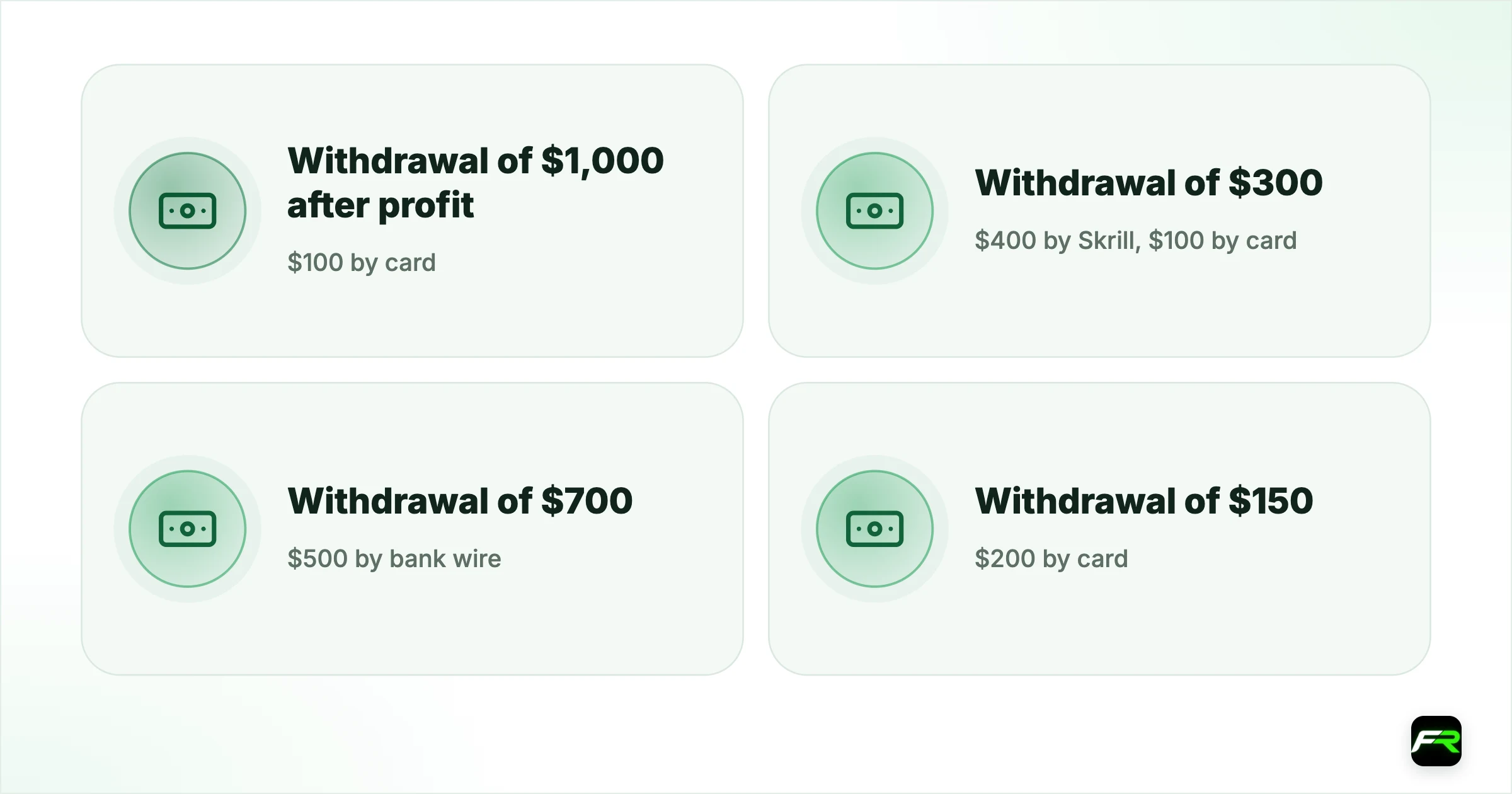
Two rules cover nearly every case. Card deposits go back to the same card, up to the total you deposited by card. Anything above that amount goes to another method you choose, such as a bank wire or e-wallet.
| Deposits made | You withdraw | Where it goes |
|---|---|---|
| $100 by card | Withdrawal of $1,000 after profit | $100 to the card, $900 by your chosen method |
| $400 by Skrill, $100 by card | Withdrawal of $300 | $100 to the card, $200 to Skrill |
| $500 by bank wire | Withdrawal of $700 | To your bank account |
| $200 by card | Withdrawal of $150 | $150 to the card |
The first two rows are Tickmill's own examples. Where you funded by card and by another method, the card is always refunded first. Plan for that if your card is close to expiry or belongs to an account you intend to close.
Third-party payments are refused in both directions. A withdrawal can only go to a card, wallet or bank account in your own name.
Currency and conversion
Tickmill processes payments in euros, pounds, rand and US dollars only. Your withdrawal leaves in the base currency of your wallet. If your bank account or e-wallet is in another currency, the provider converts it and may charge a conversion fee.
That conversion is where most of the hidden cost sits. A trader in Indonesia with a USD wallet receives dollars, which the bank turns into rupiah at its own rate. Two ways to reduce the loss: use an e-wallet that holds dollars, and withdraw less often in larger amounts.
Costs outside Tickmill's control
| Cost | Who charges it | How to limit it |
|---|---|---|
| Intermediary bank fee on a wire | Banks along the route | Use an e-wallet for smaller sums |
| E-wallet withdrawal fee | Skrill, Neteller | Check the wallet's fee table first |
| Currency conversion | Your bank or wallet | Hold a wallet in your own currency where possible |
| Fee to receive a wire | Your bank | Ask before the first wire arrives |
Tickmill says plainly that intermediary banks and e-wallet providers may apply their own charges, which are outside its control. The broker's fee is zero; your total cost may not be.
How to withdraw
- Move the money from your trading account to your wallet.
- Select Withdraw beside the wallet, or use the Withdrawal tab.
- Choose the wallet, which is preselected if you started from the Wallets screen.
- Pick the payment method for receiving funds.
- Enter the amount and submit.
- Follow the request in the Transactions History tab.
People forget the first step. Money in a trading account has to be transferred to the wallet before it can be withdrawn. Only transfer free margin if you have open positions, or your margin level will fall.
Withdrawals and open trades
Tickmill's margin call sits at a 100% margin level, which is early by offshore standards. Take money out of a trading account with positions open and the margin level drops at once. An account at 180% can fall to 110% after a transfer, and a small move then triggers the margin call.
Calculate the margin level you will have after the transfer, not the one you have now. Our Tickmill stop out guide explains the 100% and 50% thresholds.
Welcome Account profits
Profits from the $30 Welcome Account follow different rules. They can be moved to a live wallet only within set limits and after you make a qualifying deposit. Don't expect to withdraw the $30 itself. The Tickmill Welcome Account guide explains the conditions.
Why a withdrawal gets delayed
- Verification is incomplete or a document has expired.
- The destination account isn't in your name.
- Extra source-of-funds documents were requested and not yet supplied.
- The request was made outside the payments team's working hours.
- Card details changed since the deposit.
- The amount is below the minimum of 25.
Most delays are document problems that could have been fixed in advance. Complete every verification step when you open the account, as described in our account opening guide.
Tips for faster payouts
- Fund with the method you want to be paid by.
- Prefer e-wallets if speed matters, and bank wire for large sums.
- Request withdrawals early in the week and early in the day, GMT.
- Keep your ID and proof of address current.
- Test the route with a small withdrawal in your first week.
Leave spare money in the wallet, not the trading account. It is already in the right place to withdraw, and it can't be lost to a margin call.
Which method to choose
Speed, cost and convenience rarely line up. E-wallets such as Skrill and Neteller are quick once Tickmill has processed the request, though the wallet may charge you to move money on to your bank. Bank wire is slower and can lose a slice to intermediary banks, which matters on small sums and hardly at all on large ones.
Cards are a special case. You don't choose them for withdrawals; the return-to-source rule chooses for you, up to the amount you deposited by card. Because card refunds can take up to eight working days, funding by card is a poor idea if you expect to need money back quickly.
A workable approach for most traders outside the dollar, euro, pound and rand zones is an e-wallet that holds US dollars. Deposits and withdrawals stay in one currency, the money arrives fast, and you convert to local currency only when you choose to.
Records to keep
Save the confirmation of every withdrawal, with the date, amount, method and transaction reference from the Transactions History tab. Banks sometimes ask why money arrived from abroad, and tax authorities in many countries want evidence of trading income. A monthly account statement kept beside those confirmations answers both.
No fee and one working day is a good standard, and Tickmill meets it in my experience of its published terms. The card-first rule is what trips people up. If you deposit $100 by card and make $1,000, only $100 goes back to the card.
Sipho had deposited R2,000 by card and R6,000 by bank transfer into a ZAR wallet. He requested R5,000 on a Tuesday morning. R2,000 was returned to his card and R3,000 went to his bank account, which showed the money two days later with no fee from Tickmill and no conversion.
Frequently asked
Does Tickmill charge withdrawal fees?
No. Tickmill charges zero withdrawal fees. Intermediary banks and e-wallet providers may apply their own charges, and your bank may charge for currency conversion.
What is the minimum withdrawal at Tickmill?
25 in your wallet's base currency, according to Tickmill's deposits and withdrawals page.
How long do Tickmill withdrawals take?
Most are processed within one working day. Bank wires then take one to three working days, and card refunds can take up to eight working days to appear.
Where will my withdrawal be sent?
Back to the method you deposited with. Card deposits are returned to the card first, up to the amount deposited, and any profit above that goes to an alternative method you choose.
In which currency are withdrawals paid?
In the base currency of your wallet: USD, EUR, GBP or ZAR. Your bank or e-wallet converts it if your account is in another currency.
Can I withdraw to someone else's account?
No. Third-party payments are not accepted. Payment methods must be in your own name.
Related reading
The team behind this guide
Researched, checked and approved by five forex specialists
Every guide is written, fact-checked and edited before it goes live, and updated when the facts change. Spotted an error? Tell us.