IC Markets


































Is Tickmill Safe? FCA, CySEC, FSCA and FSA Licences Explained
Tickmill is regulated in four jurisdictions: the UK, Cyprus, South Africa and Seychelles. International traders are placed with the Seychelles company. Here is what each licence gives you, how the Lloyd's insurance works, and how to confirm which company holds your account.
 WriterAbir KhanWriterWrites the guides · checks every figure against primary sources View profileAbout Abir →
 Market analysisTanbir Habib RiyadForex & Crypto AnalystForex and crypto analyst · technical and fundamental analysis View profileAbout Tanbir →
 Fact-checking & riskJannatul FerdaushFact-Checker & Risk AnalystFact-checks every figure · risk analysis · Applied Statistics, University of Dhaka View profileAbout Jannatul →
 Trading reviewJowel RanaCo-Founder & Forex TraderCo-founder · forex trader · reviews guides from a trader's view View profileAbout Jowel →
 Final approvalRanjan NiskrityFounder, Owner & Forex TraderFounder and owner · forex trader · signs off every guide View profileAbout Ranjan →
Tickmill describes itself as regulated across four jurisdictions. In the UK, Tickmill UK Ltd is authorised by the Financial Conduct Authority under register number 717270. Its European arm, Tickmill Europe Ltd, holds licence 278/15 from the Cyprus Securities and Exchange Commission. South African clients deal with Tickmill South Africa (Pty) Ltd, licensed by the Financial Sector Conduct Authority as FSP 49464. The company behind the global website, Tickmill Ltd, is a Securities Dealer licensed by the Seychelles Financial Services Authority, number SD008.
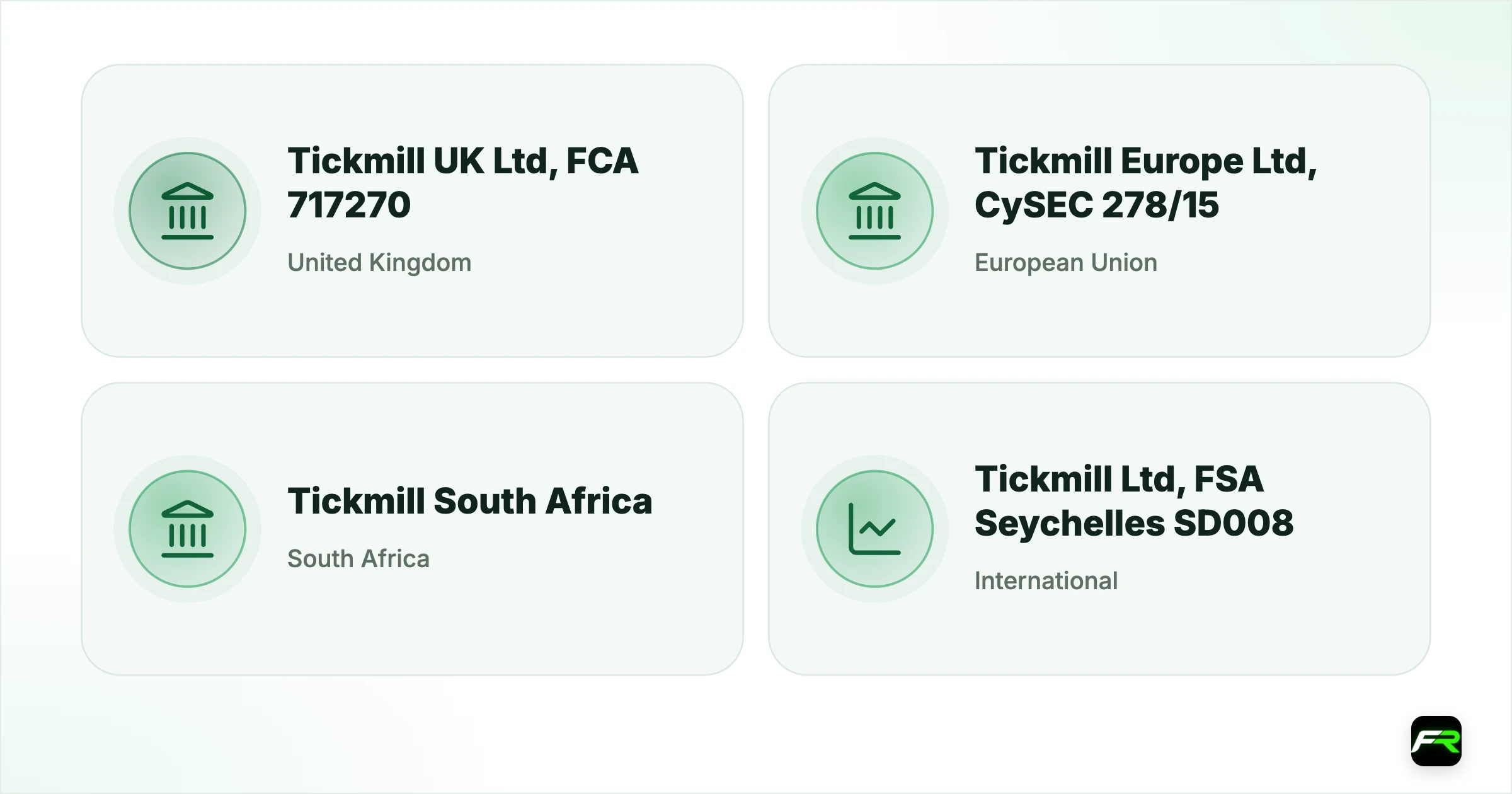
A fifth registration exists in Dubai, where Tickmill UK Ltd runs a representative office regulated by the Dubai Financial Services Authority under reference F007663. Tickmill repeats one sentence across its regulation pages, and it is the most useful one: the protections you get depend on the entity that holds your account.
| United Kingdom | Tickmill UK Ltd, FCA 717270 |
|---|---|
| European Union | Tickmill Europe Ltd, CySEC 278/15 |
| South Africa | Tickmill South Africa (Pty) Ltd, FSCA FSP 49464 |
| International | Tickmill Ltd, FSA Seychelles SD008 |
| Insurance | Lloyd's of London, $20,000 to $1,000,000 |
| Negative balance protection | Yes, account reset to zero |
The Tickmill companies side by side
| Company | Regulator and number | Clients served | Compensation scheme |
|---|---|---|---|
| Tickmill UK Ltd | FCA, 717270 | UK clients | FSCS, up to £120,000 |
| Tickmill Europe Ltd | CySEC, 278/15 | EU clients | ICF, 90% of a claim up to €20,000 |
| Tickmill South Africa (Pty) Ltd | FSCA, FSP 49464 | South African clients | None stated |
| Tickmill Ltd | FSA Seychelles, SD008 | International traders | None stated |
Each licence number can be verified, Tickmill says, on the regulator's own register. Do that. Search the FCA register for 717270, CySEC's list of investment firms for 278/15, the FSCA's FSP search for 49464 and the Seychelles FSA's list of Securities Dealers for Tickmill Ltd. The company name and website on the register should match the one you are signing up with.
What international clients get
Readers in Asia, Africa outside South Africa, the Middle East and Latin America will normally be onboarded by Tickmill Ltd in Seychelles. That is the company offering leverage up to 1:1000 and the $30 Welcome Account, neither of which the UK or EU companies can provide to retail clients.
Seychelles is a lighter regime than the FCA or CySEC. It licenses and supervises dealers, yet the compensation schemes on Tickmill's regulation page are named for UK and EU clients only. An account with Tickmill Ltd doesn't come with the FSCS or the ICF behind it. What you do have are the protections Tickmill applies across the group, described below.
The FCA and CySEC licences belong to separate Tickmill companies. They add to the group's credibility, but they don't cover an account opened with Tickmill Ltd in Seychelles.
How your money is protected
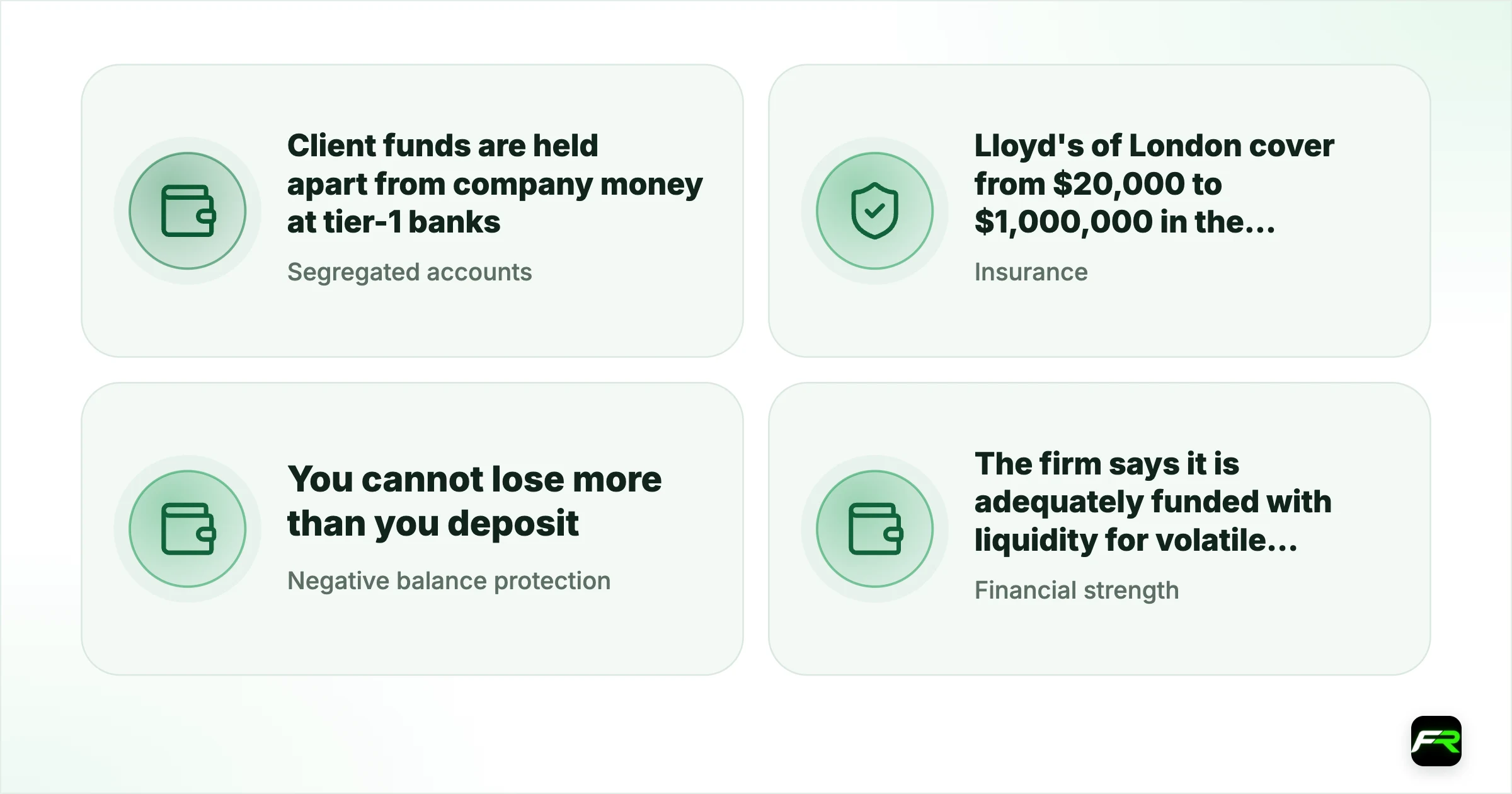
| Protection | What Tickmill states |
|---|---|
| Segregated accounts | Client funds are held apart from company money at tier-1 banks |
| Insurance | Lloyd's of London cover from $20,000 to $1,000,000 in the event of insolvency |
| Negative balance protection | You cannot lose more than you deposit; negative equity is reset to zero |
| Financial strength | The firm says it is adequately funded with liquidity for volatile markets |
Segregation means the broker can't use your deposit to run its business. It gives client money a separate status if the firm fails. That is not a guarantee of full repayment, and it has nothing to do with losses from trading.
Insurance at Lloyd's is the more unusual feature. Tickmill gives a range, from $20,000 to $1,000,000, and says it applies in the unlikely event of insolvency. The page links to further detail, and the terms of that policy decide who is eligible and for how much. Read them before you rely on the larger figure.
Negative balance protection is stated without conditions on the safety page: if market moves push your account into negative equity, Tickmill resets it to zero. For anyone using high leverage, that sets a ceiling on the damage a gap can do.
Tier-one versus offshore, in practice
| Feature | Tickmill UK / Europe | Tickmill Ltd (Seychelles) |
|---|---|---|
| Retail leverage | Capped by FCA and EU rules | Up to 1:1000 |
| Compensation scheme | FSCS or ICF | None named |
| Welcome Account | Not offered to EU residents | Offered |
| Crypto CFDs | Professional clients only | Available |
| Negative balance protection | Yes | Yes |
Neither column is simply better. Stricter rules protect you from yourself and from the firm. Looser rules give you more freedom and more ways to lose money quickly. You usually don't get to choose, since the entity follows your country of residence.
How orders are executed
Tickmill describes a hybrid execution model with market execution and an average speed of 0.15 seconds. Its account pages say every strategy is allowed, including scalping, hedging and automated trading, and that Raw account holders can place stop and limit orders at any distance from the market.
Market execution means your order is filled at the best available price, which may differ slightly from the quote on screen. A broker that allows scalpers and expert advisors without restriction is generally one that isn't troubled by clients who win, which is a mild point in its favour.
A regulator warning to know about
Regulation in one country doesn't make a broker authorised everywhere. The Reserve Bank of India, for example, publishes an alert list of forex platforms not authorised under Indian law, and Tickmill appears on it. Readers in India should take that seriously. Wherever you live, check your own regulator's position on overseas CFD brokers before sending money abroad.
Is Tickmill safe?
Tickmill has more serious licences than most brokers in this price bracket, with the FCA and CySEC at the top. Its international arm in Seychelles is weaker on paper, though segregation, Lloyd's insurance and negative balance protection make it better protected than a typical offshore account. Keep your balance modest, verify early and read our Tickmill withdrawal guide before your first payout.
- Find the company name in your client agreement and client area.
- Verify that company on its regulator's public register.
- Read the insurance terms linked from the safety page.
- Check your own country's rules on overseas brokers.
- Withdraw a small amount early to test the route.
Questions to settle before you deposit
Ask yourself four things. Which company is named in my agreement? Does that company's regulator run a compensation scheme, and am I covered by it? Have I read the terms of the insurance instead of relying on the headline figure? Could I afford to lose this deposit if the worst happened?
None of those questions has a wrong answer, as long as you know the answer. Trouble starts when a trader assumes the FCA stands behind an account that sits in Seychelles, or treats a million-dollar insurance ceiling as a personal guarantee.
Size is the last safeguard and the one you control. A broker's failure is rare, yet it is the one risk no stop loss covers. Keep in the account what your trading needs, hold the rest in your wallet or your bank, and withdraw profits on a regular schedule.
Tickmill's group is properly regulated, and I rate the FCA licence highly. The honest caveat is that a trader in Dhaka or Nairobi contracts with the Seychelles company. Judge your own protection by that licence, plus the insurance and the negative balance policy.
Rina opened her account on the global site and saw Tickmill Ltd, FSA Seychelles SD008, in the footer and her agreement. She looked up the licence on the FSA's list, deposited $150 and kept the rest of her savings in the bank. A $30 test withdrawal reached her e-wallet the next day.
Frequently asked
Is Tickmill regulated?
Yes. Tickmill UK Ltd is regulated by the FCA (717270), Tickmill Europe Ltd by CySEC (278/15), Tickmill South Africa (Pty) Ltd by the FSCA (FSP 49464) and Tickmill Ltd by the Seychelles FSA (SD008). A Dubai representative office is regulated by the DFSA.
Which Tickmill company will I trade with?
It follows your country of residence. UK clients use Tickmill UK, EU clients Tickmill Europe, South Africans the FSCA-licensed company, and most other international traders Tickmill Ltd in Seychelles.
Are my funds insured at Tickmill?
Tickmill says client funds are insured by Lloyd's of London for between $20,000 and $1,000,000 in the event of insolvency. The policy terms decide eligibility. UK and EU clients also have the FSCS and ICF schemes.
Does Tickmill offer negative balance protection?
Yes. Its safety page states you cannot lose more than you deposit and that an account falling into negative equity is reset to zero.
Does the FSCS protect international Tickmill clients?
No. The FSCS, up to £120,000, covers clients of Tickmill UK Ltd. Clients of Tickmill Europe Ltd have the ICF. Neither is named for clients of the Seychelles company.
Does Tickmill allow scalping and EAs?
Yes. Tickmill says all strategies are allowed on its accounts, including scalping, hedging and automated trading with expert advisors.
Related reading
The team behind this guide
Researched, checked and approved by five forex specialists
Every guide is written, fact-checked and edited before it goes live, and updated when the facts change. Spotted an error? Tell us.