IC Markets




































Tickmill Leverage: 1:1000 Dynamic Tiers and What They Mean for Margin
Tickmill offers leverage up to 1:1000 on MT5, Tickmill Trader and TradingView, and up to 1:500 on MT4. On the newer platforms it is dynamic: the bigger your position, the lower the leverage. Here are the tiers, margin examples and how to pick a setting.
 WriterAbir KhanWriterWrites the guides · checks every figure against primary sources View profileAbout Abir →
 Market analysisTanbir Habib RiyadForex & Crypto AnalystForex and crypto analyst · technical and fundamental analysis View profileAbout Tanbir →
 Fact-checking & riskJannatul FerdaushFact-Checker & Risk AnalystFact-checks every figure · risk analysis · Applied Statistics, University of Dhaka View profileAbout Jannatul →
 Trading reviewJowel RanaCo-Founder & Forex TraderCo-founder · forex trader · reviews guides from a trader's view View profileAbout Jowel →
 Final approvalRanjan NiskrityFounder, Owner & Forex TraderFounder and owner · forex trader · signs off every guide View profileAbout Ranjan →
Tickmill's international accounts offer leverage up to 1:1000. That maximum is available as dynamic leverage on MT5, Tickmill Trader and TradingView. On MT4, leverage is static and the maximum is 1:500. Clients of the UK and EU companies trade under the lower retail limits set by their regulators.
Dynamic leverage adjusts with the size of your position. Small positions get the highest leverage. As the position grows, leverage steps down in tiers and the margin required rises. Tickmill says the mechanism helps manage risk by limiting exposure on larger trades.
| Maximum | 1:1000 |
|---|---|
| MT4 | Static, up to 1:500 |
| MT5, Tickmill Trader, TradingView | Dynamic, up to 1:1000 |
| First forex tier | 0 to 2 lots at 1:1000 |
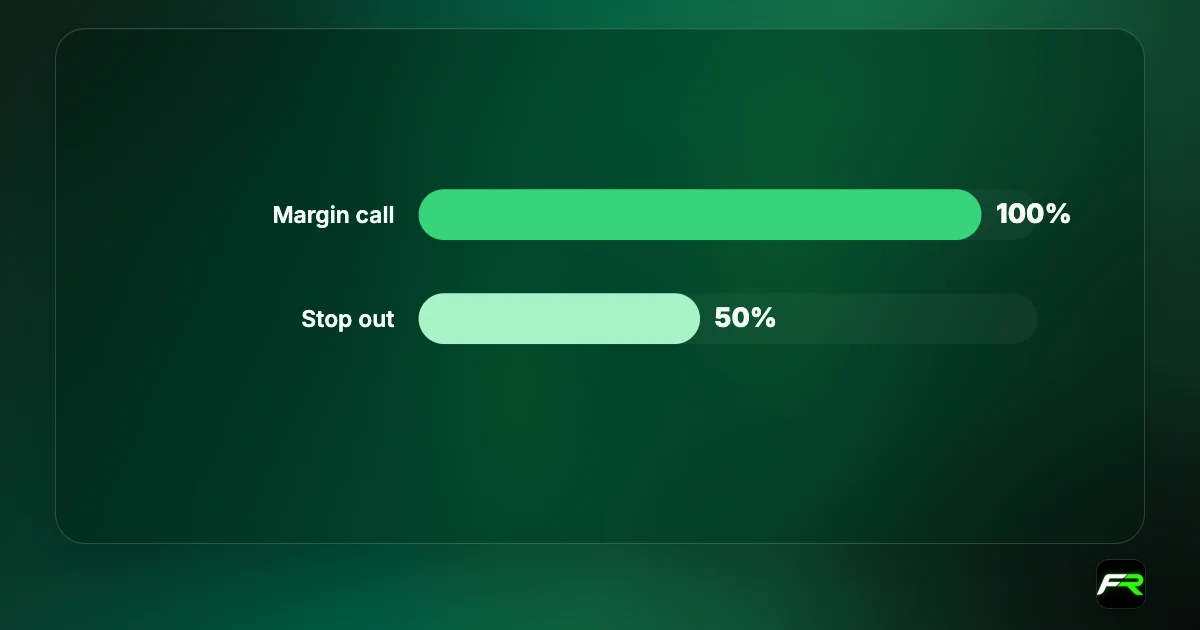
| Margin call / stop out | 100% / 50% |
| Volatile periods | Leverage may be reduced |
Dynamic tiers for forex and gold
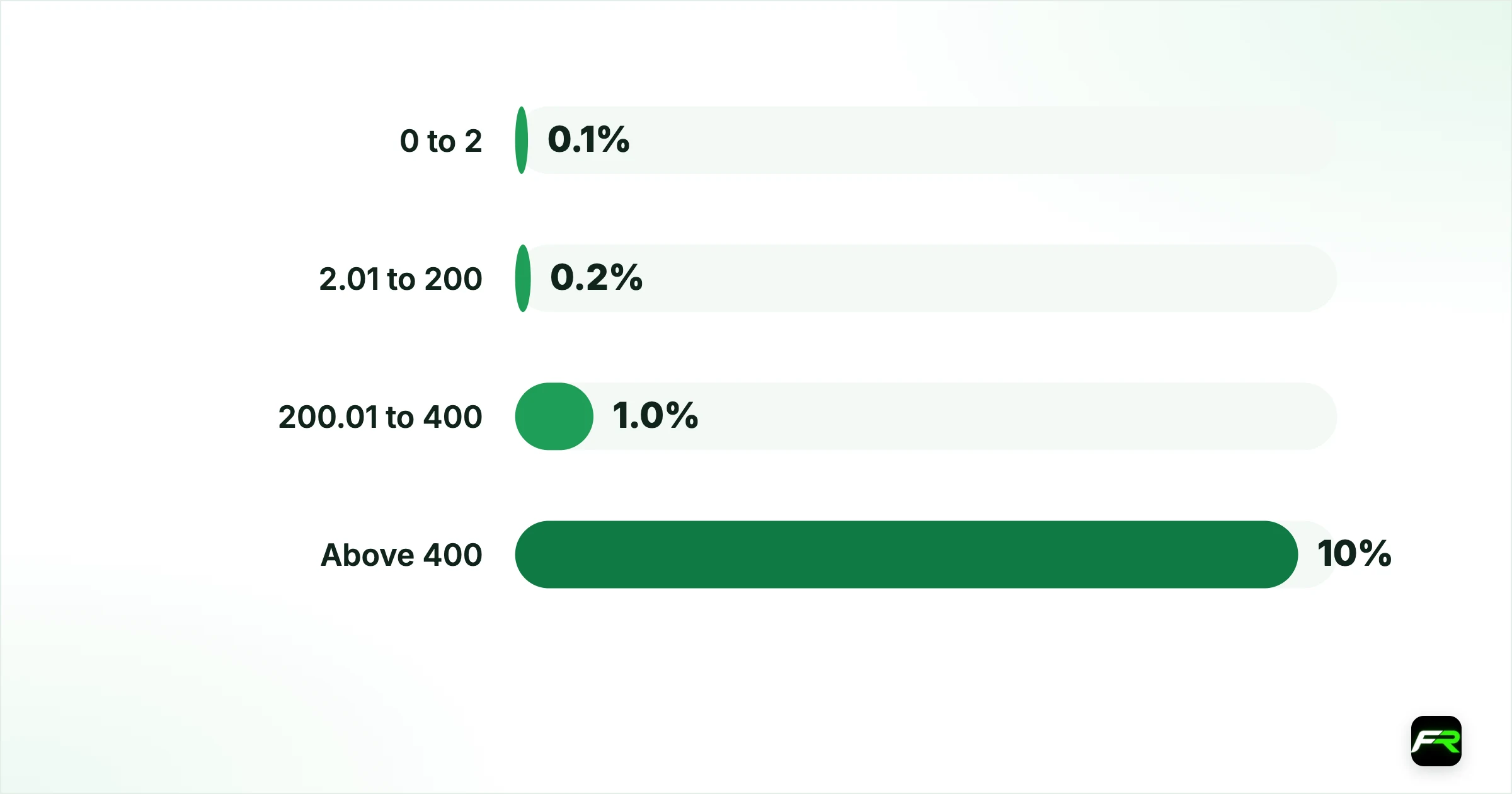
| Forex lots | Gold lots (XAUUSD, XAUEUR) | Margin requirement | Maximum leverage |
|---|---|---|---|
| 0 to 2 | 0 to 1 | 0.1% | 1:1000 |
| 2.01 to 200 | 1.01 to 50 | 0.2% | 1:500 |
| 200.01 to 400 | 50.1 to 100 | 1.0% | 1:100 |
| Above 400 | Above 100 | 10% | 1:10 |
The tiers apply in slices. Your first two lots of a forex pair are margined at 1:1000, and only the part above two lots moves to 1:500. Nobody loses the best rate on the early lots by adding more.
Dynamic leverage covers the seven major pairs, a long list of crosses, gold, silver, oil, Bitcoin, Ethereum and three stock indices. Other instruments use static leverage. On MT5, Tickmill says the dynamic leverage on these instruments aligns with the account leverage you selected.
Tickmill's gold example
Tickmill works an example with gold at 2,355 dollars on a USD account. The formula is lot size times contract size times price, divided by leverage.
| Position | Leverage applied | Margin required |
|---|---|---|
| 1 lot | 1:1000 | $236 |
| 2 lots | 1:1000 on the first lot, 1:500 on the second | $707 |
| 150 lots | 1:1000, 1:500 and 1:100 in slices | $164,615 |
Look at the jump between one and two lots. The second lot needs $471 of margin, twice the first, because it falls into the 1:500 tier. A trader who doubles a gold position expecting margin to double will find it has tripled.
Tiers on other instruments
| Instrument | First tier | Leverage | Lowest tier |
|---|---|---|---|
| Silver (XAGUSD) | 0 to 10 lots | 1:10 | 1:1.33 above 50 lots |
| Oil (XTI, Brent) | 0 to 500 lots | 1:100 | 1:7 above 10,000 lots |
| BTCUSD | 0 to 3 lots | 1:200 | 1:5 above 30 lots |
| ETHUSD | 0 to 70 lots | 1:200 | 1:5 above 750 lots |
| US30, USTEC, DE40 | 0 to 15 lots | 1:200 | 1:10 above 150 lots |
| XAUUSD.24-7 | 0 to 50 lots | 1:100 | 1:4 above 150 lots |
Silver stands out. Its first tier is only 1:10, a hundred times less than gold. A trader who moves from gold to silver with the same habits will find margin requirements of a different order. Tickmill notes that leverage ratios are subject to adjustment based on market conditions.
Stock and ETF CFDs sit outside the dynamic system. Their leverage is lower and can be reduced around earnings announcements and major corporate events, according to Tickmill's leverage page.
MT4 against MT5
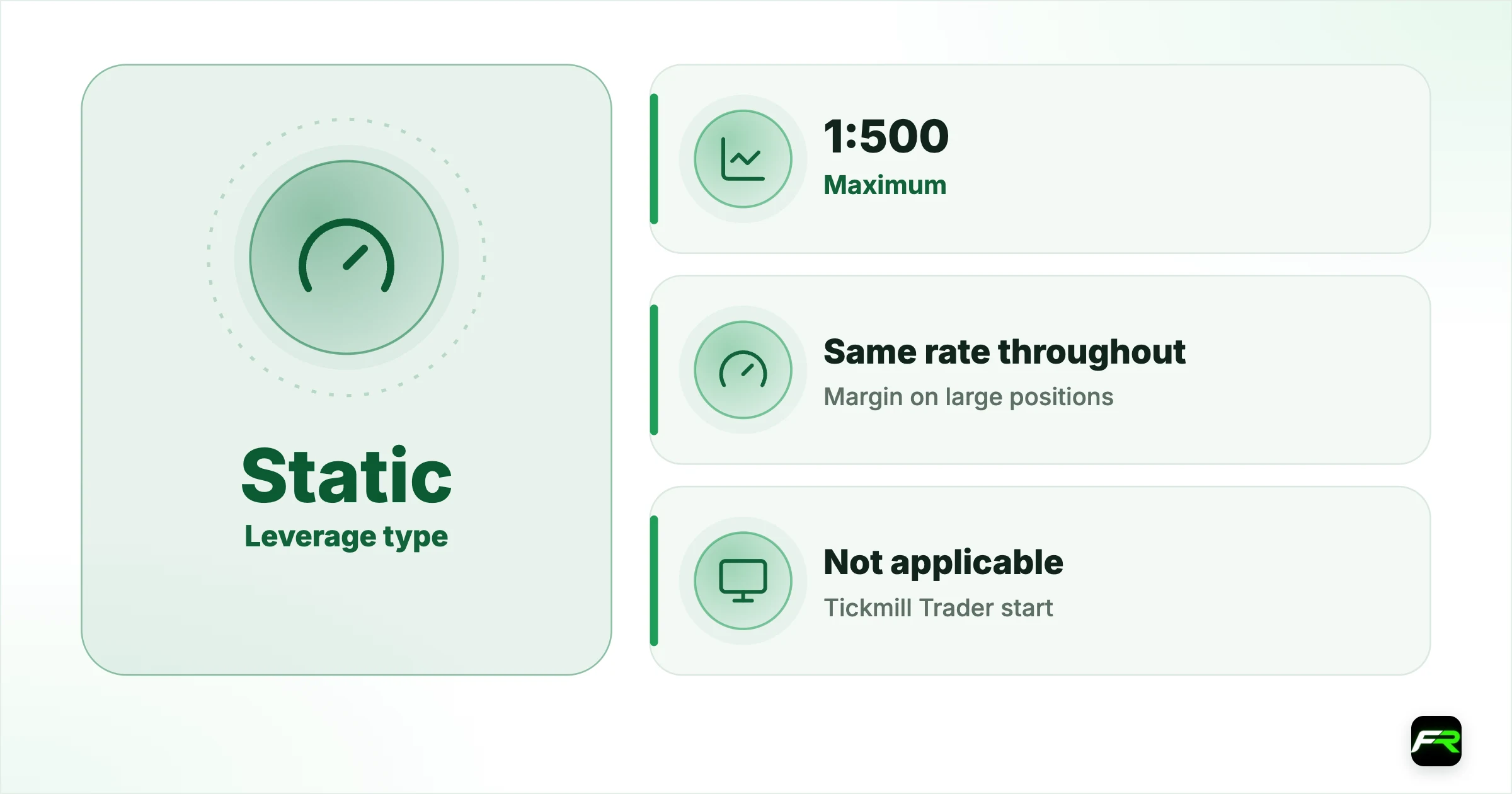
| Feature | MT4 | MT5, Tickmill Trader, TradingView |
|---|---|---|
| Leverage type | Static | Dynamic on listed instruments |
| Maximum | 1:500 | 1:1000 |
| Margin on large positions | Same rate throughout | Rises tier by tier |
| Tickmill Trader start | Not applicable | 1:1000 on forex and gold, 1:200 on crypto |
If you want one fixed leverage figure and no surprises as you add to a position, MT4 gives you that. MT5 offers more leverage on small positions and less on big ones. The Tickmill platforms guide compares the rest.
What 1:1000 does to a small account
Margin for one standard lot of a dollar-based pair is $100 at 1:1000. A $200 account can therefore open it. Each pip is worth $10. Tickmill's stop out is at a 50% margin level, so positions close when equity falls to $50. That takes a loss of $150, or 15 pips.
| Account | Position | Margin at 1:1000 | Pips to stop out |
|---|---|---|---|
| $200 | 1.00 lot | $100 | 15 |
| $200 | 0.10 lot | $10 | About 195 |
| $200 | 0.02 lot | $2 | About 995 |
Fifteen pips is a quiet hour on EUR/USD. The leverage is identical in all three rows. What separates a reckless trade from a sensible one is the lot size, and the platform will accept either.
Leverage is not extra money. It is permission to hold a position larger than your balance, and losses are counted on the whole position.
Negative balance protection
High leverage and price gaps are how accounts go below zero. Tickmill states that you cannot lose more than you deposit and that negative equity is reset to zero. That limits the worst case to your balance. It does nothing to protect the balance itself, which is your job. The Tickmill stop out guide covers the 100% and 50% levels.
How to choose a leverage level
- Fix your risk per trade, for example 1% of the account.
- Measure the distance to your stop in pips.
- Work out the lot size that loses 1% at that stop.
- Check the margin for that size with Tickmill's margin calculator.
- Pick the lowest leverage setting that covers it with room to spare.
A $500 account risking 1% with a 25-pip stop trades 0.02 lots. Margin for that is about $2 at 1:1000 and $20 at 1:100. Both are small. Lower leverage costs you nothing here and stops you opening a one-lot trade by mistake.
When leverage is cut
Tickmill says leverage may be reduced during periods of high volatility, and that ratios can be adjusted with market conditions. A reduction raises the margin on open positions. An account running near its limits can be pushed into a margin call by the change alone, with no price move at all.
Keep used margin to a small share of equity and those adjustments won't matter. A margin level above 500% leaves room for a tier change, a volatility cut and an ordinary bad day together.
Practise adding to a position on an MT5 demo. The margin jump at the second gold lot teaches the tier system faster than any table.
Myths worth dropping
High leverage doesn't raise the cost of a trade. Spread, commission and swap depend on position size, and they are identical at 1:100 and 1:1000. What changes is the margin set aside, and therefore how large a position your balance can open.
Low leverage doesn't make you safe either. A trader at 1:30 who commits the whole balance as margin is in more danger than one at 1:1000 using a fiftieth of it. Safety comes from the size of the trade measured against the size of the account.
Nor is the maximum a target. Tickmill offers 1:1000 because clients ask for it and Seychelles rules allow it. European and British regulators cap retail leverage at a small fraction of that after studying how retail accounts lose money. The lower caps reflect evidence, and you can apply the same caution yourself by choice.
One more point concerns static instruments. Anything outside the dynamic list keeps a fixed leverage figure, and stock CFDs sit far lower than forex. Look up the margin requirement in the symbol's specification before assuming your forex setting applies.
Dynamic leverage is one of the more honest designs around. Tickmill gives small positions plenty of room and makes large ones expensive. It still won't stop a $200 account from opening a full lot, so the discipline has to come from you.
Anh held one lot of gold on MT5 with $1,200 in the account and added a second lot. Margin rose from about $236 to roughly $707 instead of the $472 she expected, and her margin level dropped under 200%. She closed the second lot and now checks the margin calculator before adding.
Frequently asked
What is the maximum leverage at Tickmill?
Up to 1:1000 with Tickmill Ltd, available as dynamic leverage on MT5, Tickmill Trader and TradingView. The maximum on MT4 is 1:500. UK and EU clients have lower regulatory limits.
What is dynamic leverage?
A system that adjusts leverage to position size. For forex, the first 2 lots get 1:1000, lots 2.01 to 200 get 1:500, 200.01 to 400 get 1:100, and anything above gets 1:10.
Does dynamic leverage apply on MT4?
No. MT4 uses static leverage. Dynamic leverage is exclusive to Tickmill Trader and MT5, including demo accounts, and is used on TradingView accounts.
How much margin does one lot of gold need?
In Tickmill's example, with gold at 2,355 dollars, one lot at 1:1000 needs $236. Two lots need $707, because the second lot is margined at 1:500.
What leverage does Tickmill give on crypto?
Bitcoin and Ethereum start at 1:200 for the first tier, 0 to 3 lots of BTCUSD or 0 to 70 lots of ETHUSD, and step down to 1:5 on the largest positions.
Can Tickmill reduce my leverage?
Yes. Tickmill says leverage may be reduced during periods of high volatility and that ratios are subject to adjustment based on market conditions.
Related reading
The team behind this guide
Researched, checked and approved by five forex specialists
Every guide is written, fact-checked and edited before it goes live, and updated when the facts change. Spotted an error? Tell us.