IC Markets




































Fusion Markets Crypto Trading: CFDs, Spreads, Leverage and Weekend Hours
Fusion Markets offers crypto as CFDs with no commission, 24/7 trading and Bitcoin spreads from 0.04%. You never own the coins. Here is what you can trade, what it costs to hold, and how crypto CFDs differ from buying on an exchange.
 WriterAbir KhanWriterWrites the guides · checks every figure against primary sources View profileAbout Abir →
 Market analysisTanbir Habib RiyadForex & Crypto AnalystForex and crypto analyst · technical and fundamental analysis View profileAbout Tanbir →
 Fact-checking & riskJannatul FerdaushFact-Checker & Risk AnalystFact-checks every figure · risk analysis · Applied Statistics, University of Dhaka View profileAbout Jannatul →
 Trading reviewJowel RanaCo-Founder & Forex TraderCo-founder · forex trader · reviews guides from a trader's view View profileAbout Jowel →
 Final approvalRanjan NiskrityFounder, Owner & Forex TraderFounder and owner · forex trader · signs off every guide View profileAbout Ranjan →
Crypto at Fusion Markets is traded as contracts for difference. You speculate on the price of Bitcoin, Ethereum and other coins without owning them. Fusion charges no commission on crypto CFDs, so the cost of a trade is the spread, plus overnight financing if you hold past the daily rollover.
Markets are open 24 hours a day, seven days a week, weekends included. The broker quotes Bitcoin spreads from 0.04% and Ethereum from 0.09%. Every platform it supports carries crypto: MetaTrader 4, MetaTrader 5, cTrader and TradingView.
| Product type | CFD; no coins are owned |
|---|---|
| Commission | $0 |
| Bitcoin spread from | 0.04% |
| Ethereum spread from | 0.09% |
| Hours | 24/7 |
| Leverage | Up to 10:1, per Fusion's FAQ |
Coins and spreads
| Market | Hours | Minimum spread | Average spread |
|---|---|---|---|
| Bitcoin vs US dollar | 24/7 | 14 | 18.97 |
| Ethereum vs US dollar | 24/7 | 2.37 | 2.9 |
| Solana vs US dollar | 24/7 | 0.14 | 0.16 |
| Avalanche vs US dollar | 24/7 | 0.03 | 0.03 |
| Dogecoin vs US dollar | 24/7 | 0.0 | 0.0 |
| Cardano vs US dollar | 24/7 | 0.0 | 0.0 |
Spreads in that table are in US dollars of price, taken from Fusion's crypto page. An average of 18.97 on Bitcoin means the gap between the buy and sell price is about $19 per coin. More coins sit behind the page's Show more button, and the symbol list in your platform is the final word on what you can trade.
Dogecoin and Cardano show as 0.0 only because their prices are small and the table rounds to one or two decimals. A spread still exists. Open the symbol in your platform to see the real figure.
CFD or real coins: what is the difference?
| Point | Crypto CFD at Fusion | Buying coins on an exchange |
|---|---|---|
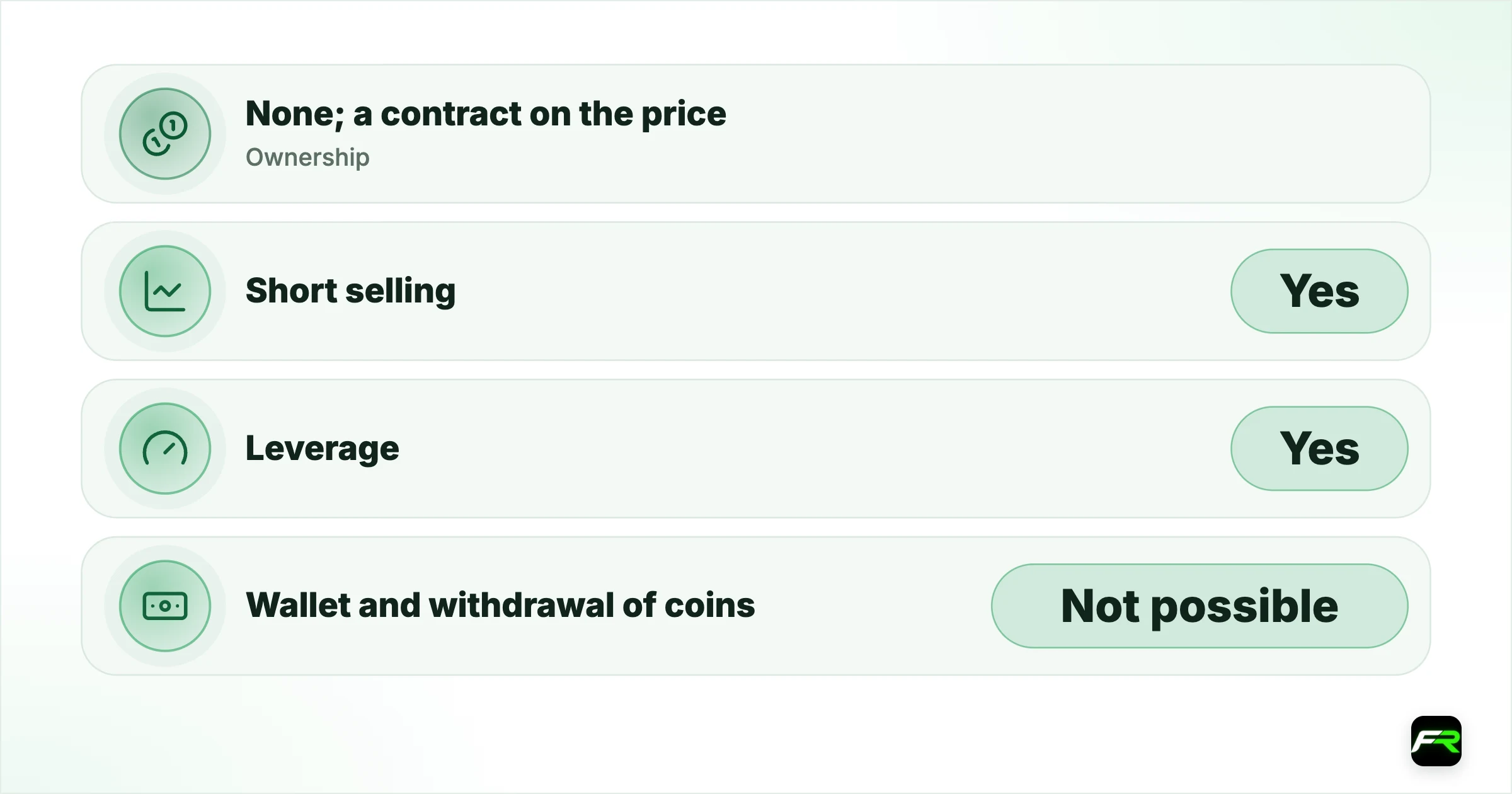
| Ownership | None; a contract on the price | You own the coin |
| Short selling | Yes | Usually not without margin products |
| Leverage | Yes | Usually none on spot |
| Wallet and withdrawal of coins | Not possible | Yes |
| Rewards from staking | No | Possible when staked on chain |
| Overnight cost | Financing charge each day | None for holding |
The table points to a simple rule. CFDs suit short-term trading in both directions. A buy-and-hold plan over years is a job for real coins, because a daily financing charge on a CFD adds up month after month and you get no staking income.
Leverage on crypto
Fusion's FAQ gives crypto leverage of up to 10:1 for clients of its international companies. One of its product pages quotes 1:2 for retail and 1:10 for professional clients, wording that fits Australian rules. Look at the margin requirement in your own platform before you trade, because that is the figure applied to your account.
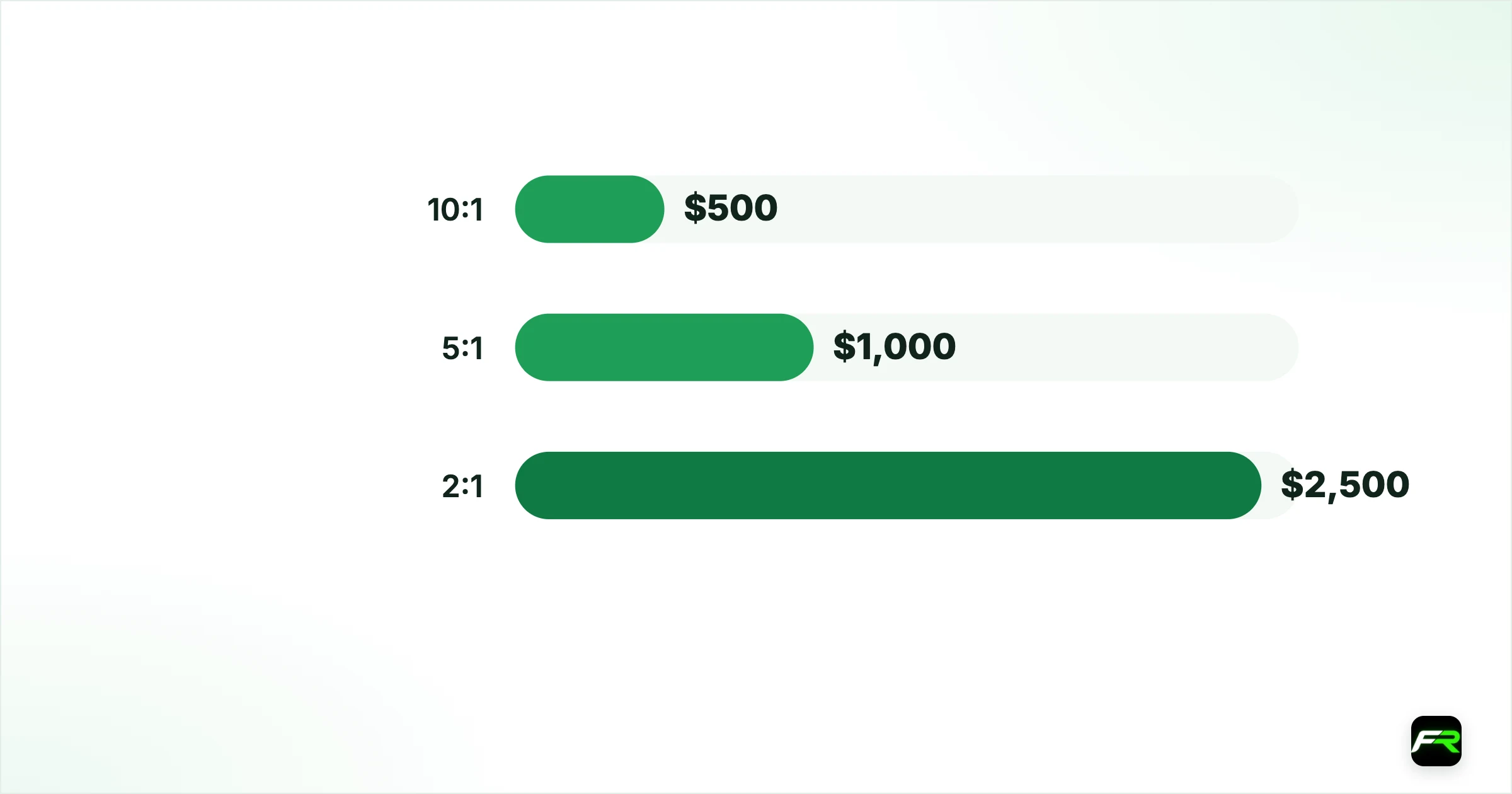
Even 10:1 is a lot for this market. Bitcoin can move 5% in a day without any news. At 10:1, a 5% move against you is a 50% loss on the margin you put up, and a 10% move takes all of it.
| Leverage | Margin for a $5,000 position | Loss if price falls 5% | Loss as share of margin |
|---|---|---|---|
| 10:1 | $500 | $250 | 50% |
| 5:1 | $1,000 | $250 | 25% |
| 2:1 | $2,500 | $250 | 10% |
The dollar loss is identical in every row. Lower leverage simply forces you to hold more of your own money behind the trade. Our Fusion Markets leverage guide covers forex and metals, and the stop out guide explains the 20% liquidation level.
What it costs to hold
An overnight financing charge applies each day at 00:00 server time for positions left open. Fusion updates the rate daily and shows it in the platform. Crypto financing is usually far higher than on currency pairs, so a trade held for a few weeks can cost more in financing than it did in spread.
No commission is charged on either the Zero or the Classic account for crypto. Deposits and withdrawals in crypto are also free at Fusion's end, although funding with Bitcoin or Tether is a separate matter from trading crypto CFDs: your balance is credited in dollars or euros. The Fusion Markets fees guide lists every charge.
Weekend trading and gaps
Forex closes on Friday night and reopens on Sunday. Crypto doesn't stop. That gives you something to trade on Saturday, and it also means your open crypto positions can hit a stop out while you are asleep or away.
Liquidity is thinner at weekends, so spreads can be wider than the weekday averages above. If your account also holds forex trades, a weekend crypto loss reduces the equity supporting them. When Sunday opens with a gap, those two problems arrive together.
Crypto CFDs combine a volatile asset with leverage. Use a stop loss, keep positions small and never fund a trade with money you need.
How to place a crypto trade
- Open your platform and add the coin's symbol to the market watch list.
- Check the contract size, margin requirement and financing rate in the symbol's specification.
- Work out the position size from your stop distance and a risk of about 1% of the account.
- Place the order with a stop loss attached.
- Review the trade daily if you hold it overnight, since financing reduces your equity.
Try the same trade on a demo account first to see the real spread and the daily financing charge on your chosen coin.
Who crypto CFDs suit
They suit a trader who wants short exposure to price moves and already has an account for forex. You use one balance, one platform and the same order types across currencies, gold and coins. A short trade is as easy as a long one, which matters in a market that falls as hard as it rises.
Long-term investors are poorly served. So are people who want to use crypto: you can't send a CFD position to a wallet, pay with it or stake it. If your plan is to own Bitcoin for five years, buy the coin through a regulated exchange in your country and store it properly.
How to size a crypto position
Percentage moves are larger in crypto, so stops need to sit further away and positions need to be smaller. Take a $1,000 account risking 1%, or $10. With a stop 4% from entry on Ethereum, the position value should be $250, because 4% of $250 is $10. At 10:1 leverage the platform would let you open $10,000, forty times that amount.
Check the contract size before entering a volume. One lot of a crypto CFD is often one coin, though not always, and it differs between symbols. Your platform's specification window lists the contract size and the minimum volume. A first trade at the smallest size shows you the real profit and loss per dollar of price movement.
Local rules deserve a look as well. Some countries restrict or tax crypto derivatives differently from currencies. The broker accepting your order doesn't settle that question, so check the position of your own regulator and tax office.
Zero commission and weekend hours make Fusion's crypto CFDs handy for short trades. I wouldn't use them to hold Bitcoin for a year. The daily financing would eat the position, and you'd own nothing at the end.
Ahmed traded Ethereum CFDs on weekends with a $1,000 account. He kept each position near $1,500 in value with a stop 3% away, risking about $45. One trade he left open for 12 days cost him more in financing than the spread had, so he set a rule to close crypto trades within three days.
Frequently asked
Can I trade crypto at Fusion Markets?
Yes, as CFDs. Bitcoin, Ethereum, Solana, Dogecoin, Cardano, Avalanche and other coins are quoted against the US dollar. You trade the price and don't own the coins.
Does Fusion Markets charge commission on crypto?
No. Crypto CFDs carry $0 commission. You pay the spread and a daily overnight financing charge on positions held past 00:00 server time.
Can I trade crypto at the weekend?
Yes. Fusion lists its crypto CFDs as tradable 24/7. Spreads can be wider at weekends when liquidity is thinner.
What leverage does Fusion Markets give on crypto?
The FAQ states up to 10:1 for international clients. One product page shows 1:2 for retail and 1:10 for professional clients, so confirm the margin requirement in your own platform.
Can I withdraw the coins I trade?
No. A CFD is a contract on the price, so nothing can be sent to a wallet. Profits and losses are settled in your account currency.
Do crypto CFDs pay staking rewards?
No. Fusion's FAQ says staking rewards are given only to assets staked on chain, and a CFD position doesn't qualify.
Related reading
The team behind this guide
Researched, checked and approved by five forex specialists
Every guide is written, fact-checked and edited before it goes live, and updated when the facts change. Spotted an error? Tell us.