 IC Markets




































Exness Zero Spread Account
Exness Zero offers 0.0 pip spreads on its top 30 instruments 95% of the day, and on other instruments 50% of the day. Instead of a spread markup you pay a commission that varies by instrument, from $0.05 per side per lot on forex and $5.50 per side on gold. Spreads can rise above zero during high volatility, news and rollovers, and the first deposit starts from $200 depending on region.
 WriterAbir KhanWriterWrites the guides · checks every figure against primary sources View profileAbout Abir →
 Market analysisTanbir Habib RiyadForex & Crypto AnalystForex and crypto analyst · technical and fundamental analysis View profileAbout Tanbir →
 Fact-checking & riskJannatul FerdaushFact-Checker & Risk AnalystFact-checks every figure · risk analysis · Applied Statistics, University of Dhaka View profileAbout Jannatul →
 Trading reviewJowel RanaCo-Founder & Forex TraderCo-founder · forex trader · reviews guides from a trader's view View profileAbout Jowel →
 Final approvalRanjan NiskrityFounder, Owner & Forex TraderFounder and owner · forex trader · signs off every guide View profileAbout Ranjan →
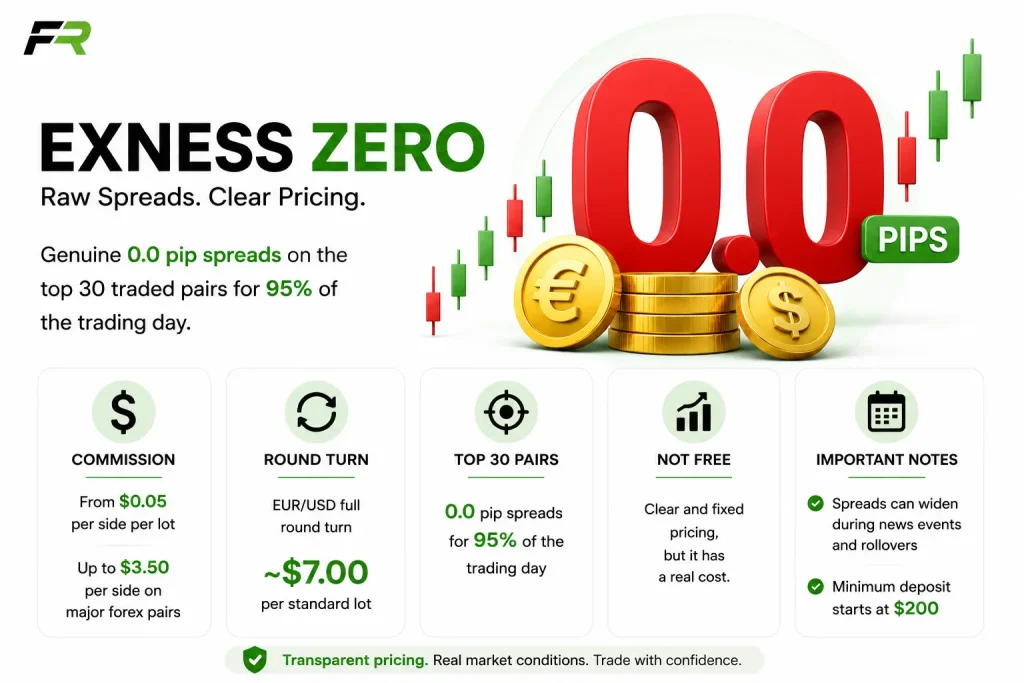
Zero spread sounds like free trading. It isn’t. Exness Zero is one of the best-known account types in retail forex because spreads on its top instruments sit at 0.0 pips for most of the day. But the real price is in the commission, the swap, and the moments when the spread rises above zero.
This guide uses Exness’s own published conditions: its Help Center account and instrument specifications and the spread tables on its website. For the broker as a whole, see our Exness Review.
What the Exness Zero Is (and Is Not)
Zero is one of Exness’s three Professional accounts, alongside Pro and Raw Spread. It uses market execution, so there are no requotes, and it is designed for traders who want the spread itself to be as close to zero as possible.
Instead of building its fee into the spread, Exness charges a commission on each lot you open and close, so you can work out the cost before you trade. On a Standard account, the fee sits in a wider spread: Exness’s published previous-day average for EUR/USD on Standard was 0.8 pips on 30 September 2026.
The Real Cost Breakdown
Commission: What the Numbers Say
Exness says Zero commissions start from $0.05 per lot per side and vary by instrument. Its forex specification gives forex commissions “from 0.05” on Zero, and its commodities specification sets gold (XAUUSD) at $5.50 per side on Zero. Exness does not publish every pair’s rate in one public list, so check the exact figure in the instrument specification in MT4 or MT5, or in Exness’s trading calculator, before you trade.
| Instrument | Zero Commission (per side, per lot) | Round Turn (1 lot) |
| Forex | From $0.05, varies by pair | Check the instrument specification |
| XAUUSD (gold) | $5.50 | $11.00 |
| Other instruments | Varies by instrument | Check the instrument specification |
Source: Exness Help Center forex and commodities specifications, checked 30 September 2026.
The 95% Rule: When Spreads Stop Being Zero
Exness says Zero offers a zero spread on its top 30 traded instruments 95% of the day, and on its other instruments 50% of the day, depending on market volatility. The spread floats during key periods such as economic news and rollovers, and Exness says spreads on the top 30 instruments may rise above zero during high volatility.
That remaining time matters. Around major data releases, central bank decisions and the daily rollover, spreads widen on every account type. If you trade right at a release, Zero does not shield you from that. Use Exness’s economic calendar to plan around high-impact events.
Swap Fees: The Overnight Price Tag
Positions held past the daily rollover (21:00 GMT in summer, 22:00 GMT in winter) are charged or credited swap, which depends on the instrument and direction. All Exness accounts start with swap-free status on a list of popular instruments, and clients registered in Islamic countries get it on all instruments, but the status can be lost if you regularly hold large positions overnight. Exness also reserves the right to charge an overnight administration fee depending on your trading activity.
No Deposit, Withdrawal, or Inactivity Fees From Exness
Exness charges no deposit or withdrawal fees of its own and no fees for inactive accounts. Third-party payment providers may charge their own fees.
Zero vs Standard: Where the Cost Gap Shows Up
The choice between Standard and Zero depends on how often you trade and what you trade.
On one standard lot of EUR/USD, each pip is worth $10. With Standard’s published average of 0.8 pips, the spread costs about $8 per round turn. On Zero, the spread is usually 0.0 on top instruments and you pay the commission for that pair instead. If the commission for your pair works out lower than the Standard spread, Zero is cheaper per trade, and the difference grows with the number of trades.
For low-frequency swing traders, Standard or Pro can work out cheaper because there is no commission on each entry. Pro in particular charges no commission and has tighter spreads than Standard (a published EUR/USD average of 0.6 pips on 30 September 2026).
Zero vs Raw Spread
Both charge commission and give very tight pricing. The difference is how the spread and commission behave.
Zero aims to keep the spread at 0.0 pips on its top 30 instruments 95% of the day, with a commission that varies by instrument. Raw Spread has floating spreads from 0.0 pips and a fixed commission of up to $3.50 per side per lot, set per instrument: on 30 September 2026 Exness listed EUR/USD on Raw Spread at a 0.0 pip average spread with $2.50 per side, and gold at an 8-pip spread with $3.50 per side.
On gold, Exness’s figures that day made the two close: Raw Spread cost about $15 per round-turn lot ($8 spread plus $7 commission) and Zero about $15 ($4 spread plus $11 commission). Compare both for the instruments you trade.
Account Setup: Deposit, Platforms, and Leverage
The first deposit starts from $200, depending on your region; your Personal Area shows the exact amount for your location.
Zero accounts run on MT4 and MT5, and MT5 accounts can also be traded in the Exness Terminal and the Exness Trade app. You can hold up to 100 real MT4 and 100 real MT5 accounts in one Personal Area. MT4 allows up to 1,000 open orders; MT5 has no limit on open orders (up to 1,000 pending).
Leverage can be unlimited on forex majors and minors and gold and silver for eligible accounts (equity under $5,000 and at least 10 closed orders totalling 5 lots). Otherwise the maximum depends on equity: 1:2000 below $30,000, 1:1000 below $100,000 and 1:500 above that. Clients of the Kenyan company are limited to 1:400.
The margin call level is 30% and the stop-out level is 0%, rising to 100% on stocks during their daily break.
Who Should (and Should Not) Use This Account
Zero makes most sense for:
- Scalpers targeting small moves, where even a 1-pip spread takes a large share of the target.
- Algorithmic traders running Expert Advisors that depend on predictable entry costs; Exness says the account suits EAs.
- Active day traders opening and closing many positions each session.
- Traders who want to know the exact cost of each trade in advance.
It is less suited to:
- Beginners still learning position sizing and risk management. The commission adds another calculation, so Standard or Standard Cent is a better start.
- Swing or position traders who hold trades for days, where fewer trades mean less saving from the tighter spread.
- Traders focused on exotic or less liquid instruments, which have zero spreads only 50% of the day.
How to Calculate Your Fee Before Entering a Trade
Use Exness’s trading calculator: choose Zero, then enter the instrument, lot size and currency to see the commission, swap, pip value and margin for that trade.
In MT4 or MT5, right-click the instrument in Market Watch and choose Specification to see its details. For a quick check, the round-turn commission is twice the per-side rate multiplied by your lots; on gold at $5.50 per side, one lot costs $11 in commission.
Exness Regulation and Safety
Exness was founded in 2008, and its group companies hold licences from 11 regulators, including the FSA (Seychelles), FSCA (South Africa), CMA (Kenya), CBCS (Curaçao), CySEC and the FCA. Its CySEC and FCA companies do not serve retail clients. Exness says it serves more than 800,000 active traders and keeps client funds in segregated accounts.
Regulation doesn’t remove trading risk, but it does set rules for how a broker operates. Check which Exness company holds your account, because that decides which protections apply.
Common Questions
Are spreads really 0.0 pips all day?
No. Exness says Zero has zero spreads on its top 30 instruments 95% of the day and on other instruments 50% of the day. During news, market opens and rollovers, spreads can rise.
Is Zero good for beginners?
In most cases, no. Beginners are better served by Standard or Standard Cent first, because the commission model needs a good grasp of lot sizes and per-trade costs.
Is there an Islamic (swap-free) option?
Yes. All accounts start with swap-free status on a list of popular instruments, and clients registered in Islamic countries get it on all instruments automatically. Exness can remove the status if you regularly hold large positions overnight.
How much does Zero cost on EUR/USD?
Exness publishes forex commissions on Zero as “from $0.05” per side and varies them by pair, so check the EUR/USD specification in your platform or Exness’s trading calculator before trading.
Can I use Expert Advisors?
Yes. Exness says the Zero account suits Expert Advisors, with market execution and no requotes.
At a Glance
| Feature | Detail |
| Spread | 0.0 pips on the top 30 instruments 95% of the day; other instruments 50% of the day |
| Commission | From $0.05 per lot per side, varies by instrument ($5.50 on gold) |
| Minimum first deposit | From $200, depending on region |
| Leverage | Up to unlimited for eligible accounts; equity-based limits otherwise |
| Margin call / stop out | 30% / 0% |
| Execution | Market execution, no requotes |
| Platforms | MT4, MT5, Exness Terminal, Exness Trade app (MT5) |
| Instruments | Forex, metals, crypto, energies, indices, stocks |
| Swap | Applies outside swap-free status |
| Inactivity fee | None |
| Deposit/withdrawal fees (Exness) | None |
| Best suited for | Scalpers, day traders, EA traders |
The Bottom Line
Exness Zero delivers what it promises most of the time: 0.0 pip spreads on its top instruments for most of the day. The cost has moved into a commission that varies by instrument, so check the rate for the instruments you actually trade.
It falls short of the headline around news, rollovers and on less liquid instruments, where the spread is not held at zero. Swap also applies outside swap-free status.
For scalpers and algorithmic traders who want predictable costs, it is one of the stronger setups at this price level. For everyone else, compare the cost per lot against Standard, Pro and Raw Spread for your own strategy before committing.
The team behind this guide
Researched, checked and approved by five forex specialists
Every guide is written, fact-checked and edited before it goes live, and updated when the facts change. Spotted an error? Tell us.
Related Articles
 Brokers
10 min read
Brokers
10 min read

 Brokers
10 min read
Brokers
10 min read
 Brokers
11 min read
Brokers
11 min read
 Brokers
9 min read
Brokers
9 min read
 Brokers
15 min read
Brokers
15 min read
 Brokers
9 min read
Brokers
9 min read