 IC Markets




































Forex Prop Firms vs Futures Prop Firms
Forex prop firms run CFD accounts on MetaTrader. Futures prop firms use exchange-listed contracts. The rules, costs and payouts differ more than the names suggest.
 WriterAbir KhanWriterWrites the guides · checks every figure against primary sources View profileAbout Abir →
 Market analysisTanbir Habib RiyadForex & Crypto AnalystForex and crypto analyst · technical and fundamental analysis View profileAbout Tanbir →
 Fact-checking & riskJannatul FerdaushFact-Checker & Risk AnalystFact-checks every figure · risk analysis · Applied Statistics, University of Dhaka View profileAbout Jannatul →
 Trading reviewJowel RanaCo-Founder & Forex TraderCo-founder · forex trader · reviews guides from a trader's view View profileAbout Jowel →
 Final approvalRanjan NiskrityFounder, Owner & Forex TraderFounder and owner · forex trader · signs off every guide View profileAbout Ranjan →
Most prop firms fall into two camps. Forex and CFD firms such as FTMO let you trade currencies, indices, commodities and more on MetaTrader or cTrader. Futures firms such as Topstep give you contracts listed on exchanges like the CME, on futures platforms. Some, such as FundedNext, now offer both.
The main differences
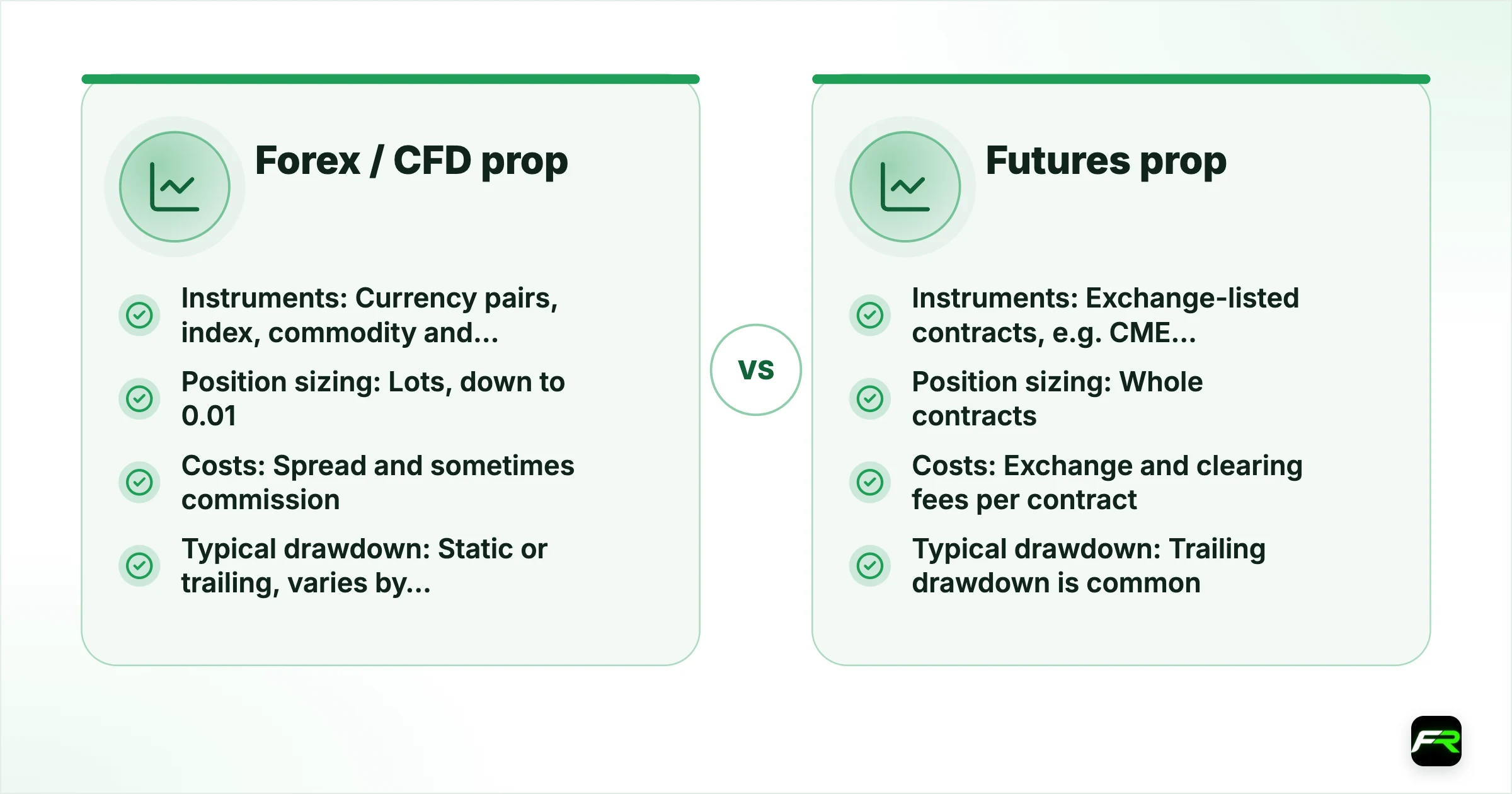
| Forex / CFD prop | Futures prop | |
|---|---|---|
| Instruments | Currency pairs, index, commodity and crypto CFDs | Exchange-listed contracts, e.g. CME index, energy and metal futures |
| Position sizing | Lots, down to 0.01 | Whole contracts (micro contracts for small size) |
| Costs | Spread and sometimes commission | Exchange and clearing fees per contract |
| Typical drawdown | Static or trailing, varies by plan | Trailing drawdown is common |
| Example firm | FTMO: 2-Step 10% then 5%, 5% daily, 10% static | Topstep: Trading Combine, then funded accounts |
| Split | FTMO: 80–90% | Topstep: keep 90% |
What Topstep publishes
Topstep is one of the few firms to publish outcomes. For 2025 it reports that 16.8 per cent of Trading Combines were passed, that 51.8 per cent of individual participants reached the funded level in at least one Combine, that 33.3 per cent of funded participants received a payout, and that 0.71 per cent of Express Funded traders were called up to a Live Funded account. It says more than $1.5 billion has been paid out to its traders, and that Live Funded traders unlock daily payouts after 30 winning days of $150 or more.
The gap between 16.8 per cent of attempts and 51.8 per cent of people shows how many traders need several attempts. The step from funded to paid is the harder one.
Which suits you
- Forex prop if you trade currency pairs, use MetaTrader expert advisors, or want very small position sizes.
- Futures prop if you trade US index futures or commodities intraday, want exchange-traded prices, and are comfortable with whole-contract sizing.
- Either way, read the drawdown rule first. Trailing drawdowns are more common on futures plans and change how you manage winning trades.
Our prop firm rules compared has the forex and futures firms in separate tables.
Futures are leveraged too. A single E-mini contract moves in large increments; use micro contracts while you learn a futures firm’s rules.
Frequently asked
What is the difference between forex and futures prop firms?
Forex prop firms run CFD accounts on platforms like MetaTrader for currencies, indices and commodities. Futures prop firms use exchange-listed contracts such as CME futures, with whole-contract sizing, per-contract fees and often trailing drawdowns.
Is Topstep a forex or futures prop firm?
A futures prop firm. Traders use exchange-listed futures in its Trading Combine and funded accounts, and Topstep says funded traders keep 90 per cent of profits.
What percentage of traders pass Topstep?
Topstep reports that 16.8 per cent of Trading Combines were passed in 2025, that 51.8 per cent of participants reached the funded level in at least one Combine, and that 33.3 per cent of funded participants received a payout.
Can I trade forex at a futures prop firm?
Only as currency futures listed on an exchange, not spot forex pairs. Some firms, such as FundedNext, offer separate CFD and futures programmes.
Related reading
The team behind this guide
Researched, checked and approved by five forex specialists
Every guide is written, fact-checked and edited before it goes live, and updated when the facts change. Spotted an error? Tell us.