IC Markets





























Negative Free Margin in MT5: What It Means and What to Do
Free margin turns negative when open losses push equity below the margin your trades use. You cannot open new trades, pending orders may not fill, and a stop out may be close. Here is what to do.
 WriterAbir KhanWriterWrites the guides · checks every figure against primary sources View profileAbout Abir →
 Market analysisTanbir Habib RiyadForex & Crypto AnalystForex and crypto analyst · technical and fundamental analysis View profileAbout Tanbir →
 Fact-checking & riskJannatul FerdaushFact-Checker & Risk AnalystFact-checks every figure · risk analysis · Applied Statistics, University of Dhaka View profileAbout Jannatul →
 Trading reviewJowel RanaCo-Founder & Forex TraderCo-founder · forex trader · reviews guides from a trader's view View profileAbout Jowel →
 Final approvalRanjan NiskrityFounder, Owner & Forex TraderFounder and owner · forex trader · signs off every guide View profileAbout Ranjan →
Negative free margin in MetaTrader 5 means your equity has fallen below the margin your open trades are using. Free margin is equity minus used margin, so once losses push equity under the used margin, the figure goes below zero. Your margin level is then under 100%, you cannot open new positions, and if it keeps falling the broker's stop out will start closing trades.
It is a warning state, not a final one. You can still close positions, reduce size or add funds. The sooner you act, the more choice you have, because the stop out takes the decision away from you.
| Free margin | Equity minus used margin |
|---|---|
| Negative means | Used margin is above equity |
| Margin level | Below 100% |
| New trades | Blocked until free margin is positive |
| Next step if ignored | Stop out closes positions |
How free margin goes negative
When you open a trade, the broker sets aside margin from your equity. The rest is free margin, the room for new trades and for losses. As an open trade loses money, equity falls but the margin held stays the same. Once the loss eats through all of the free margin, the figure crosses zero and keeps falling.
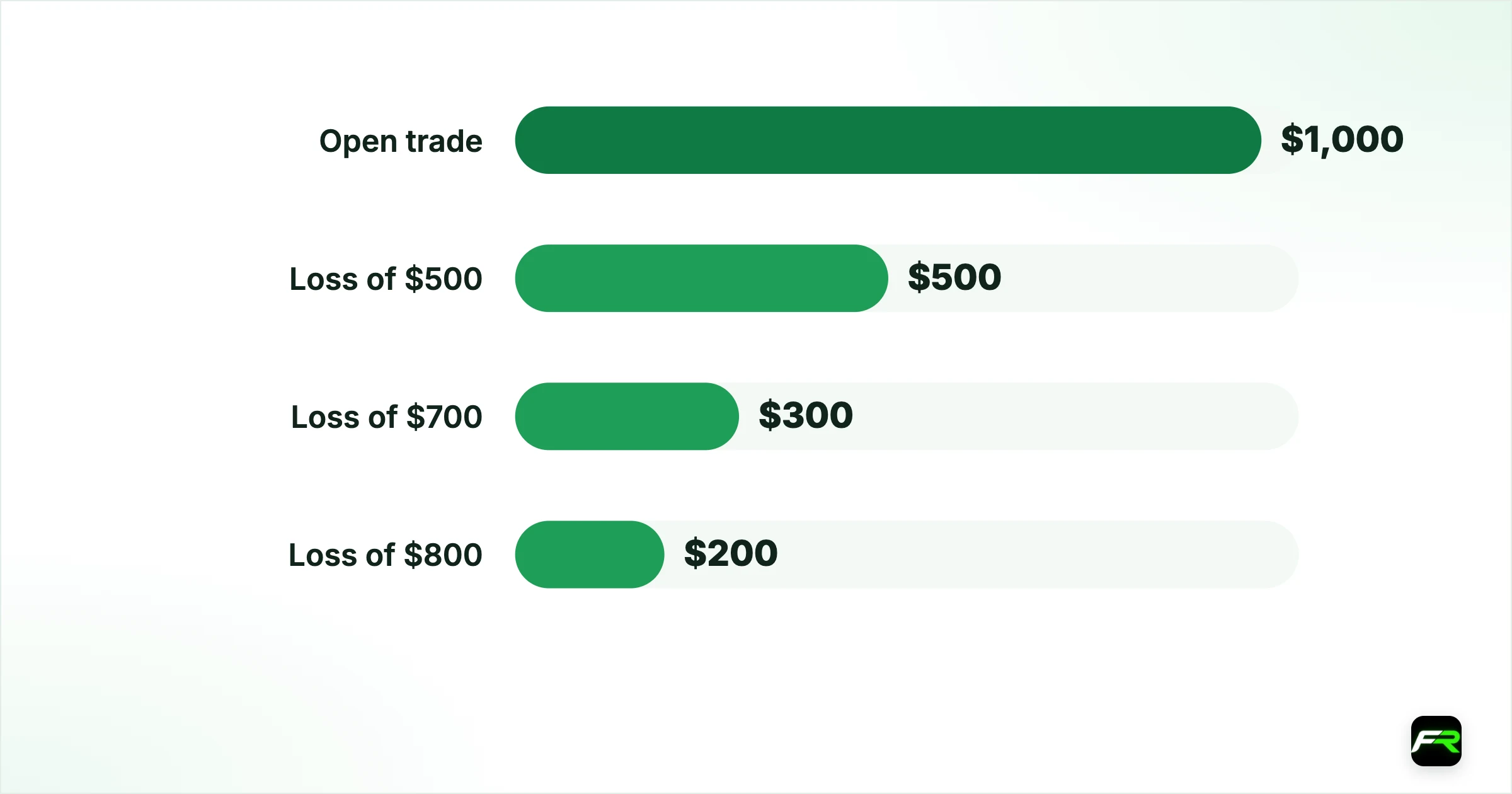
| Step | Balance | Open P/L | Equity | Used margin | Free margin |
|---|---|---|---|---|---|
| Open trade | $1,000 | $0 | $1,000 | $400 | $600 |
| Loss of $500 | $1,000 | −$500 | $500 | $400 | $100 |
| Loss of $700 | $1,000 | −$700 | $300 | $400 | −$100 |
| Loss of $800 | $1,000 | −$800 | $200 | $400 | −$200 |
In the last two rows margin level is 75% and then 50%. With a stop out at 50%, the broker would start closing positions at the last row.
What stops working
- New orders. Any order that needs margin is rejected with "Not enough money"; see our guide to the not enough money error.
- Pending orders. Orders waiting to trigger may be rejected when price reaches them, because they need margin.
- Withdrawals. Brokers only allow withdrawal of free margin, so nothing can be withdrawn while it is negative.
- Internal transfers. Moving money to another account is blocked for the same reason.
Your options, best first
- Close the position with the largest loss, or the one you trust least. This releases its margin immediately.
- Reduce position sizes with partial closes, which releases margin in proportion.
- Close one side of a hedge only if you understand the margin effect; it can make things worse.
- Add funds only if the trade still fits a written plan with a stop loss.
Waiting for the market to come back is the most common response and the most expensive. If the original stop loss was missing or moved, the position is already larger than planned.
Hedged accounts
On hedging accounts, opposite positions on one symbol often use reduced hedged margin. Closing one side removes the hedge, so the other side's margin rises to full. If free margin is already negative, that can push margin level lower immediately and bring the stop out closer. Check the effect in the order window before closing one leg.
A trader in Nairobi holds four buy positions on gold, added as price fell. Free margin shows −$150 and margin level 82%, with the broker's stop out at 50%. Closing the two oldest, largest losers releases $600 of margin. Free margin returns to about $450 and margin level rises above 200%. The trader takes a painful loss but keeps half the account, rather than letting the stop out close everything at the worst moment.
What the stop out does next
If margin level keeps falling, the broker's stop out closes positions automatically, usually the biggest loser first. Each closure releases margin and lifts margin level, so the process may stop after one or two trades. The fills are at market, so in a fast move they can be worse than the price where the stop out level was crossed. After the dust settles, check the History tab: closed trades show a comment such as "so" or "stop out" next to them.
How to avoid it
- Set a stop loss on every trade before it opens.
- Do not add to losing positions without a written plan and a total risk limit.
- Keep used margin well below a fifth of equity.
- Check exposure across correlated pairs, which can lose together.
- Reduce size before weekends and major news, when brokers may raise margin.
Watching it on your phone
The MT5 mobile app shows free margin and margin level on the Trade screen, above the list of positions. Many traders only look at profit and loss, which hides how close the account is to trouble. Get into the habit of reading margin level first. Brokers' own apps often send a push message when margin level drops below a threshold you choose, which gives earlier warning than the broker's margin call email.
Free margin vs balance vs equity
Balance is your account value from closed trades, deposits and withdrawals. Equity is balance plus the profit or loss of open trades. Margin is the deposit held for open trades. Free margin is equity minus margin. Margin level is equity divided by margin. Our guide to forex margin explains each in detail.
Negative free margin vs negative balance
Negative free margin is common and temporary. A negative balance is rarer: it happens when a stop out fills at a price so bad that losses exceed the whole account, usually after a gap. Negative balance protection, required for retail clients in the EU, UK and Australia and offered by many offshore entities, resets that balance to zero. Protection does not cover negative free margin, because the account still has money in it.
Add a free margin column to your weekly review. If it ever dipped below half of equity, the position sizes that week were too large.
Negative free margin can turn into a stop out within seconds in fast markets. Do not wait for a better price to act.
Frequently asked
What does negative free margin mean in MT5?
Your equity is below the margin your open trades use, so free margin, which is equity minus used margin, is below zero. Margin level is under 100%, new trades are blocked, and a stop out may follow if losses grow.
Can I trade with negative free margin?
You cannot open positions that need margin, and pending orders may be rejected when triggered. Closing or reducing existing positions still works, and it releases margin and can bring free margin back above zero.
Will my broker close my trades if free margin is negative?
Not immediately. Positions close when margin level reaches the broker's stop out, often between 0% and 50%. Negative free margin means margin level is below 100%, so the stop out may be close.
Can I withdraw money when free margin is negative?
No. Brokers only let you withdraw free margin, the part of equity not needed for open trades. While it is negative, nothing is available to withdraw. Close or reduce positions first.
Is negative free margin the same as a negative balance?
No. Negative free margin means equity is below used margin but still above zero. A negative balance means losses exceeded the whole account, usually after a gap, and negative balance protection may reset it to zero.
How do I fix negative free margin quickly?
Close the position with the largest loss, or partially close several positions. This releases margin immediately. Adding funds also works, but only if the trades still fit a plan with stop losses.
Official sources: MetaTrader 5 Help
Related reading
The team behind this guide
Researched, checked and approved by five forex specialists
Every guide is written, fact-checked and edited before it goes live, and updated when the facts change. Spotted an error? Tell us.