IC Markets





























Margin Call vs Stop Out: What the Difference Means, With a Worked Example
A margin call is a warning; a stop out is the broker closing your trades. Both are set as margin level percentages. Here is how the numbers work on a real account and how to stay well clear of both.
 WriterAbir KhanWriterWrites the guides · checks every figure against primary sources View profileAbout Abir →
 Market analysisTanbir Habib RiyadForex & Crypto AnalystForex and crypto analyst · technical and fundamental analysis View profileAbout Tanbir →
 Fact-checking & riskJannatul FerdaushFact-Checker & Risk AnalystFact-checks every figure · risk analysis · Applied Statistics, University of Dhaka View profileAbout Jannatul →
 Trading reviewJowel RanaCo-Founder & Forex TraderCo-founder · forex trader · reviews guides from a trader's view View profileAbout Jowel →
 Final approvalRanjan NiskrityFounder, Owner & Forex TraderFounder and owner · forex trader · signs off every guide View profileAbout Ranjan →
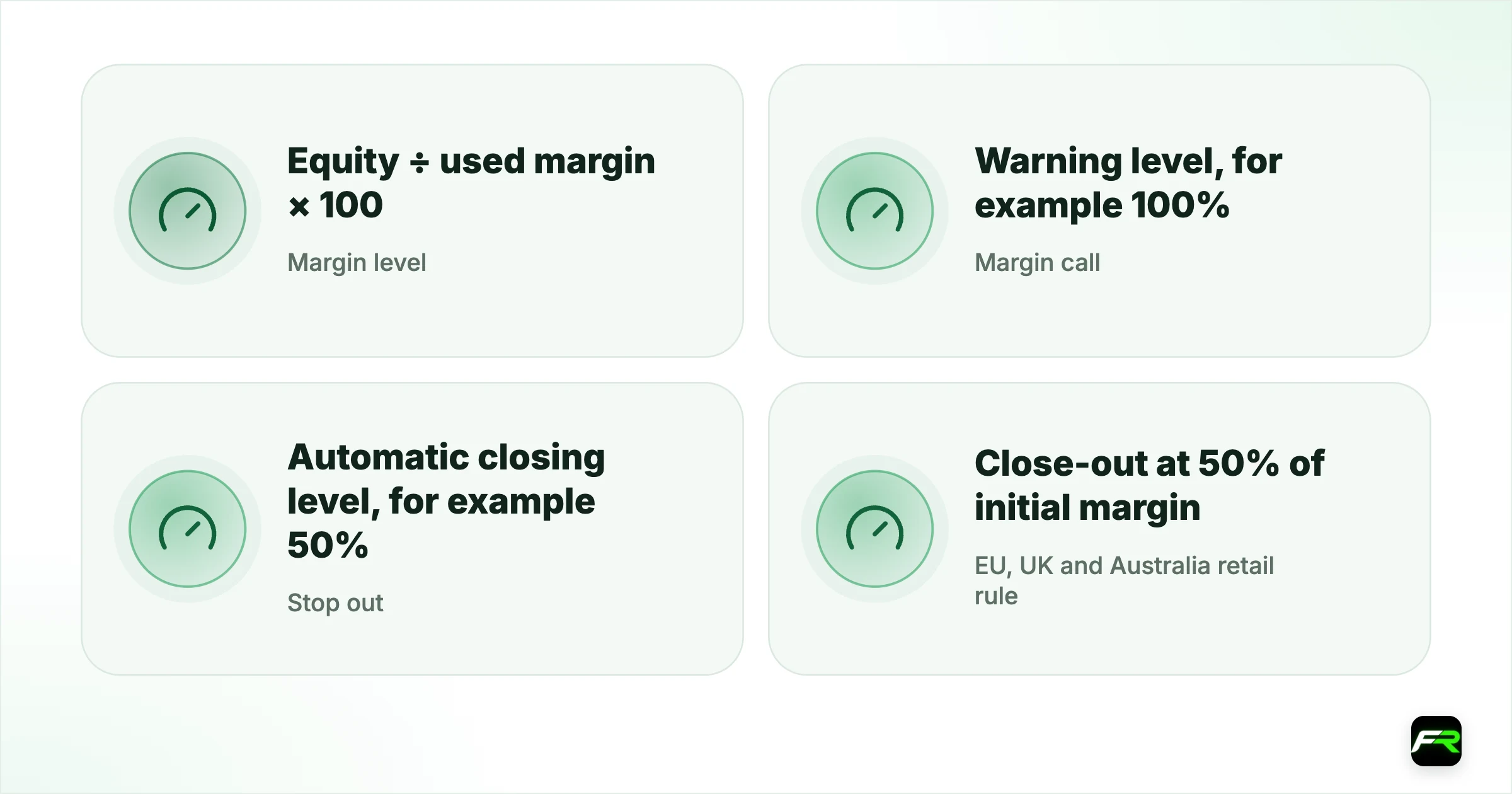
A margin call is a warning that your account is running short of usable equity. The stop out is the broker automatically closing your positions because equity has fallen further. Both are measured by margin level, which is equity divided by used margin, shown as a percentage. If your broker's margin call is 100% and its stop out is 50%, you are warned at 100% and positions start closing at 50%.
The gap between the two is your time to act: add funds, close positions or cut size. This page shows the calculation on a real-sized account, the levels brokers commonly use, the regulatory rule for retail clients in the EU, UK and Australia, and how to keep margin level far above both.
| Margin level | Equity ÷ used margin × 100 |
|---|---|
| Margin call | Warning level, for example 100% |
| Stop out | Automatic closing level, for example 50% |
| EU, UK and Australia retail rule | Close-out at 50% of initial margin |
| What closes first | Usually the position with the biggest loss |
Margin level in plain numbers
Equity is your balance plus or minus the profit or loss on open trades. Used margin is the deposit held for those trades. Margin level divides one by the other. With $1,000 equity and $200 of used margin, margin level is 500%. If losses cut equity to $400, margin level falls to 200%. At $200 equity it is 100%, and at $100 it is 50%.
MetaTrader shows margin level in the Trade tab of the Toolbox, next to balance, equity, margin and free margin. When no positions are open, used margin is zero and margin level shows blank.
A worked example on a $1,000 account
| Event | Equity | Used margin | Margin level | What happens |
|---|---|---|---|---|
| Open 0.5 lot EUR/USD at 1:100 | $1,000 | $585 | 171% | Nothing |
| Price falls 83 pips | Down to $585 | $585 | 100% | Margin call warning |
| Price falls another 58 pips | $295 | $585 | 50% | Stop out: position closed |
| After the stop out | About $295 | $0 | None | Account left with what remains |
Each pip on 0.5 lots of EUR/USD is worth $5, so 83 pips cost $415 and the next 58 pips another $290. The example uses a margin call at 100% and a stop out at 50% to show the mechanics; your broker's levels may differ.
The levels brokers use
Margin call levels are often set between 50% and 100%, and stop outs between 0% and 50%. A low stop out, such as 20% or 0%, lets positions run longer before they are closed, which sounds generous but means you can lose almost the whole account before anything happens. Higher stop outs close positions earlier, leaving more of the balance.
Our broker guides list each broker's exact levels; see XM stop out, Exness stop out, IC Markets stop out and FP Markets stop out.
The rule for retail clients in the EU, UK and Australia
The European Securities and Markets Authority requires CFD providers to close a retail client's positions when the account's funds fall to 50% of the margin needed to keep them open. Equivalent rules apply through the FCA in the UK and ASIC in Australia. Brokers' offshore entities are not bound by this and often set lower stop outs.
Which positions close first
At a stop out, most brokers close the position with the largest loss first, then recheck margin level. If it is still below the stop out, the next largest loser closes, and so on. Some close all positions at once. The broker's client agreement states the method. Positions in profit are usually closed last, if at all.
A trader in Lagos holds three trades on a $2,000 account: two small winners on gold and EUR/USD and one large loser on GBP/JPY. Margin level slides to the broker's 50% stop out during a sharp yen move. The platform closes GBP/JPY first, which lifts margin level back above 50%, so the two winners stay open. Without the GBP/JPY position, the account would never have come close.
Why stop outs often happen at worse prices
A stop out is a market order sent automatically when the level is reached. In fast markets, at the weekend open or around news, the fill can be worse than the price at which the level was crossed. That is why accounts sometimes end below the stop out level, or briefly negative. Negative balance protection, required for retail clients in the EU, UK and Australia and offered by many offshore entities, resets a negative balance to zero.
How to stay clear of both
- Size each trade so its stop loss risks 1% to 2% of equity.
- Keep used margin below about 20% of equity, which keeps margin level above 500%.
- Watch correlated positions: three trades against the dollar act like one big trade.
- Close or reduce losing trades before the margin call, not after.
- Never add funds just to hold a losing position open.
The margin calculator shows margin per trade, and the position size calculator sets the lot size from your stop.
Margin call emails and push alerts
Brokers usually send an email and a platform message when margin level reaches the margin call. MetaTrader can also push it to your phone. These warnings often arrive when price is moving fast, so they are a last line of defence, not a plan. A stop loss on every trade does the job earlier and more reliably.
Check margin level, not just profit, before the weekend. A level that looks safe on Friday can fall quickly if Monday opens with a gap.
On its own, a margin call does not stop losses on its own. If you do nothing, the stop out follows, and in fast markets the gap between the two can close in seconds.
Frequently asked
What is the difference between a margin call and a stop out?
A margin call is a warning when margin level falls to a set level, such as 100%. The stop out is the broker closing positions automatically at a lower level, such as 50%. Between them lies the time you have to add funds or reduce positions.
How is margin level calculated?
Margin level equals equity divided by used margin, times 100. With $800 equity and $400 of used margin, it is 200%. It falls as losses reduce equity, and rises as profits grow or positions close.
What happens at a stop out?
The broker closes positions automatically, usually starting with the biggest loser, until margin level is back above the stop out. Each fill is at market, so in fast markets it can be worse than the level where the stop out triggered.
What is the stop out level for retail clients in Europe?
ESMA's rules require CFD providers to close a retail client's positions when funds fall to 50% of the initial margin needed. The UK's FCA and Australia's ASIC apply equivalent rules. Offshore entities may set lower levels.
Is a 0% stop out good?
It lets positions stay open until equity nearly matches used margin, so you can lose almost all of the account before anything closes. This suits traders with strict stop losses; for others, it removes a safety net.
Can I lose more than my deposit after a stop out?
In fast markets a stop out can fill below zero equity. Negative balance protection, required for retail clients in the EU, UK and Australia and offered by many offshore entities, resets the balance to zero. Check that your entity offers it.
Official sources: MetaTrader 5 Help · ESMA: CFD product intervention measures
Related reading
The team behind this guide
Researched, checked and approved by five forex specialists
Every guide is written, fact-checked and edited before it goes live, and updated when the facts change. Spotted an error? Tell us.