 IC Markets





























Fair Use of Forex Margin in Trading
Forex margin is the portion of your funds a broker sets aside as collateral when you open a trade, giving you access to positions far larger than your account balance alone. It works hand in hand with leverage, meaning both your profits and losses are calculated on the full position size, not just what you deposited. Understanding how margin, free margin, and margin levels work is what separates traders who stay in the game from those who get wiped out by an unexpected margin call.
 WriterAbir KhanWriterWrites the guides · checks every figure against primary sources View profileAbout Abir →
 Market analysisTanbir Habib RiyadForex & Crypto AnalystForex and crypto analyst · technical and fundamental analysis View profileAbout Tanbir →
 Fact-checking & riskJannatul FerdaushFact-Checker & Risk AnalystFact-checks every figure · risk analysis · Applied Statistics, University of Dhaka View profileAbout Jannatul →
 Trading reviewJowel RanaCo-Founder & Forex TraderCo-founder · forex trader · reviews guides from a trader's view View profileAbout Jowel →
 Final approvalRanjan NiskrityFounder, Owner & Forex TraderFounder and owner · forex trader · signs off every guide View profileAbout Ranjan →
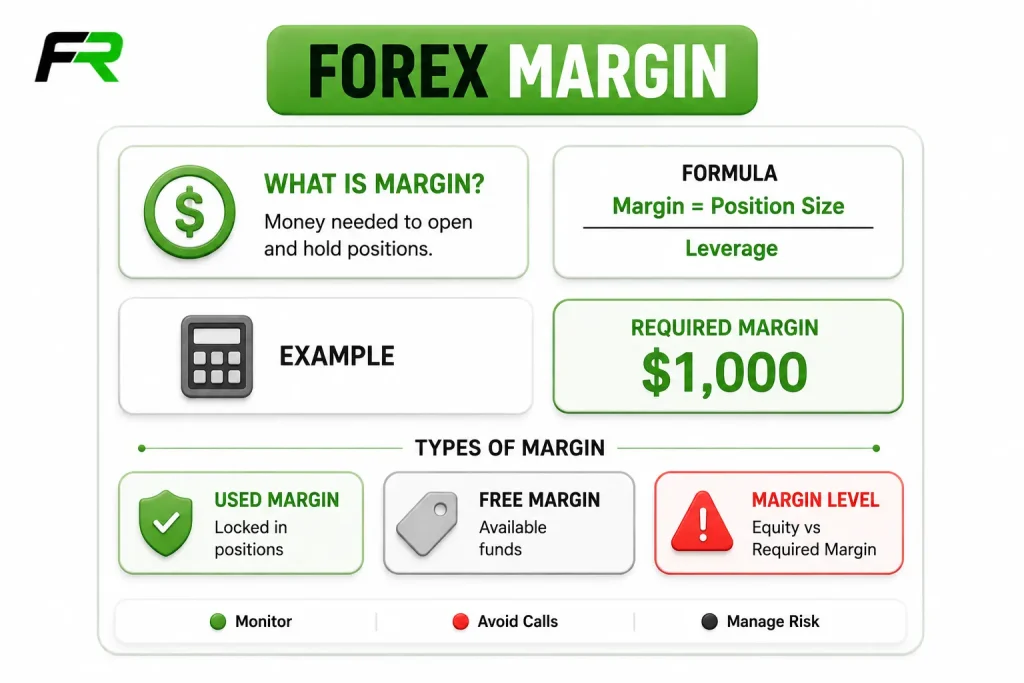
If financial terminology like forex margin sounds intimidating at first glance, you are certainly not alone. It sounds intimidating the first time you hear it.
But here is the simple version: margin is a portion of your capital that your broker temporarily locks as collateral to keep a trade open. Nothing more, nothing less.
Think of it like a deposit at a car rental place. That $500 you hand over is not the full rental cost. It is a pledge. The agency holds it while you drive off. Once you return the car, you get it back.
The same principle applies directly to currency trading. You put up a slice of your capital, your broker locks it temporarily, and when you close the trade, it comes right back.
Used with a clear head, margin is one of the most useful mechanics in forex trading. Used carelessly, it can empty an account before lunch.
This article covers exactly how margin works, the maths, the risks, the common traps, and how to trade it without getting caught off guard.
What Is Forex Margin?
Margin is not a fee. It is not a cost. It is a portion of your existing funds that gets ring-fenced the moment you open a trade.
Keep the following core principles in mind::
- Margin requirements are expressed as a percentage of the full position size, commonly referred to as the notional value.
- Once you close the trade, the margin returns to your available balance
- If you do not have enough margin, you simply cannot open the trade
So when traders say they do not have enough margin, they mean their available funds are too thin to open another position, not that they have been charged something extra.
Margin percentages vary based on several factors. A 2% margin requirement represents a 50:1 leverage ratio, requiring $2 of collateral for every $100 of notional exposure. A 5% requirement means $5 for every $100. Brokers set these figures based on their own rules, the currency pair involved, and the regulatory environment they operate under.
Reviewing how lot sizes connect to this concept is helpful background. The two concepts are tightly linked.
What Is Margin Trading?
Margin trading simply means using that collateral to control a position bigger than your account balance would normally allow.
Suppose you fund an account with $1,000; applying 10:1 leverage allows you to open a $10,000 position. Your $1,000 acts as the margin. The broker provides the remaining $9,000 in market exposure through leveraged funding.
This is where forex leverage comes in. Leverage and margin are two sides of the same coin:
- Leverage describes the multiplier, such as 30:1
- Margin describes what percentage of the position you must fund yourself
They move in opposite directions. Higher leverage means a lower margin requirement. Lower leverage means a higher margin requirement.
The buying power expansion is substantial. A trader with $500 can access positions worth tens of thousands of dollars. The risk is equally real. Losses scale up just as fast as profits.
How to Calculate Margin on a Forex Trade
Let us look at a practical calculation.
Example:
You want to trade EUR/USD. Your broker offers 30:1 leverage, which is the regulatory cap set by bodies like ESMA and the FCA for major currency pairs in retail accounts.
- Margin requirement = 1 divided by 30 = 3.33%
- One standard lot equals 100,000 units of the base currency in major forex pairs.
- Assuming EUR/USD trades at an exchange rate of 1.1000, one standard lot represents a notional valuation of $110,000.
- Margin needed = 3.33% of $110,000 = $3,663
Your broker locks that $3,663 as used margin. The rest of your account balance stays as free margin, available for new trades or to absorb any losses that come in.
If your account only holds $3,700, you are tying up almost everything in one trade.That leaves your account in a vulnerable position.
Understanding pip values matters here too. How much each pip move costs you depends on your position size, which is directly shaped by how much margin you commit.
Why Margin Requirements Differ by Broker and Pair
Two brokers. Same currency. Different margin requirements. Let us examine why.
Regulation
Tier-1 regulators such as the FCA, ASIC, and CySEC enforce strict caps on maximum retail leverage across major and minor currency pairs. Retail clients under ESMA regulations face strict leverage caps, whereas clients who qualify for professional elective status may access higher leverage. A higher leverage cap means a lower margin requirement, and vice versa.
Currency pair volatility
A major currency pair like EUR/USD or GBP/USD trades in a tight, liquid market. Brokers are comfortable offering lower margin requirements there. Exotic pairs such as USD/TRY or USD/ZAR exhibit higher volatility and reduced liquidity, prompting brokers to mandate higher margin requirements.
Broker risk model
Each broker runs its own internal models. Some are more conservative, others less so. Two regulated brokers can have legitimately different margin figures for the same pair.
This is why it pays to check the specific margin requirements before opening any trade, rather than assuming they are all the same.
Margin Calls, Free Margin and Margin Level Explained
These three terms frequently cause confusion among retail participants. The following breakdown clarifies how these metrics interact..
Used Margin
The total collateral currently locked across all your open positions.
Free Margin
Your account equity minus used margin. This is the money you can still use to open new trades or absorb losses without triggering a crisis.
Formula: Free Margin = Equity minus Used Margin
If your account has $5,000 and $2,000 is locked in trades, your free margin is $3,000.
Margin Level
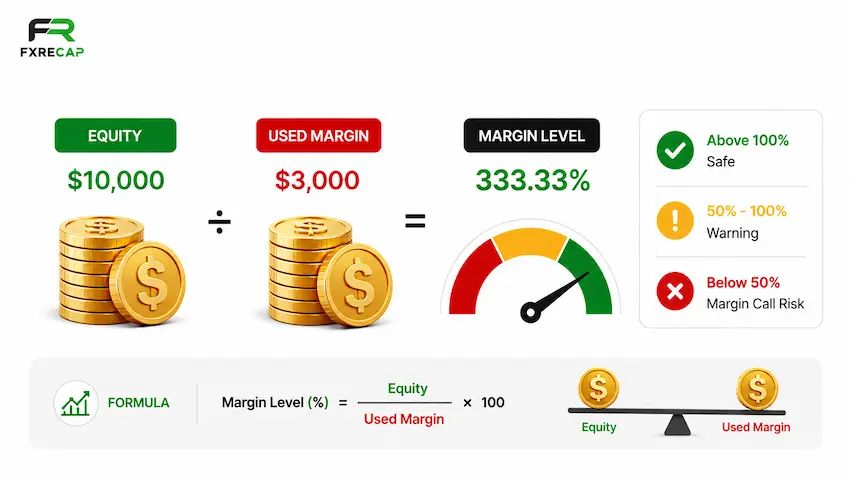
This is the early warning number. It tells you how healthy your account is relative to what is locked up.
Formula: Margin Level = (Equity divided by Used Margin) multiplied by 100%
Brokers typically issue a margin call when the margin level drops to 100%, followed by an automatic position liquidation (stop-out) if it reaches levels like 50%. At that point, they will ask you to deposit more funds or start closing your positions.
A real example of how this plays out:
Consider a trader named Sarah who committed a major portion of her balance to a single EUR/USD trade. She had $4,000 equity and $3,200 tied up as used margin, leaving only $800 free. The market moved against her. As losses chipped away at her equity, her margin level slid from 125% down past 110%. The broker triggered a margin call. Sarah had to either deposit more cash or watch the broker automatically close her position.
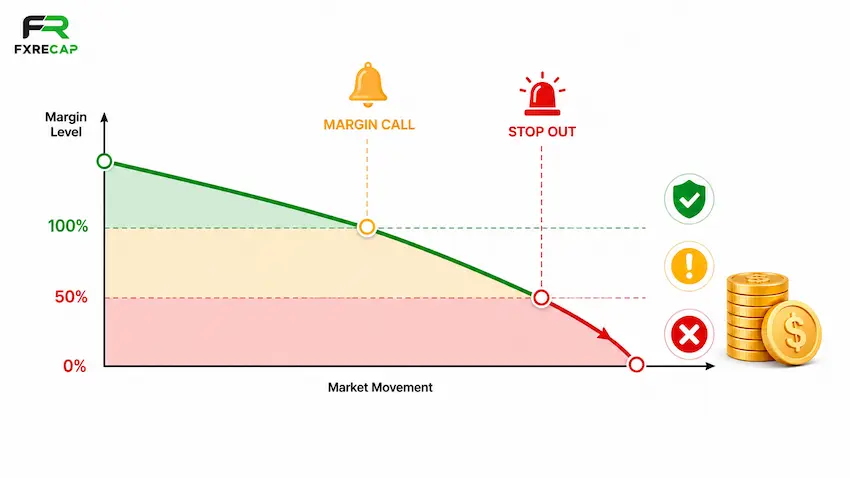
This mechanism is designed for account protection rather than penalty.It is a protection mechanism. The way to avoid it is to keep free margin healthy in the first place.
A practical guide to forex risk management covers the broader discipline behind keeping situations like Sarah’s from arising.
Margin vs. Leverage
People use these words interchangeably, but they describe different things.
| Margin | Leverage | |
| What it is | % of position you must fund | Multiplier of your buying power |
| Example | 2% margin requirement | 50:1 leverage |
| Direction | Higher margin = less leverage | Higher leverage = less margin needed |
A 1% margin requirement means 100:1 leverage. A 5% margin requirement means 20:1 leverage. These metrics remain mathematically linked.
Brokers display one or the other depending on their interface. Understanding both means you will not be caught off guard when the figures look different on paper.
More detail at what is forex leverage.
Risks and Rewards of Margin Trading
Potential Advantages
You can take positions that your raw capital would not otherwise reach. In forex, standard lots are $100,000 in size and no retail trader funds that outright. Margin makes meaningful position sizing possible for ordinary accounts.
Profits are calculated on the full notional position, not just your margin. A $500 gain on a $10,000 position is a 5% return, not 0.05%.
Associated Risks
The same maths applies to losses. A position that moves against you can eat through your margin faster than many new traders expect.
During high-impact macroeconomic releases or market open gaps, sudden liquidity vacuums can cause prices to skip past specified stop-loss levels. If a pair moves sharply through your stop loss, your loss can exceed your margin deposit. Regulated brokers in jurisdictions like the EU, UK, and Australia mandate negative balance protection for retail accounts, whereas unregulated offshore brokers may not.It is worth checking before you open an account.
Ed Seykota, one of the more clear-eyed trading thinkers, framed good trading as three things: cut losses, let profits run, and know when to stay in a trade. Margin trading trips people up most on the first one. Losses that should have been small become account-threatening because leverage amplified them.
Stop loss and take profit orders are not optional when trading with margin. They are the basic infrastructure that keeps a bad trade from becoming a crisis.
How to Use Margin Prudently
A few practical rules that experienced traders generally stick to:
1. Risk a fixed percentage per trade
Professional risk management frameworks commonly restrict risk exposure to 1% to 2% of total account equity per individual trade. With leverage, your actual position size will be larger, but your defined loss is capped at that slice.
2. Use stop losses without exception
Every margined trade needs a stop loss. Not most trades. Every trade. The leverage that makes margin attractive is the same thing that makes an unprotected position dangerous.
3. Do not max out available leverage
Just because a broker offers 100:1 does not mean using it makes sense. Experienced retail traders often maintain conservative effective leverage between 5:1 and 20:1 to mitigate catastrophic drawdown risks.
4. Watch your free margin actively
If free margin is running low, that is not just a number. It is a signal that one bad move could trigger a margin call. Pull back, or close a position to free up room.
5. Size trades to match your margin buffer
Your total used margin across all open positions should leave a comfortable buffer. Prudent capital allocation guidelines often suggest keeping total used margin well below 30% of total account equity to maintain a healthy safety buffer.
Learning about forex trading strategies will help you see how position sizing and margin interact in real approaches.
Common Trader Confusions
My broker suddenly reduced my available margin. Let us explore the primary reasons behind these variations.
This typically happens when an open trade incurs a loss that erodes your account equity. Account equity is calculated as the current account balance combined with floating unrealized profits and losses from open positions. If a trade is running at a loss, your equity drops, which in turn reduces your free margin even if no new trades were opened. This behavior aligns with standard brokerage risk-management protocols.The maths just caught up.
Do I pay interest on margin in forex?
Margin itself is not a loan in the traditional sense, so there is no interest charge on it. Swap or rollover fees are applied when holding positions past the daily market rollover at 5:00 PM New York time, reflecting interest rate differentials. Some pairs have positive swaps, some negative, depending on the interest rate differential between the two currencies. Traders should verify their broker’s specific financing or swap rates prior to maintaining open positions across the daily rollover.
Can I lose more than my account balance?
Yes, in some cases. If a market gaps sharply and your stop loss does not execute at the expected price, losses can exceed your margin deposit. Brokers that offer negative balance protection will absorb anything beyond zero, but not all do. Regulated brokers across the EU, UK, Australia, and other tier-1 regions are legally required to provide negative balance protection for retail traders. Check the terms before opening an account.
A Real Trade with Margin: Joe’s Story
Joe has a $2,000 account. His broker offers 100:1 leverage, meaning a 1% margin requirement.
He identifies a technical setup on EUR/USD and opens a standard lot equivalent to a $100,000 position.
- Margin required: 1% of $100,000 = $1,000
- Account balance: $2,000
- Free margin remaining: $1,000
The trade goes his way. EUR/USD moves 50 pips in his favour. At $10 per pip on a standard lot, that is $500 profit. Account jumps to $2,500.
But say it moves 50 pips against him instead. He is now down $500. Account equity: $1,500. Free margin has thinned to $500. One more bad move and the broker may issue a margin call.
Joe learns two things from this. Margin gave him access to a $100,000 position from a $2,000 account. That is the power. But half his account was locked into one trade. That is the exposure.
Next time, Joe uses a mini lot ($10,000 position), needs only $100 in margin, and keeps $1,900 as a buffer. Same trade, same direction, but far less danger if it turns against him.
This is also where understanding forex account types becomes useful. The account type affects lot sizes, spreads, and in some cases margin requirements.
Wrapping Up
Forex margin is not complicated once you see it for what it is: a deposit that temporarily locks up part of your capital while a trade is open.
The complexity primarily stems from attached leverage and the sequence of consequences when trades move against you. Free margin shrinks, margin level drops, margin calls arrive.
The traders who use margin well are not the ones who take the biggest positions. They are the ones who keep their free margin healthy, size positions sensibly, and treat a stop loss as non-negotiable.
Before your next trade, ask yourself: how much of my account is going into used margin? What is left over as a buffer? If those numbers make you uncomfortable, that is worth listening to.
A good place to build on this foundation: start trading forex as a beginner covers the broader context of how all these concepts come together in a live account.
Further reading:
Forex Market Basics | Forex Quotes | Bid and Ask | Forex Spread | Forex Market Hours
The team behind this guide
Researched, checked and approved by five forex specialists
Every guide is written, fact-checked and edited before it goes live, and updated when the facts change. Spotted an error? Tell us.
Related Articles
 Education
5 min read
Education
5 min read

 Education
7 min read
Education
7 min read
 Education
8 min read
Education
8 min read
 Education
7 min read
Education
7 min read
 Education
9 min read
Education
9 min read
 Education
7 min read
Education
7 min read