 IC Markets




































Is a Funded Prop Account Real Money?
Usually not. Most funded accounts are simulations, and your payout is the firm paying you from its own funds. A few firms do move their best traders onto real capital.
 WriterAbir KhanWriterWrites the guides · checks every figure against primary sources View profileAbout Abir →
 Market analysisTanbir Habib RiyadForex & Crypto AnalystForex and crypto analyst · technical and fundamental analysis View profileAbout Tanbir →
 Fact-checking & riskJannatul FerdaushFact-Checker & Risk AnalystFact-checks every figure · risk analysis · Applied Statistics, University of Dhaka View profileAbout Jannatul →
 Trading reviewJowel RanaCo-Founder & Forex TraderCo-founder · forex trader · reviews guides from a trader's view View profileAbout Jowel →
 Final approvalRanjan NiskrityFounder, Owner & Forex TraderFounder and owner · forex trader · signs off every guide View profileAbout Ranjan →
“Funded” suggests the firm has put its money in your hands. At most retail prop firms that is not what happens. The account you trade after passing is a simulation, the profits on it are simulated, and the payout is a real payment the firm makes to you under its contract.
What the firms say
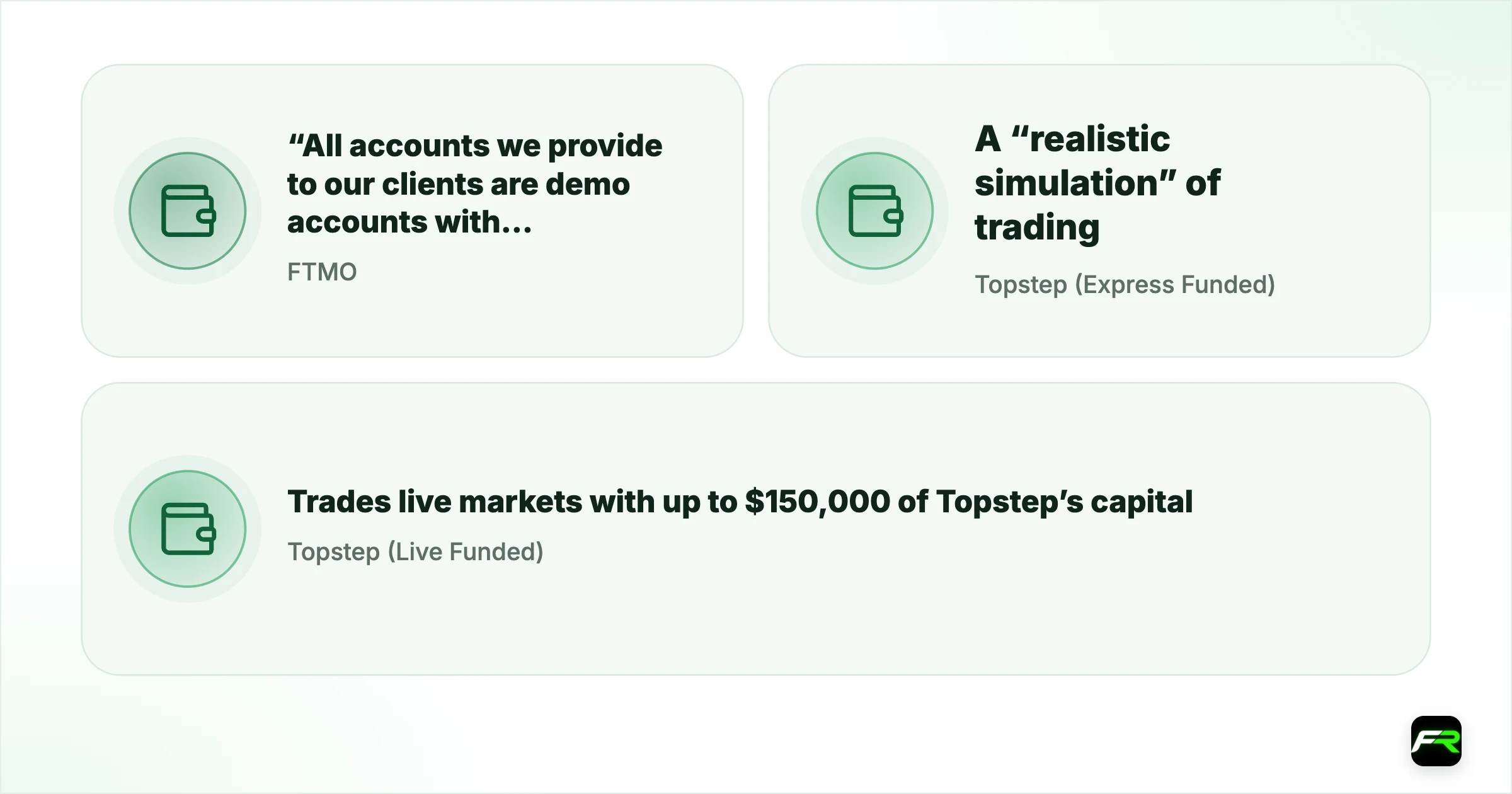
| Firm | What the account is | Source |
|---|---|---|
| FTMO | “All accounts we provide to our clients are demo accounts with fictitious funds”; rewards are a share of simulated profit | FTMO’s FAQ |
| Topstep (Express Funded) | A “realistic simulation” of trading | Topstep’s risk disclosure |
| Topstep (Live Funded) | Trades live markets with up to $150,000 of Topstep’s capital | Topstep’s site |
Topstep shows how rare the real-capital step is. It reports that in 2025 only 0.71 per cent of traders on its Express Funded Accounts were called up to a Live Funded Account.
Are the payouts real?
Yes, at firms that pay. FTMO reports more than $650 million paid in rewards and Topstep more than $1.5 billion paid out. The money is real; it simply does not come from your trades reaching a market. It comes from the firm’s revenue, mostly challenge fees. Our guide to how prop firms make money explains the model.
Why it matters
- Your payout depends on the firm’s finances. If it runs short of cash, it can delay or stop paying, whatever your account shows.
- The firm sets the terms. Payouts follow its contract, including reviews for banned strategies.
- Execution may differ from a live market. Simulated fills can be kinder, or harsher, than real ones.
- There is no client money of yours at risk beyond the fee, which is the model’s main advantage.
Treat a funded balance as a promise, not savings. Take payouts on the firm’s earliest schedule rather than letting profit build up; see what happens if a prop firm closes.
Frequently asked
Is a prop firm funded account real money?
Usually not. Most retail funded accounts are simulations; FTMO, for example, says its accounts are demo accounts with fictitious funds. The payout you receive is real money paid by the firm under its contract.
Do any prop firms give you real capital?
A few move top traders to live accounts. Topstep's Live Funded Account trades live markets with up to $150,000 of Topstep's capital, but it reports that only 0.71 per cent of Express Funded traders were called up to Live in 2025.
Where does the payout money come from?
From the firm's own revenue, mainly challenge fees, since the trading itself is simulated. That is why a firm's financial health matters to whether you are paid.
Can I lose more than the challenge fee?
Not on a simulated prop account. Your financial risk is the fee and any add-ons; the trading losses are simulated.
Related reading
The team behind this guide
Researched, checked and approved by five forex specialists
Every guide is written, fact-checked and edited before it goes live, and updated when the facts change. Spotted an error? Tell us.