 IC Markets




































What Happens to Your Account if a Prop Firm Closes
If a prop firm closes, a simulated funded account usually has no value of its own. What you can recover depends on what the firm owes you, and how quickly you act.
 WriterAbir KhanWriterWrites the guides · checks every figure against primary sources View profileAbout Abir →
 Market analysisTanbir Habib RiyadForex & Crypto AnalystForex and crypto analyst · technical and fundamental analysis View profileAbout Tanbir →
 Fact-checking & riskJannatul FerdaushFact-Checker & Risk AnalystFact-checks every figure · risk analysis · Applied Statistics, University of Dhaka View profileAbout Jannatul →
 Trading reviewJowel RanaCo-Founder & Forex TraderCo-founder · forex trader · reviews guides from a trader's view View profileAbout Jowel →
 Final approvalRanjan NiskrityFounder, Owner & Forex TraderFounder and owner · forex trader · signs off every guide View profileAbout Ranjan →
Prop firms do close: after a payment processor drops them, a platform provider withdraws their licence, payouts outgrow fee income, or a regulator steps in. Because most funded accounts are simulations, what you lose and what you can claim are different from a broker failing.
What you lose
- Unpaid profit. A simulated balance is not money held for you. If the firm stops paying, profit awaiting payout may never arrive.
- Challenge fees in progress, and any refund you were due with a first payout.
- Your track record with that firm, including scaling progress.
You do not lose deposited trading capital, because you never deposited any. That is the one advantage of the model when a firm fails.
Compared with a broker failing
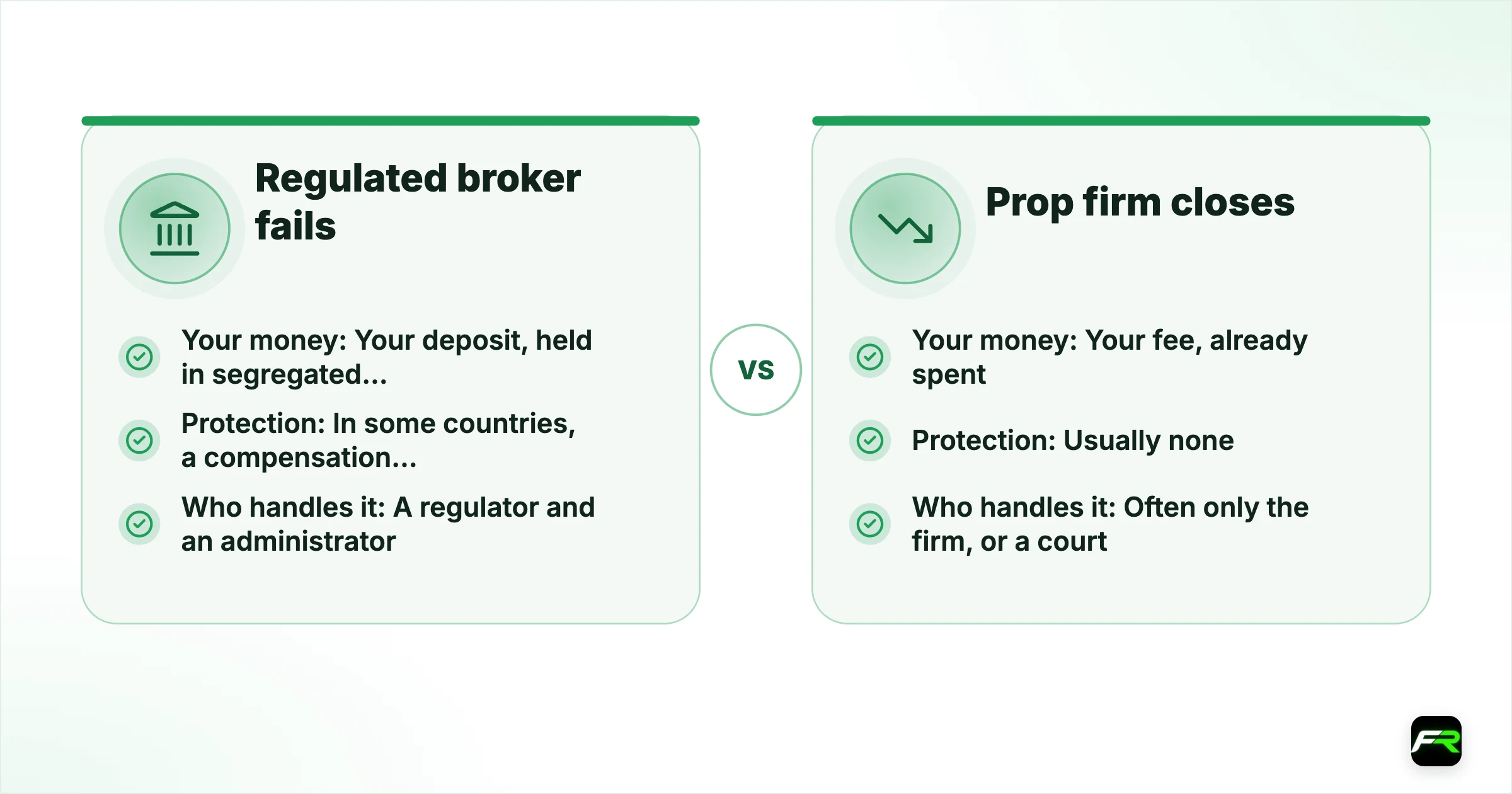
| Regulated broker fails | Prop firm closes | |
|---|---|---|
| Your money | Your deposit, held in segregated client accounts | Your fee, already spent; profit is a claim on the firm |
| Protection | In some countries, a compensation scheme | Usually none |
| Who handles it | A regulator and an administrator | Often only the firm, or a court |
What to do
- Request any payout you are eligible for immediately, in writing.
- Save dated screenshots of your account, payout history, fees paid and every message.
- If you paid by card or a payment service recently, ask whether a dispute or chargeback is possible.
- Find the firm’s legal entity and check its country’s company register for insolvency notices.
- If a regulator or court is involved, follow its notices for how claims are handled.
Two traders at a firm that starts delaying payouts both have $2,000 in profit. One requests a payout the day delays are reported and is paid within the week. The other waits to reach a bigger balance, and the firm stops paying a month later. Taking the smaller payout early was the protection.
How to limit the risk in advance
- Take payouts on the firm’s earliest schedule rather than building a balance.
- Spread across firms rather than scaling up with one.
- Favour firms with a long, dated payout record.
- Watch for slower payouts and changing rules, the usual signs before a closure.
Which prop firms have shut down covers the closures so far, including the My Forex Funds case.
Frequently asked
What happens to my funded account if a prop firm closes?
Usually the simulated account has no value of its own. You lose profit awaiting payout, fees in progress and your record with the firm, but not deposited capital, since you never deposited any.
Can I get my money back if a prop firm shuts down?
Sometimes part of it. Request any eligible payout immediately, keep records, ask your card or payment provider about disputes, and follow any regulator or court notices about claims.
Is there compensation if a prop firm fails?
Usually not. Compensation schemes cover clients of regulated brokers and investment firms, and most prop firms are not regulated as such.
How do I protect myself from a prop firm closing?
Take payouts early and often, spread across firms, choose firms with a long payout record, and watch for slower payouts and changing rules.
Related reading
The team behind this guide
Researched, checked and approved by five forex specialists
Every guide is written, fact-checked and edited before it goes live, and updated when the facts change. Spotted an error? Tell us.