 IC Markets




































A-Book vs B-Book Prop Firms, and Why It Affects Your Payout
Whether your trades reach a real market decides how a prop firm earns, what it can afford to pay, and what happens when too many traders win.
 WriterAbir KhanWriterWrites the guides · checks every figure against primary sources View profileAbout Abir →
 Market analysisTanbir Habib RiyadForex & Crypto AnalystForex and crypto analyst · technical and fundamental analysis View profileAbout Tanbir →
 Fact-checking & riskJannatul FerdaushFact-Checker & Risk AnalystFact-checks every figure · risk analysis · Applied Statistics, University of Dhaka View profileAbout Jannatul →
 Trading reviewJowel RanaCo-Founder & Forex TraderCo-founder · forex trader · reviews guides from a trader's view View profileAbout Jowel →
 Final approvalRanjan NiskrityFounder, Owner & Forex TraderFounder and owner · forex trader · signs off every guide View profileAbout Ranjan →
The terms come from brokerage. An A-book broker passes your orders to the market; a B-book broker takes the other side itself. Prop firms use the same words for a related question: is your funded account trading real money in a real market, or is it a simulation the firm pays out on?
The three models
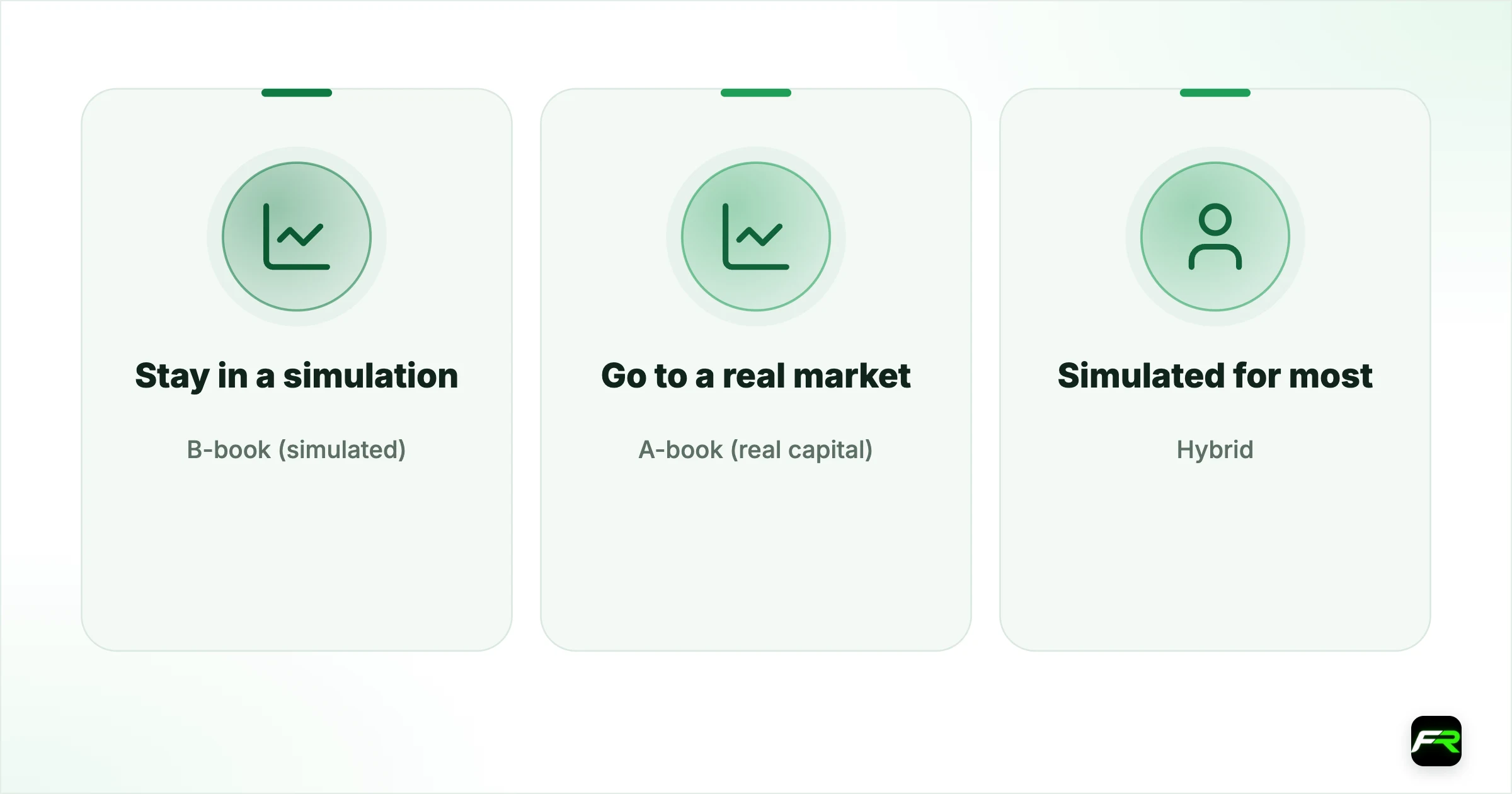
| Model | Your trades | Where payouts come from | Main risk to you |
|---|---|---|---|
| B-book (simulated) | Stay in a simulation | The firm’s revenue, mostly fees | The firm runs short of cash if payouts outgrow sales |
| A-book (real capital) | Go to a real market | Real trading profit, shared | Fewer firms; strict selection |
| Hybrid | Simulated for most; real for proven traders | Both | Depends on how many traders are moved to real capital |
Most retail forex prop firms are B-book: FTMO, for example, says its accounts use fictitious funds. Topstep is closer to a hybrid: its Combine and Express Funded Accounts are simulated, and a small share of traders, 0.71 per cent of Express Funded traders in 2025, are called up to a Live Funded Account trading Topstep’s capital.
Why it affects your payout
In a B-book firm, every payout is a cost to the firm, paid from fees. The firm stays healthy as long as fee income comfortably exceeds payouts. That gives B-book firms a reason to keep rules strict and to scrutinise payouts closely, and it is why a sudden run of winning traders, or a drop in new sign-ups, can push a weak firm into delaying or stopping payouts.
A firm that routes proven traders to real capital earns when they earn. That aligns its interest with yours, but it can afford to do it for only a few traders, which is why real-capital programmes are selective.
What to look for
- A long, dated record of payouts: the best evidence a B-book firm’s finances work.
- Clear disclosure of whether accounts are simulated. Established firms state it.
- A route to real capital, if offered, with published criteria.
- Stable payout rules. Firms under financial strain tend to tighten rules first.
Neither model is a scam in itself. A simulated model that is disclosed and pays reliably is the industry norm; what matters is whether the firm can keep paying. See how to check a firm actually pays.
Frequently asked
What is a B-book prop firm?
A firm whose funded accounts are simulations, paying traders a share of simulated profit from its own revenue, mostly challenge fees. Most retail forex prop firms work this way; FTMO says its accounts are demo accounts with fictitious funds.
What is an A-book prop firm?
A firm that puts traders' orders into real markets with its own capital and shares the real profit. Few retail firms do this for most traders; some, such as Topstep with its Live Funded Account, move a small share of proven traders to real capital.
Is a B-book prop firm a scam?
Not in itself. It is the industry's standard model and is legal when disclosed. The risk is financial: payouts depend on the firm's revenue, so check its payout record and stability.
How can I tell which model a firm uses?
Read its terms and risk disclosures: established firms say whether accounts are simulated. Look for any published route to a live account and its criteria.
Related reading
The team behind this guide
Researched, checked and approved by five forex specialists
Every guide is written, fact-checked and edited before it goes live, and updated when the facts change. Spotted an error? Tell us.