 IC Markets




































How Prop Firm Payouts Are Taxed
A prop payout is not a trading gain on your own money. In most countries that makes it income, and the details depend on where you live.
 WriterAbir KhanWriterWrites the guides · checks every figure against primary sources View profileAbout Abir →
 Market analysisTanbir Habib RiyadForex & Crypto AnalystForex and crypto analyst · technical and fundamental analysis View profileAbout Tanbir →
 Fact-checking & riskJannatul FerdaushFact-Checker & Risk AnalystFact-checks every figure · risk analysis · Applied Statistics, University of Dhaka View profileAbout Jannatul →
 Trading reviewJowel RanaCo-Founder & Forex TraderCo-founder · forex trader · reviews guides from a trader's view View profileAbout Jowel →
 Final approvalRanjan NiskrityFounder, Owner & Forex TraderFounder and owner · forex trader · signs off every guide View profileAbout Ranjan →
Because most prop accounts are simulated, a payout is not the proceeds of selling something you owned. It is a payment from the firm to you, under a contract, for trading activity. That is why tax authorities that have addressed trading income tend to treat regular trading as income rather than capital gains.
The general principles
- Payouts are usually income. SARS, for example, says frequent or business-like trading gains are taxable as ordinary income at your marginal rate.
- Fees may be costs. Whether challenge fees can be deducted depends on whether your trading counts as a business in your country.
- Currency matters. Record each payout in your local currency on the day you receive it.
- The firm usually does not deduct tax for you. Reporting is your responsibility.
By country
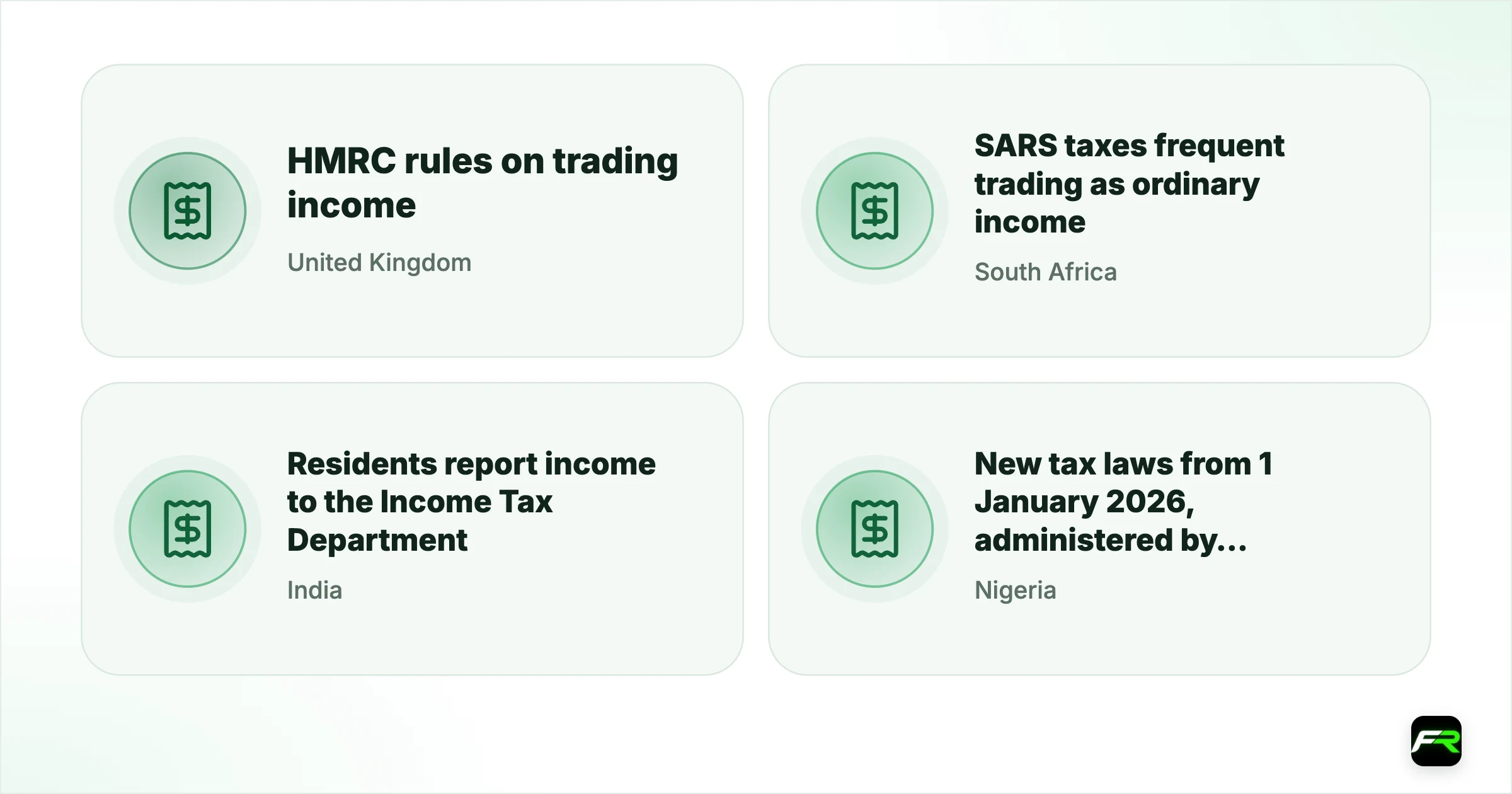
| Country | Starting point | Our guide |
|---|---|---|
| United Kingdom | HMRC rules on trading income | Prop firm payouts and UK tax |
| South Africa | SARS taxes frequent trading as ordinary income | Prop trading in South Africa |
| India | Residents report income to the Income Tax Department; RBI rules on remittances also apply | Prop trading in India |
| Nigeria | New tax laws from 1 January 2026, administered by the Nigeria Revenue Service | Prop trading in Nigeria |
| Pakistan | Income reported to the FBR; SBP rules restrict payments to offshore trading platforms | Prop trading in Pakistan |
Records to keep
- Every challenge fee, reset and add-on, with date, amount and currency.
- Every payout, with date, amount, currency and the local-currency value.
- The firm’s name, legal entity and payout statements.
- Bank or wallet statements showing money in and out.
Keep records from your first fee. If your trading becomes regular, you will need them to show income and any deductible costs.
This guide summarises official sources for general information. It is not legal or tax advice; for your own position, speak to a qualified adviser in your country.
Income or capital: why the label matters
Most tax systems treat income and capital gains differently. Income is usually taxed at your marginal rate as it arrives; capital gains often have their own rates, allowances or inclusion rules. Traders sometimes assume a trading profit is a capital gain because it came from a market. A prop payout is a weaker case for that than a gain on your own account, for three reasons.
- You never owned the position. On a simulated account there is no asset that you bought and sold. The payout is a contractual reward from the firm.
- It recurs. Payouts arrive on a schedule, every few weeks, which looks like regular income rather than a one-off disposal.
- It is a service relationship. You trade under the firm’s rules and it pays you a share; several tax authorities describe arrangements like that as income from an activity.
None of this decides your own case, which depends on your country’s law and facts. It explains why advisers usually start from the assumption that payouts are income and work from there.
Fees, refunds and losses
Fees are where prop tax gets fiddly, because the money moves both ways. A trader may pay several challenge fees, receive one back as a refund with a first payout, then pay for a reset. Keep each item as its own line in your records rather than netting them:
| Item | What to record | Why |
|---|---|---|
| Challenge fee paid | Date, firm, amount, currency, card or wallet used | May be a cost of earning income, depending on your country |
| Fee refunded with a payout | Date and amount, separately from the reward itself | A refund is not the same as a profit share |
| Payout received | Date, gross amount, any fees deducted, local-currency value | This is the figure most likely to be taxed |
| Payment or conversion fees | Each fee charged by the bank, wallet or exchange | Often a deductible cost where trading is a business |
If a firm closes owing you money, record the unpaid amount and every message about it. Whether an unpaid reward can be written off as a loss is a question for an adviser, and the records are what they will ask for.
Currency conversion
Firms pay in US dollars, euros or crypto, while your tax return is in your own currency. Use one method consistently, usually the rate on the day you received the money, and note where each rate came from. If you are paid in crypto and later convert it, the conversion may be a separate event with its own tax treatment in some countries.
A trader pays three challenge fees of $100 each, receives one refund of $100 with a first payout of $900, and two later payouts of $600 and $750. Their records show $300 of fees, $100 refunded, and $2,250 of payouts, each converted at the rate on the day. That clean list is what an adviser needs to work out the tax, whichever way the country treats it.
When to get advice
- Your payouts have become regular, or larger than a small side income.
- You trade across several firms or receive payouts in crypto.
- You are unsure whether your trading counts as a business in your country.
- You have moved country during the year, or are paid into an account abroad.
Tell an adviser which firm pays you, how often, in what currency and to which account. Those four facts settle most of the questions they will need to answer.
A simple year-end checklist
- Total payouts received, in local currency.
- Total fees, resets and add-ons paid, and refunds received.
- Payment, conversion and wallet fees.
- A list of firms and the countries they pay from.
With these four totals and the records behind them, filing becomes a short conversation with an adviser rather than a reconstruction.
The short version
Assume payouts are income, keep every fee and payout in local currency, and take advice once payouts are regular. The country guides above give the starting point for each.
Related guides
The country guides give the starting point for tax where you live, and the payout guide explains what you are being paid.
- Prop trading in India: the RBI Alert List and LRS rules.
- Prop trading in South Africa: SARS, the FSCA and the SARB allowances.
- Prop trading in Nigeria: the SEC’s position and the 2026 tax laws.
- How payouts work: splits, waiting periods, minimums and reviews.
Frequently asked
Are prop firm payouts taxable?
In most countries, yes. A payout is a payment to you for trading activity, and tax authorities generally treat regular trading as income. SARS, for example, taxes frequent or business-like trading as ordinary income.
Is a prop payout a capital gain?
Usually not. Most prop accounts are simulated, so a payout is not the proceeds of selling an asset you owned; it is a contractual payment, which points to income treatment.
Can I deduct prop challenge fees?
It depends on whether your trading counts as a business in your country. Keep records of every fee and ask a tax adviser.
Does the prop firm deduct tax?
Usually not. Reporting payouts is your responsibility, so keep records in your local currency.
Do I need to declare prop firm payouts if they are small?
Thresholds depend on your country, but in most tax systems income is declarable whatever its size, and small amounts add up over a year. Record every payout from the start so you can declare accurately.
Is a refunded challenge fee taxable?
A refund returns money you paid, which is different from a profit share. Record refunds separately from rewards and ask an adviser how your country treats them.
What exchange rate should I use for prop payouts?
Use one consistent method, usually the rate on the day you received the payout, and keep a note of its source.
Related reading
The team behind this guide
Researched, checked and approved by five forex specialists
Every guide is written, fact-checked and edited before it goes live, and updated when the facts change. Spotted an error? Tell us.