 IC Markets




































Why Most Traders Fail Prop Firm Evaluations
Most evaluations end in a breached loss limit, not a missed target. The reasons are predictable, and almost all of them are about size and behaviour, not strategy.
 WriterAbir KhanWriterWrites the guides · checks every figure against primary sources View profileAbout Abir →
 Market analysisTanbir Habib RiyadForex & Crypto AnalystForex and crypto analyst · technical and fundamental analysis View profileAbout Tanbir →
 Fact-checking & riskJannatul FerdaushFact-Checker & Risk AnalystFact-checks every figure · risk analysis · Applied Statistics, University of Dhaka View profileAbout Jannatul →
 Trading reviewJowel RanaCo-Founder & Forex TraderCo-founder · forex trader · reviews guides from a trader's view View profileAbout Jowel →
 Final approvalRanjan NiskrityFounder, Owner & Forex TraderFounder and owner · forex trader · signs off every guide View profileAbout Ranjan →
“90 per cent of traders fail” is repeated everywhere, but few firms publish their numbers. Topstep does: in 2025, 16.8 per cent of its evaluations were passed, so about five in six were not. Of those who reached a funded account, 33.3 per cent received a payout. Whatever the exact figure at a given firm, failing is the normal outcome.
Looking at how evaluations end explains why. Almost none fail because time runs out; at firms such as FTMO there is no time limit. They fail because a loss limit is hit.
The five reasons, in order of how often they appear
- Position size too large. A trader risks 2 to 3 per cent a trade to pass quickly, and three normal losses in a day breach a 5 per cent daily limit.
- Revenge trading. After a loss, the next trade is bigger or rushed to win it back, and the second loss is the one that ends the account.
- Not knowing a rule. Equity-based daily limits, trailing drawdowns and news windows catch traders who only read the headline percentages.
- No tested method. The challenge becomes the place to find out whether the strategy works, at the firm’s strictest limits.
- Pressure. Treating the fee as money that must be won back changes decisions, especially near the target.
The arithmetic behind it
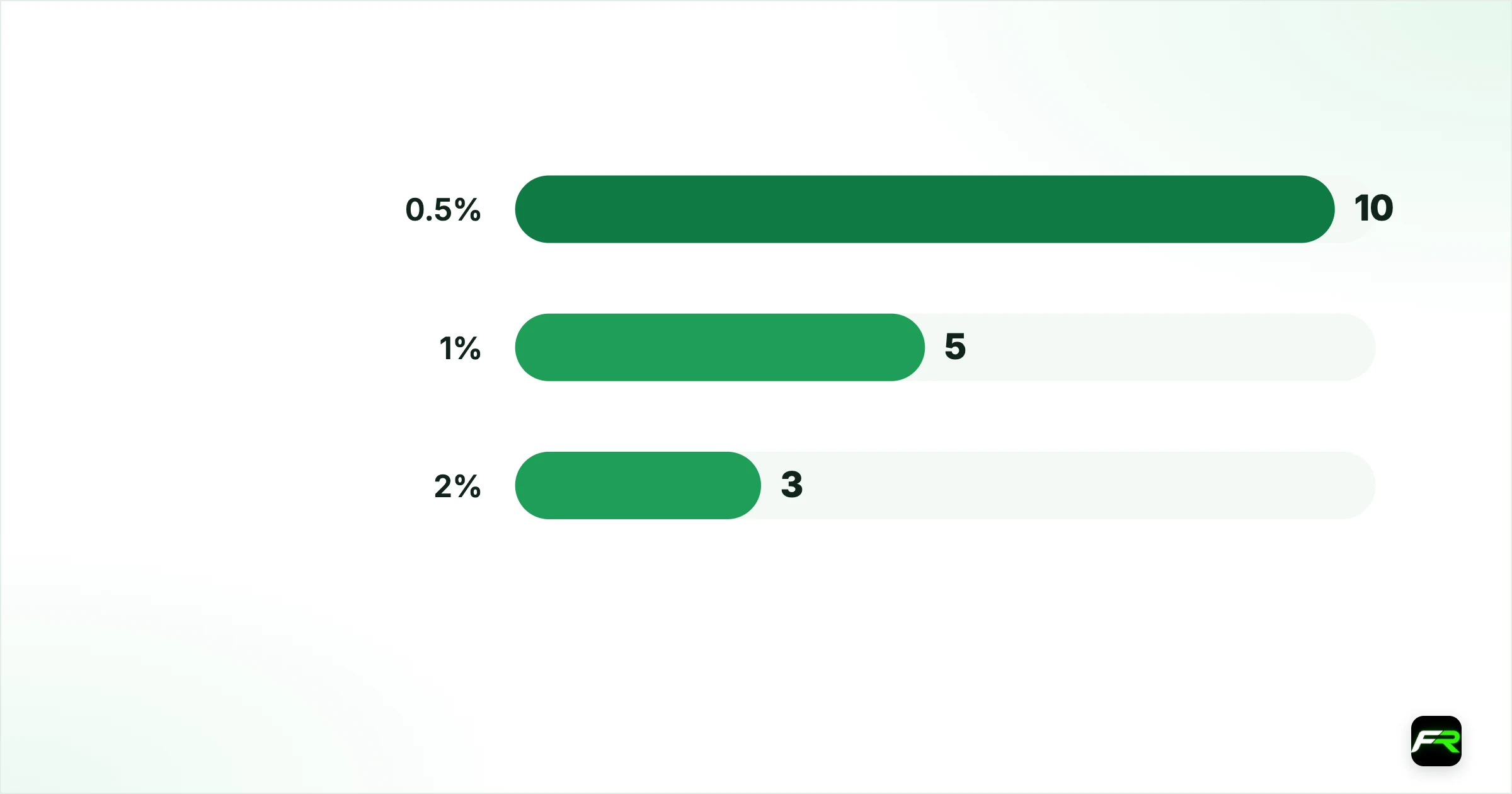
| Risk per trade | Losses in a row to breach a 5% daily limit | How often a 45% win-rate trader sees that streak |
|---|---|---|
| 0.5% | 10 | Rarely |
| 1% | 5 | Several times over a few hundred trades |
| 2% | 3 | Often, sometimes in a single day |
A trader who wins 45 per cent of the time will meet runs of five losses regularly. At 1 per cent risk that is survivable over a day only if the losses are spread out; at 2 per cent, three losses end it. The strategy is the same in every row. Only the size changes.
What the passers do differently
- Risk 0.5 to 1 per cent a trade, and less after a loss.
- Stop for the day at their own limit, well inside the firm’s.
- Know the exact rules of the plan, including how daily loss and maximum loss are measured.
- Arrive with a method already tested on a demo account under the same limits.
- Accept that passing takes weeks, not days.
Our guides to position sizing and the daily loss limit cover the two rules that end most attempts.
Nobody fails a challenge on their first loss. They fail on the trade after it. Decide in advance what you will do after a losing trade, and the challenge gets much easier.
Frequently asked
Do 90 per cent of traders fail prop firm challenges?
Few firms publish the figure. Topstep reports that 16.8 per cent of its evaluations were passed in 2025, so about five in six failed, and that 33.3 per cent of funded traders received a payout. Failing is the normal outcome.
Why do most traders fail prop firm evaluations?
Mostly because a loss limit is hit, usually through position sizes that are too large, revenge trading after a loss, or a rule the trader did not fully understand, such as an equity-based daily limit.
Is failing a prop challenge a sign my strategy is bad?
Not necessarily. Many failures come from size and behaviour rather than the method. Test the same strategy on a demo account at 0.5 to 1 per cent risk under the firm's limits before deciding.
What is the best way to avoid failing?
Risk 0.5 to 1 per cent a trade, stop for the day well inside the firm's daily limit, learn exactly how the limits are measured, and arrive with a method already tested under them.
Related reading
The team behind this guide
Researched, checked and approved by five forex specialists
Every guide is written, fact-checked and edited before it goes live, and updated when the facts change. Spotted an error? Tell us.