 IC Markets




































Position Sizing for a Prop Challenge: The Exact Math
Position size is the one setting that decides whether a bad streak ends your challenge. Here is how to work it out from the firm’s own loss limits.
 WriterAbir KhanWriterWrites the guides · checks every figure against primary sources View profileAbout Abir →
 Market analysisTanbir Habib RiyadForex & Crypto AnalystForex and crypto analyst · technical and fundamental analysis View profileAbout Tanbir →
 Fact-checking & riskJannatul FerdaushFact-Checker & Risk AnalystFact-checks every figure · risk analysis · Applied Statistics, University of Dhaka View profileAbout Jannatul →
 Trading reviewJowel RanaCo-Founder & Forex TraderCo-founder · forex trader · reviews guides from a trader's view View profileAbout Jowel →
 Final approvalRanjan NiskrityFounder, Owner & Forex TraderFounder and owner · forex trader · signs off every guide View profileAbout Ranjan →
Most failed challenges are not failed by a bad strategy. They are failed by size: a few normal losses at too large a position, and the daily or maximum loss limit is gone. Sizing from the firm’s limits backwards fixes that.
Step 1: decide risk per trade
Start from the tightest limit. On FTMO’s 2-Step, the daily loss limit is 5 per cent and the maximum loss 10 per cent of the starting account. A common rule is to risk no more than 0.5 to 1 per cent of the account per trade, so that five losing trades in a row still leave you inside the daily limit.
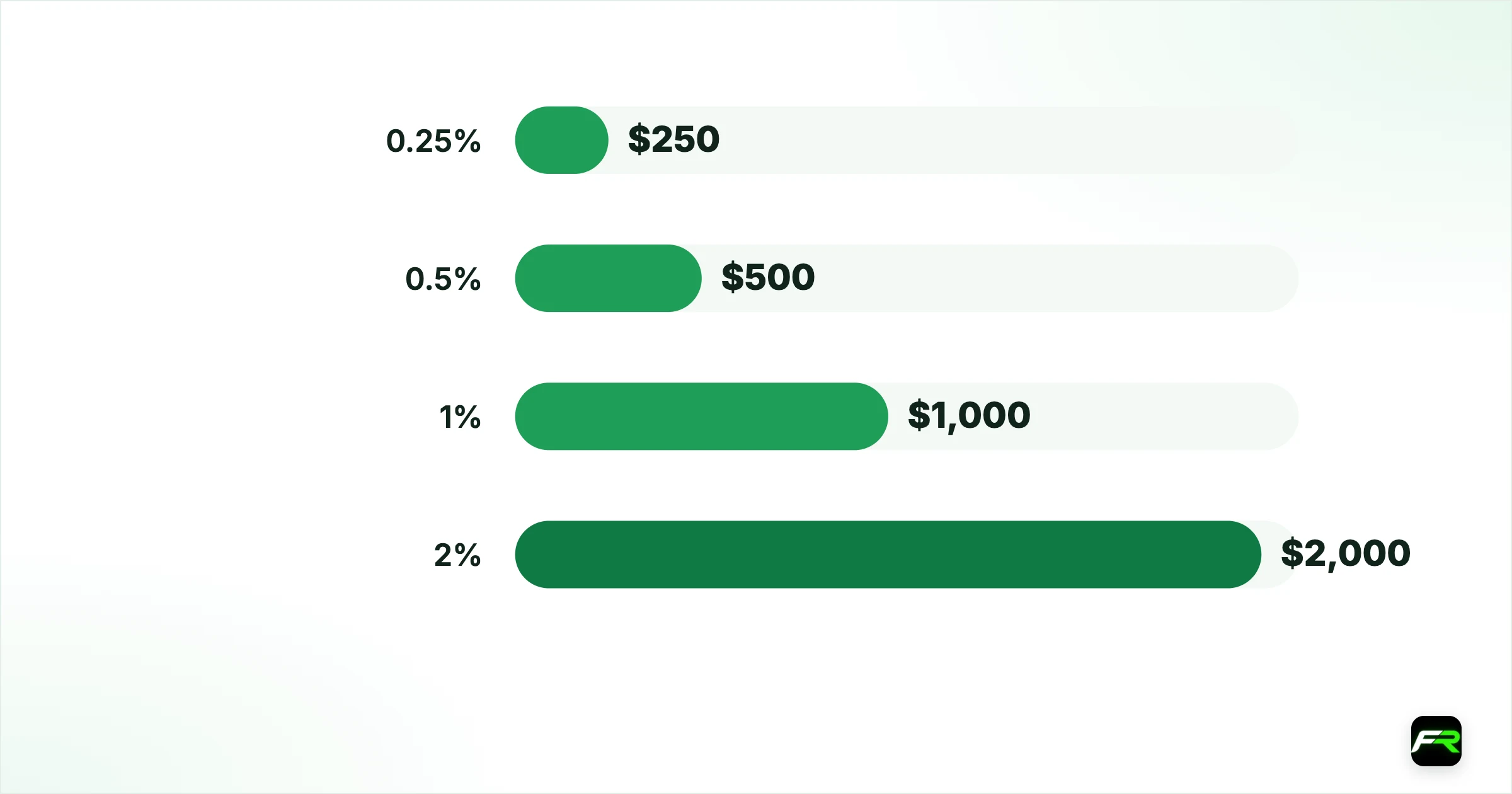
| Risk per trade | On $100,000 | Losses in a row to hit a 5% daily limit | Losses in a row to hit 10% maximum loss |
|---|---|---|---|
| 0.25% | $250 | 20 | 40 |
| 0.5% | $500 | 10 | 20 |
| 1% | $1,000 | 5 | 10 |
| 2% | $2,000 | about 3 | 5 |
At 2 per cent a trade, three ordinary losses in a day end a 2-Step account and a streak of five ends any account. At 0.5 per cent you need ten losses in one day.
Step 2: turn risk into lots
Position size in lots = money at risk ÷ (stop loss in pips × pip value per lot). On EUR/USD and other pairs quoted in US dollars, one standard lot is worth about $10 a pip.
On a $100,000 challenge, risking 0.5 per cent means $500. With a 25-pip stop on EUR/USD: $500 ÷ (25 × $10) = 2 lots. With a 40-pip stop the same risk is $500 ÷ (40 × $10) = 1.25 lots. The risk stays fixed; the lot size moves with the stop.
On pairs not quoted in dollars, such as USD/JPY, the pip value changes with the exchange rate, so recalculate it or use a calculator.
Our prop firm calculator and position size calculator do this arithmetic for you.
Step 3: cap total open risk
Firms measure equity, including open trades. Three trades open at 1 per cent risk each is 3 per cent of exposure if all three hit their stops together, which is easy when the trades are correlated, such as EUR/USD and GBP/USD long. Add up the risk of every open position and keep the total well inside the day’s remaining room.
Step 4: shrink after losses
When you are close to a limit, cut size. If you are 3 per cent down on the day against a 5 per cent limit, a full-size loss takes you to 4 per cent and a second one ends the account. Halving size after a loss, or stopping for the day at your own lower limit, keeps one bad session from ending a challenge.
Doubling size to “win back” a loss is the fastest way to fail. The target can wait; FTMO sets no time limit.
Frequently asked
How much should I risk per trade on a prop challenge?
Commonly 0.5 to 1 per cent of the account. At 0.5 per cent on a $100,000 account you would need ten losing trades in one day to reach a 5 per cent daily loss limit.
How do I calculate lot size for a prop challenge?
Divide the money you are risking by the stop loss in pips times the pip value per lot. Risking $500 with a 25-pip stop on EUR/USD, at about $10 a pip per standard lot, gives 2 lots.
Do open trades count towards the daily loss limit?
At FTMO, yes: equity, including open trades, must stay above the daily limit. Add up the risk of all open positions, especially correlated ones.
Should I trade bigger to pass faster?
No. Larger size makes a run of normal losses fatal. Most firms, including FTMO, set no time limit, so a slower pass at safe size is the better plan.
Related reading
The team behind this guide
Researched, checked and approved by five forex specialists
Every guide is written, fact-checked and edited before it goes live, and updated when the facts change. Spotted an error? Tell us.