 IC Markets




































The Mistakes That Fail a Prop Evaluation
Ten specific mistakes that end prop challenges, and the simple habit that prevents each one.
 WriterAbir KhanWriterWrites the guides · checks every figure against primary sources View profileAbout Abir →
 Market analysisTanbir Habib RiyadForex & Crypto AnalystForex and crypto analyst · technical and fundamental analysis View profileAbout Tanbir →
 Fact-checking & riskJannatul FerdaushFact-Checker & Risk AnalystFact-checks every figure · risk analysis · Applied Statistics, University of Dhaka View profileAbout Jannatul →
 Trading reviewJowel RanaCo-Founder & Forex TraderCo-founder · forex trader · reviews guides from a trader's view View profileAbout Jowel →
 Final approvalRanjan NiskrityFounder, Owner & Forex TraderFounder and owner · forex trader · signs off every guide View profileAbout Ranjan →
Prop challenges end in a small number of ways, and most of them are avoidable with a habit set up before the first trade. Here are the ten we see most, each with the fix.
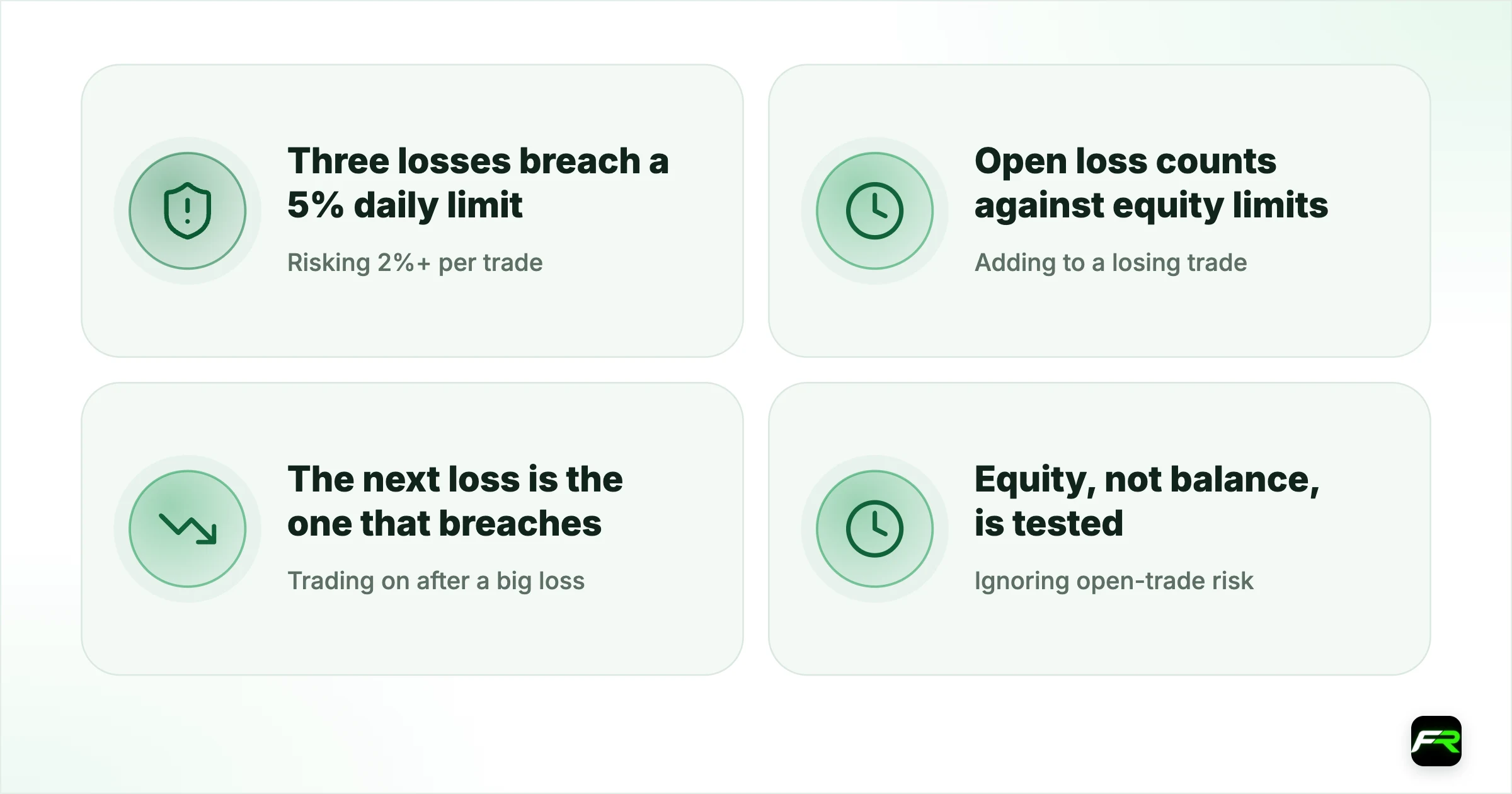
| Mistake | Why it fails you | The habit that prevents it |
|---|---|---|
| Risking 2%+ per trade | Three losses breach a 5% daily limit | Cap risk at 0.5–1% per trade |
| Adding to a losing trade | Open loss counts against equity limits | One entry per idea, stop set before entry |
| Trading on after a big loss | The next loss is the one that breaches | Stop for the day at half the firm’s limit |
| Ignoring open-trade risk | Equity, not balance, is tested | Add up the stop-loss risk of every open trade |
| Correlated positions | EUR/USD and GBP/USD long lose together | Count related pairs as one position |
| Holding through big news | Gaps jump past stops | Flatten or cut size before high-impact releases |
| Missing the daily reset time | Losses carried across the reset change the limit | Write the reset time in your own time zone |
| Misreading a trailing drawdown | Giving back profit breaches it | Know your current floor before each session |
| Token trades for minimum days | A careless trade hits the daily limit | Use minimum size with a tight stop |
| Rushing near the target | Size goes up as patience goes down | Keep the same size until the target is hit |
The two that matter most
If you fix only two, fix size and the day after a loss. Most of the table follows from those: a trader who risks 0.5 per cent a trade and stops for the day at 2.5 per cent down cannot breach a 5 per cent daily limit with one bad session.
A trader 6 per cent up on a $100,000 2-Step Challenge loses $1,500 on a news spike, then doubles size to recover it. Two more losses later, equity is $5,100 below the morning balance and the account is closed, three weeks of work gone in an hour. At half the size and a self-imposed 2.5 per cent daily stop, the same Tuesday costs $2,500 and the challenge continues.
A pre-trade checklist
- Is this trade’s risk 1 per cent or less?
- With it, is total open risk inside today’s remaining room?
- Is a restricted or high-impact release due in this market soon?
- Where is my maximum loss floor today?
- Am I taking this trade because of the setup, or because of the last result?
A challenge fee is a sunk cost. Trading to “earn it back” is the mindset behind most of the mistakes above.
Frequently asked
What is the most common mistake in prop firm challenges?
Position sizes that are too large. Risking 2 per cent or more per trade means three ordinary losses can breach a 5 per cent daily loss limit.
Should I add to a losing trade in a prop challenge?
No. Open losses count against equity-based limits, so adding to a loser increases the chance of a breach. Use one entry per idea with the stop set in advance.
Can correlated trades fail a challenge?
Yes. Pairs such as EUR/USD and GBP/USD often move together, so two positions can hit their stops at the same time. Count them as one position when sizing.
What should I do after a big loss in a challenge?
Stop for the day, ideally at your own limit of about half the firm's daily allowance. The trade after a loss is where most accounts are breached.
Related reading
The team behind this guide
Researched, checked and approved by five forex specialists
Every guide is written, fact-checked and edited before it goes live, and updated when the facts change. Spotted an error? Tell us.