 IC Markets




































What to Do After Failing a Prop Firm Challenge
Do not buy the next challenge today. Find the rule that failed you, fix the habit behind it, and prove the fix on demo first.
 WriterAbir KhanWriterWrites the guides · checks every figure against primary sources View profileAbout Abir →
 Market analysisTanbir Habib RiyadForex & Crypto AnalystForex and crypto analyst · technical and fundamental analysis View profileAbout Tanbir →
 Fact-checking & riskJannatul FerdaushFact-Checker & Risk AnalystFact-checks every figure · risk analysis · Applied Statistics, University of Dhaka View profileAbout Jannatul →
 Trading reviewJowel RanaCo-Founder & Forex TraderCo-founder · forex trader · reviews guides from a trader's view View profileAbout Jowel →
 Final approvalRanjan NiskrityFounder, Owner & Forex TraderFounder and owner · forex trader · signs off every guide View profileAbout Ranjan →
Failing a challenge costs a fee and a few weeks. Buying another one the same day, to win it back, is how one failed challenge becomes five. The useful thing to do with a failure is to learn exactly why it happened.
Step 1: name the rule
Look at the firm’s breach report. Which limit was hit, daily loss or maximum loss, and on which day? Was it a closed loss or an open trade’s equity? Was it near a news release or the daily reset?
Step 2: find the trade behind it
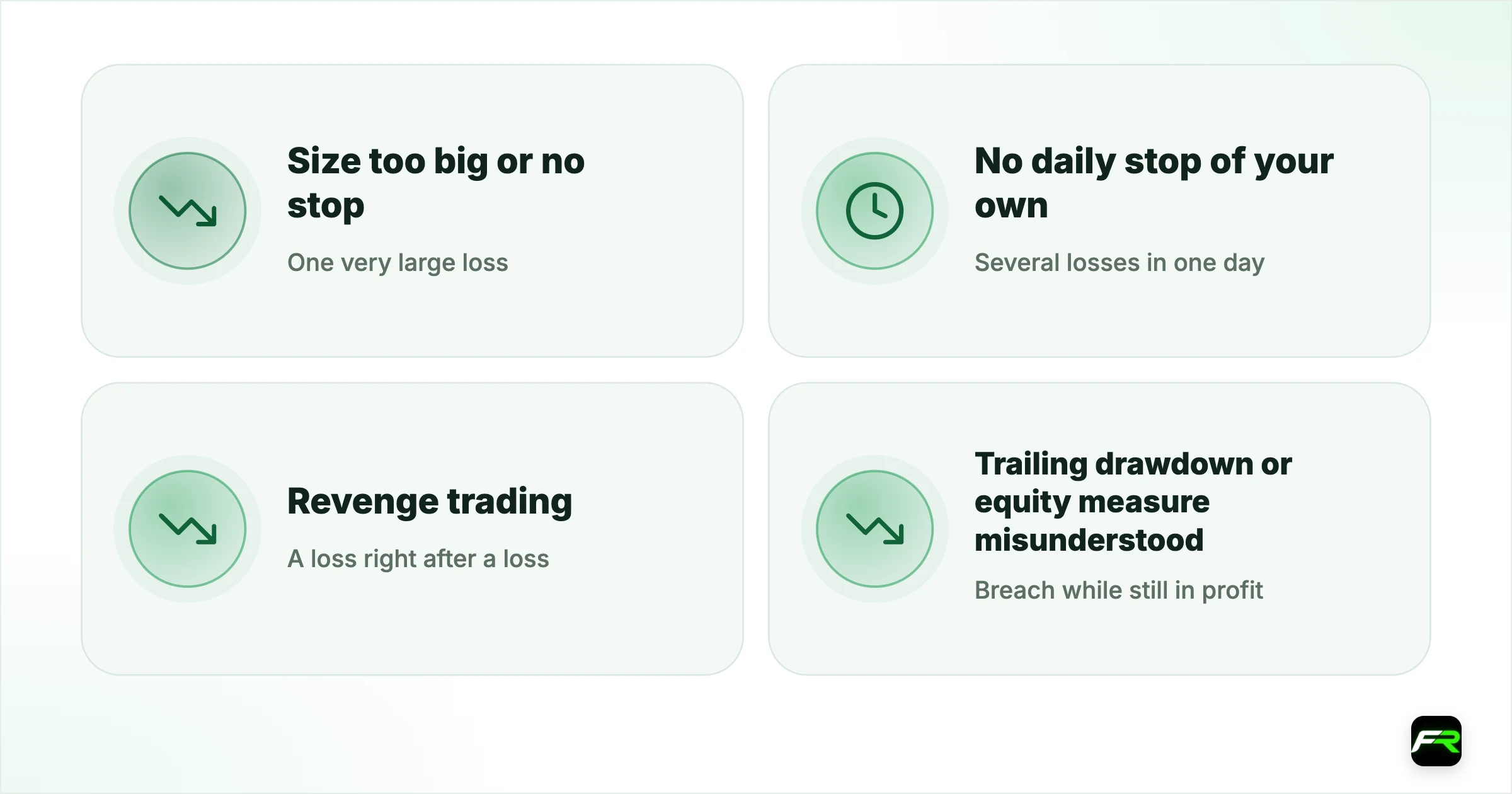
| What you find | What it usually means | The fix |
|---|---|---|
| One very large loss | Size too big or no stop | Cap risk at 0.5–1%; always place the stop at entry |
| Several losses in one day | No daily stop of your own | Stop at half the firm’s daily limit |
| A loss right after a loss | Revenge trading | Mandatory break after a losing trade |
| Breach while still in profit | Trailing drawdown or equity measure misunderstood | Track your floor before each session |
| Losses around news | Holding through releases | Flatten or cut size before high-impact events |
| Slow steady losses | The method itself is not working | Back to demo; test before paying again |
Step 3: prove the fix on demo
Trade the corrected plan on a free demo account under the same limits for two to four weeks. If it would have passed, you have a reason to pay again. If not, you have saved a fee.
Step 4: decide whether to retry
- Set a fee budget in advance, such as two attempts, and stop when it is spent.
- Consider a smaller account size: the rules are the same in percentage terms and the fee is lower.
- Prefer a plan whose fee is refunded with the first payout, such as FTMO’s 2-Step; its 1-Step and Instant fees are not refunded.
- Look at whether a one-step or two-step format suits your trading better; our guide to one-step vs two-step compares them.
Discounted “reset” offers arrive right after a failure for a reason. Decide with a clear head, after the review, not in the hour after the breach.
A failed challenge with a clear lesson is cheaper than a passed one with none. Write the lesson down before you buy anything.
Frequently asked
What should I do after failing a prop firm challenge?
Find which rule you breached and the trade that caused it, fix the habit behind it, and test the fix on a free demo account under the same limits before paying for another challenge.
Should I buy a reset after failing?
Not immediately. Review the failure first. A reset only helps if the reason you failed has been fixed and tested.
How many prop challenges should I try?
Set a fee budget in advance, such as two attempts. If you fail both, step back to demo trading rather than buying more.
Is it better to retry with a smaller account?
Often. The rules are the same in percentage terms, the fee is lower, and the lesson costs less to learn.
Related reading
The team behind this guide
Researched, checked and approved by five forex specialists
Every guide is written, fact-checked and edited before it goes live, and updated when the facts change. Spotted an error? Tell us.