 IC Markets




































Prop Firm Reset and Add-On Fees, Explained
Resets, extensions and paid add-ons can double what a challenge costs. Here is what each one buys, and when it is worth paying for.
 WriterAbir KhanWriterWrites the guides · checks every figure against primary sources View profileAbout Abir →
 Market analysisTanbir Habib RiyadForex & Crypto AnalystForex and crypto analyst · technical and fundamental analysis View profileAbout Tanbir →
 Fact-checking & riskJannatul FerdaushFact-Checker & Risk AnalystFact-checks every figure · risk analysis · Applied Statistics, University of Dhaka View profileAbout Jannatul →
 Trading reviewJowel RanaCo-Founder & Forex TraderCo-founder · forex trader · reviews guides from a trader's view View profileAbout Jowel →
 Final approvalRanjan NiskrityFounder, Owner & Forex TraderFounder and owner · forex trader · signs off every guide View profileAbout Ranjan →
The challenge fee is rarely the whole bill. Firms sell resets after a failure, and add-ons at checkout that change the rules in your favour. Each one makes sense on its own; together they can cost more than the challenge.
Resets
A reset restarts a failed challenge, usually at a discount to a new one. It saves a little money, but it also makes it very easy to buy attempt after attempt without stopping to work out why the last one failed. Treat a reset as a new challenge, and buy it only after the review in our what to do after failing guide.
Some firms make resets less necessary. FTMO sets no time limit on its challenges, so there is no reset for running out of time, and it offers free trials to practise its rules before paying.
Common add-ons
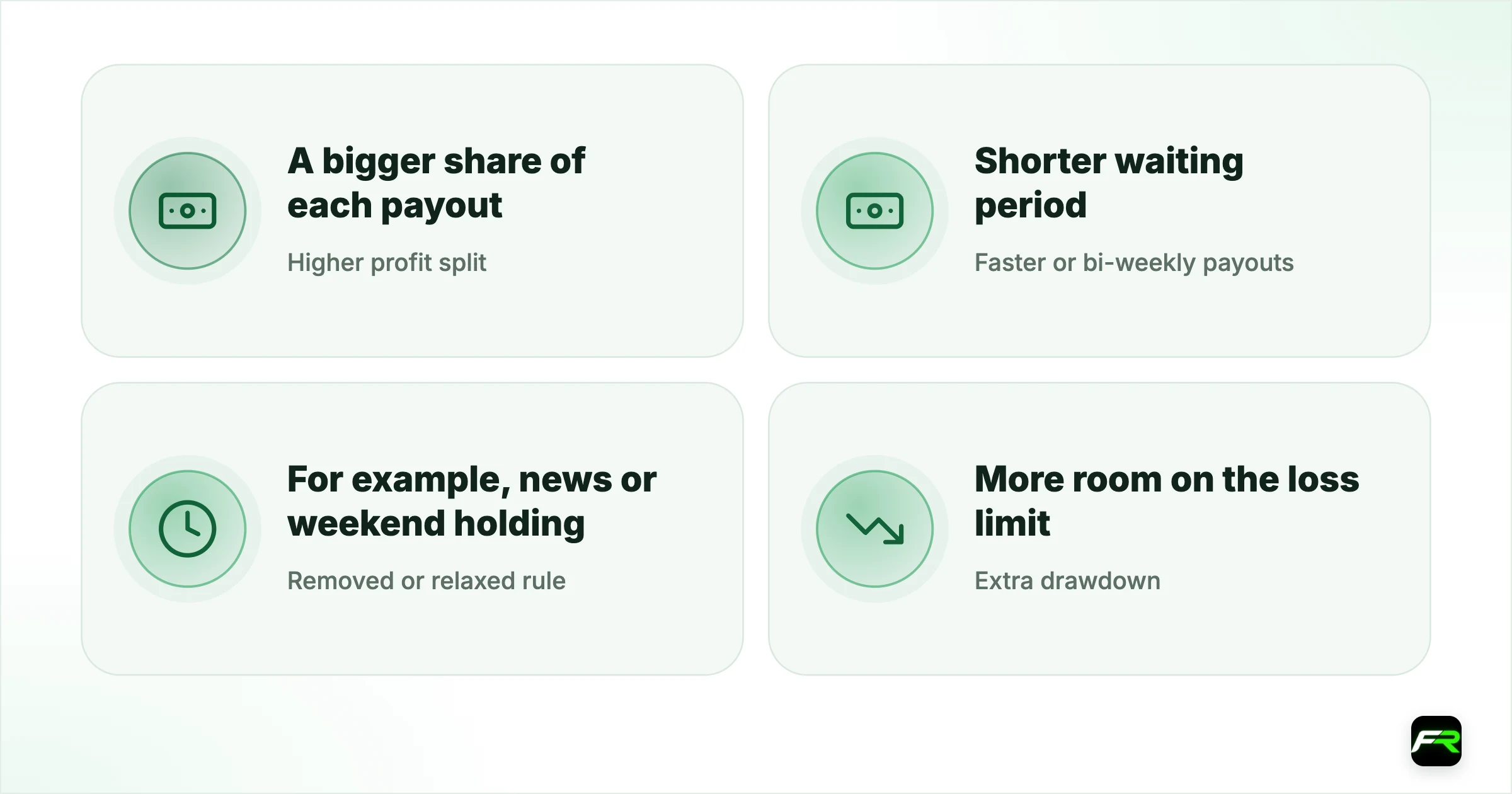
| Add-on | What it buys | When it is worth it |
|---|---|---|
| Higher profit split | A bigger share of each payout | Only if you expect several payouts |
| Faster or bi-weekly payouts | Shorter waiting period | Rarely; the first payout is the one that matters |
| Removed or relaxed rule | For example, news or weekend holding | If your method genuinely needs it |
| Extra drawdown | More room on the loss limit | If your normal losing days sit close to the limit |
| Refundable fee | Fee back with the first payout | Usually worth it if you expect to pass |
How to decide
- Add up the full price: fee, add-ons and a realistic number of resets.
- Compare that with a plan whose standard rules already suit you, such as a firm whose base plan allows the trading you do.
- Pay for add-ons that change whether you pass or get paid, not ones that only change how much you are paid.
- Skip add-ons on your first attempt at a new firm; buy them once you know the rules fit.
A swing trader holds over weekends. At one firm the base plan bans it and a weekend add-on costs 20 per cent extra. At FTMO the Swing account type on the 2-Step allows holding and news trading, at lower leverage (1:30 instead of 1:100), without an add-on. Choosing the plan whose standard rules fit is cheaper than buying the fix.
Discount codes and “last chance” reset offers are timed for the moment after a failure. Decide on resets the next day, not in the same hour.
Frequently asked
What is a prop firm reset?
A paid restart of a failed challenge, usually cheaper than buying a new one. It is only worth buying once you know why the last attempt failed and have fixed it.
Are prop firm add-ons worth it?
Some are. Add-ons that change whether you pass or get paid, such as extra room on a loss limit your normal trading approaches, can be worth it. Higher splits and faster payouts matter only once you are being paid regularly.
Does FTMO charge for resets?
FTMO sets no time limit on its challenges, so you cannot fail by running out of time, and it offers free trials. A failed challenge still means buying a new one.
How do I keep the total cost down?
Choose a plan whose standard rules already fit your trading, start with a smaller account, prefer refundable fees, and set a budget for attempts before you begin.
Related reading
The team behind this guide
Researched, checked and approved by five forex specialists
Every guide is written, fact-checked and edited before it goes live, and updated when the facts change. Spotted an error? Tell us.