 IC Markets




































Cheapest Prop Firm Challenges, and the Catch
Cheap challenges exist, but the price per attempt is the wrong measure. Here are real published prices, and how to compare them properly.
 WriterAbir KhanWriterWrites the guides · checks every figure against primary sources View profileAbout Abir →
 Market analysisTanbir Habib RiyadForex & Crypto AnalystForex and crypto analyst · technical and fundamental analysis View profileAbout Tanbir →
 Fact-checking & riskJannatul FerdaushFact-Checker & Risk AnalystFact-checks every figure · risk analysis · Applied Statistics, University of Dhaka View profileAbout Jannatul →
 Trading reviewJowel RanaCo-Founder & Forex TraderCo-founder · forex trader · reviews guides from a trader's view View profileAbout Jowel →
 Final approvalRanjan NiskrityFounder, Owner & Forex TraderFounder and owner · forex trader · signs off every guide View profileAbout Ranjan →
Challenge prices range from under €100 to over €1,000, and promotions move them every month. Before chasing the lowest price, it helps to know what a fair price looks like and what usually comes with a cheap one.
A reference price list: FTMO
FTMO publishes its full price list, read on its site on 14 October 2026:
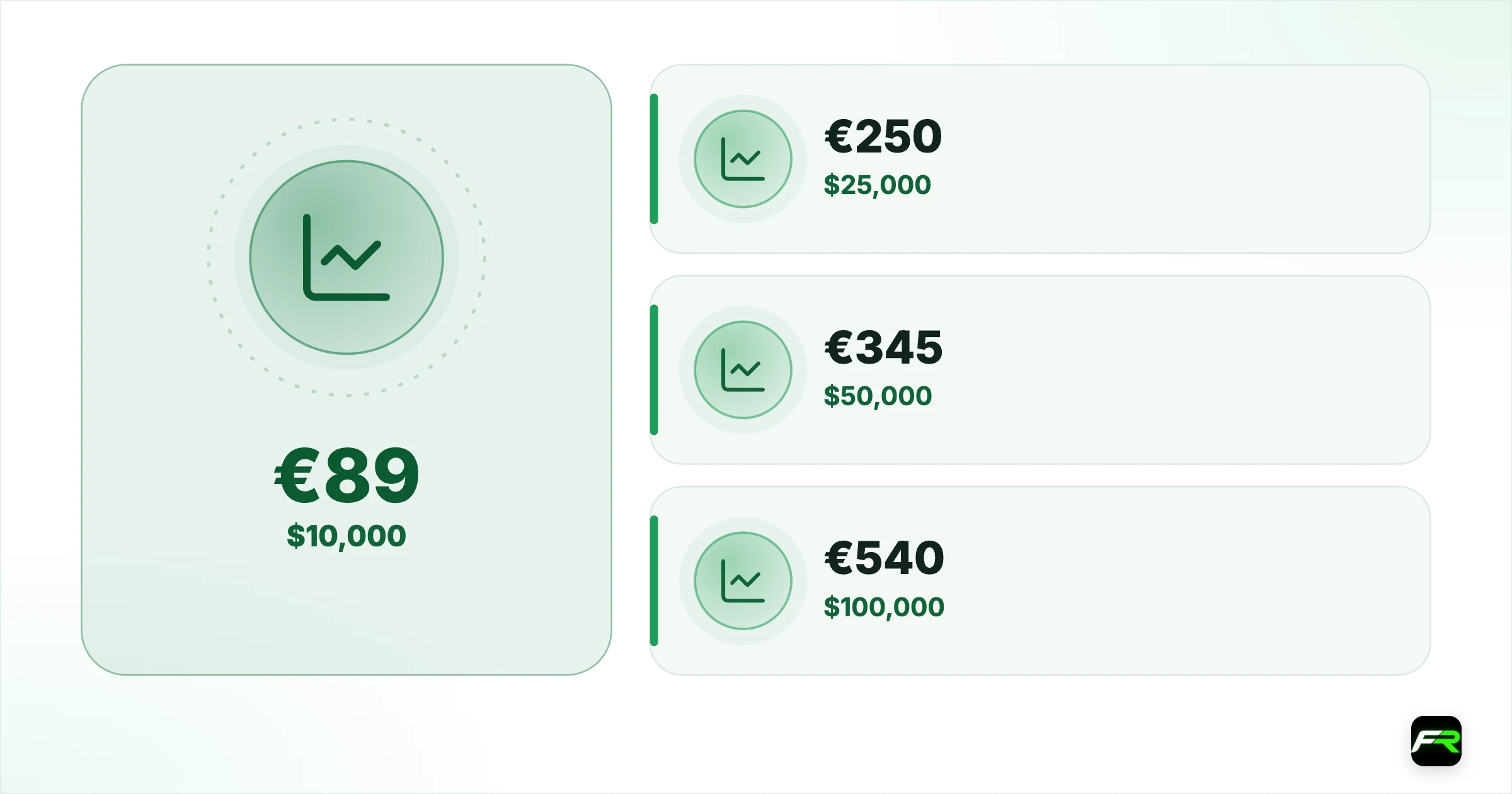
| Account | 2-Step fee (refundable) | 1-Step fee (not refundable) |
|---|---|---|
| $10,000 | €89 | €79 |
| $25,000 | €250 | €199 |
| $50,000 | €345 | €319 |
| $100,000 | €540 | €499 |
| $200,000 | €1,080 | €999 |
On the day we checked, FTMO was also running an offer on the $100,000 accounts (€439 on the 2-Step and €399 on the 1-Step). The 2-Step fee is refunded with your first reward; the 1-Step fee is not.
Cheaper offers elsewhere
- The5ers was advertising a limited-time “$100K for $149” offer on 14 October 2026.
- FundedNext’s Stellar Lite plan is described by the firm as a two-phase challenge at a lower upfront cost, with 8 and 4 per cent targets.
- FundedNext’s futures Flex plan starts from $74.99.
Promotions change often, so check the firm’s own site on the day you buy.
Compare cost per $1,000 of account
The fairest comparison is the fee divided by the account size. From FTMO’s list, the 2-Step costs about €8.90 per $1,000 at $10,000 and €5.40 per $1,000 at $100,000 and $200,000. Bigger accounts are cheaper per dollar, but a failed attempt costs more in absolute terms.
The catch
- Non-refundable fees. A cheaper plan whose fee is never returned can cost more than a dearer one refunded with the first payout.
- Tighter rules. Lower prices often come with smaller daily limits, trailing drawdowns or consistency caps that make passing harder.
- Promotional pricing that reverts, sometimes on resets and add-ons too.
- A short track record. The cheapest offers are often from the newest firms. A refund means nothing if the firm does not pay.
Two $100,000 plans: one costs €540 and is refunded with the first payout, the other €399 and is never refunded. A trader who passes on the second attempt and is paid has spent €1,080 and got €540 back with the first payout, a net €540. On the cheaper plan they spent €798 and got nothing back. If the tighter rules on the cheaper plan cost them one extra attempt, the gap widens to €1,197 against €540.
Start with the smallest account size at a firm you trust. The rules are the same in percentage terms, and a failed attempt costs less.
Frequently asked
What is the cheapest prop firm challenge?
Prices change with promotions. On 14 October 2026, FTMO's cheapest was €79 for a $10,000 1-Step and €89 for a $10,000 2-Step, The5ers advertised a limited-time $100K challenge for $149, and FundedNext's futures Flex started from $74.99.
How much does an FTMO challenge cost?
On 14 October 2026, the 2-Step cost €89 to €1,080 depending on account size (€540 for $100,000) and is refunded with the first reward; the 1-Step cost €79 to €999 (€499 for $100,000) and is not refunded.
Are cheap prop firm challenges worth it?
Only if the rules suit you and the firm pays. Cheap plans often have non-refundable fees, tighter limits or come from newer firms. Compare the cost per $1,000 of account and the refund policy, not just the price.
Is a bigger account better value?
Per dollar of account, usually yes: FTMO's 2-Step costs about €5.40 per $1,000 at $100,000 against €8.90 at $10,000. But a failed attempt costs more, so start smaller while you are proving your method.
Related reading
The team behind this guide
Researched, checked and approved by five forex specialists
Every guide is written, fact-checked and edited before it goes live, and updated when the facts change. Spotted an error? Tell us.