 IC Markets




































How Long It Really Takes to Pass a Prop Firm Challenge
Firms quote the fastest possible pass. At a safe position size, most consistent traders need weeks, and that is fine when there is no deadline.
 WriterAbir KhanWriterWrites the guides · checks every figure against primary sources View profileAbout Abir →
 Market analysisTanbir Habib RiyadForex & Crypto AnalystForex and crypto analyst · technical and fundamental analysis View profileAbout Tanbir →
 Fact-checking & riskJannatul FerdaushFact-Checker & Risk AnalystFact-checks every figure · risk analysis · Applied Statistics, University of Dhaka View profileAbout Jannatul →
 Trading reviewJowel RanaCo-Founder & Forex TraderCo-founder · forex trader · reviews guides from a trader's view View profileAbout Jowel →
 Final approvalRanjan NiskrityFounder, Owner & Forex TraderFounder and owner · forex trader · signs off every guide View profileAbout Ranjan →
FTMO says you can reach a funded account in as few as 8 trading days on its 2-Step Challenge and as few as 2 on its 1-Step. Those are the minimums the rules allow, not a guide to what a careful trader should expect.
The rules set the floor, not the pace
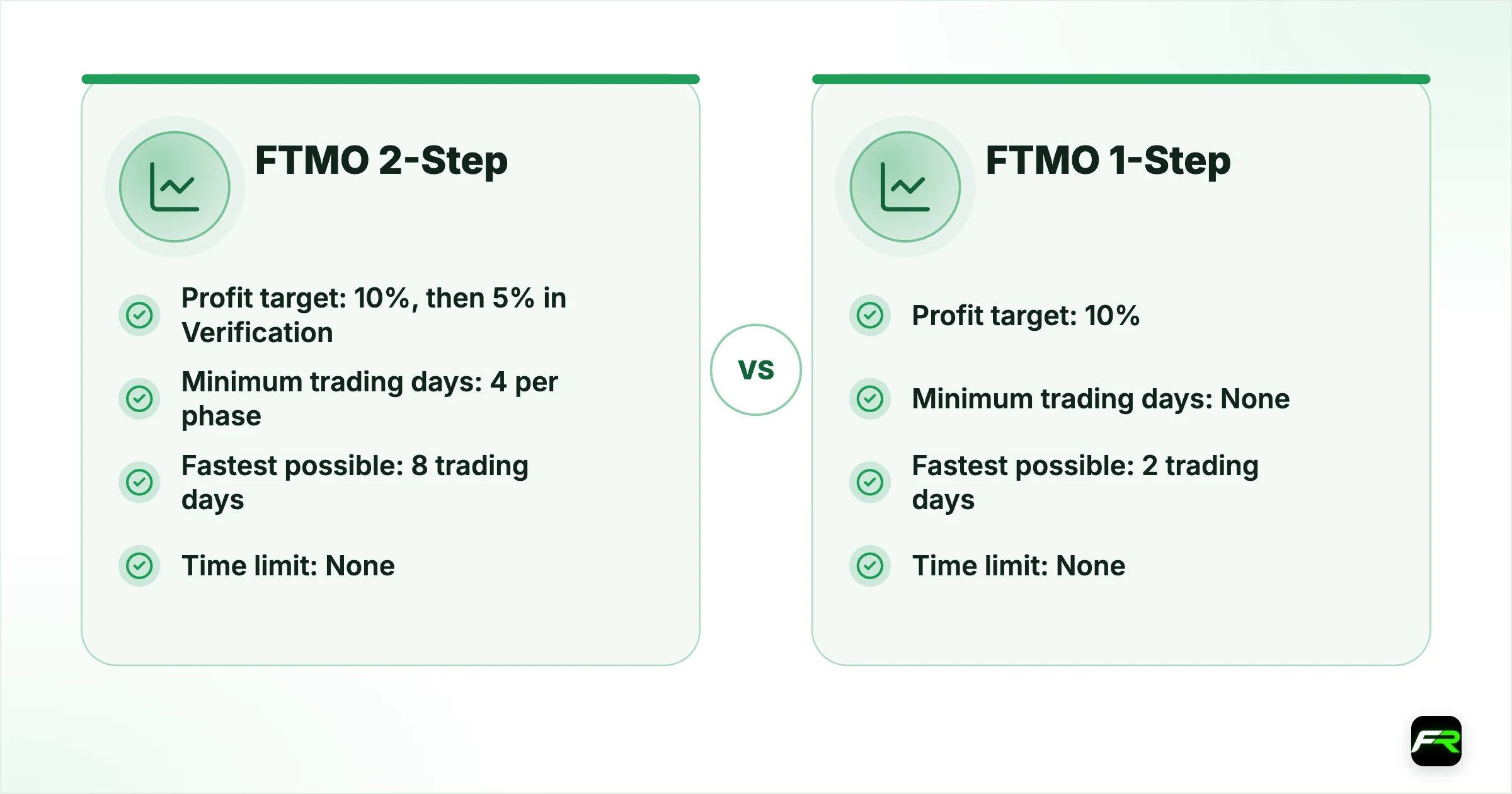
| FTMO 2-Step | FTMO 1-Step | |
|---|---|---|
| Profit target | 10%, then 5% in Verification | 10% |
| Minimum trading days | 4 per phase | None (50% Best Day Rule) |
| Fastest possible | 8 trading days | 2 trading days |
| Time limit | None | None |
Without a time limit, the question is not how fast you can pass, but how long your method takes to make 10 per cent at a size that will not breach the loss limits.
Working it out from your own numbers
Expected gain per trade = (win rate × average win) − (loss rate × average loss), measured in units of your risk. Divide the target by that, and by how many trades you take a day.
A trader risks 0.5 per cent per trade, wins 45 per cent of trades at twice the risk and loses 55 per cent at the full risk. Expected gain per trade is 0.45 × 2 − 0.55 × 1 = 0.35 times the risk, or about 0.175 per cent of the account. A 10 per cent target needs about 57 trades. At two trades a day that is roughly 29 trading days, about six weeks. The 5 per cent Verification needs about half as many trades, so around three more weeks.
Losing streaks stretch that further. The same trader will see runs of five or six losses in a row over 57 trades, which is why safe sizing matters more than speed.
Why fast passes are a warning sign
- Passing in a few days usually means large size, which works until the first bad streak, often on the funded account.
- A method that needs big size to pass will need it to make payouts too, under the same loss limits.
- Firms review trades before paying; a fast pass built on luck tends to show up later as a breached funded account.
If you have hit the target with a few minimum days left, see our guide to minimum trading days for how to finish safely.
Six weeks at half a per cent risk is a good pass. It is also the pace you will need to keep on the funded account, so it is the right one to practise.
Frequently asked
How long does it take to pass a prop firm challenge?
The rules allow a fast pass, but at a safe position size most consistent traders take weeks. FTMO's minimum is 8 trading days for the 2-Step and 2 for the 1-Step, with no time limit.
Is there a time limit on the FTMO Challenge?
No. FTMO says there is no maximum time limit on its 2-Step or 1-Step Challenge.
How can I estimate my own time to pass?
Work out your expected gain per trade from your win rate and average win and loss, divide the profit target by it, then divide by the number of trades you take a day.
Is passing quickly a good sign?
Not usually. Very fast passes tend to come from large position sizes, which also make a funded account easy to lose. A steady pace at 0.5 to 1 per cent risk is more likely to lead to payouts.
Related reading
The team behind this guide
Researched, checked and approved by five forex specialists
Every guide is written, fact-checked and edited before it goes live, and updated when the facts change. Spotted an error? Tell us.