IC Markets




































Elev8 Copy Trading: Fees, Master Trader Commission and How Copying Works
Elev8's copy trading lets you subscribe to Master Traders from your Wallet, set a copying proportion and stop at any time. The service fee is a 0.2-pip mark-up, plus each Master's own commission. Here is how to choose, what it costs and where it goes wrong.
 WriterAbir KhanWriterWrites the guides · checks every figure against primary sources View profileAbout Abir →
 Market analysisTanbir Habib RiyadForex & Crypto AnalystForex and crypto analyst · technical and fundamental analysis View profileAbout Tanbir →
 Fact-checking & riskJannatul FerdaushFact-Checker & Risk AnalystFact-checks every figure · risk analysis · Applied Statistics, University of Dhaka View profileAbout Jannatul →
 Trading reviewJowel RanaCo-Founder & Forex TraderCo-founder · forex trader · reviews guides from a trader's view View profileAbout Jowel →
 Final approvalRanjan NiskrityFounder, Owner & Forex TraderFounder and owner · forex trader · signs off every guide View profileAbout Ranjan →
Elev8 runs a copy trading service with two roles. A Master Trader trades their own account and allows others to copy. Copiers subscribe to one or more Masters, and the Master's orders are repeated in proportion on the Copier's side. Money for copying comes from your Wallet, and you can subscribe to an unlimited number of Master Traders at once.
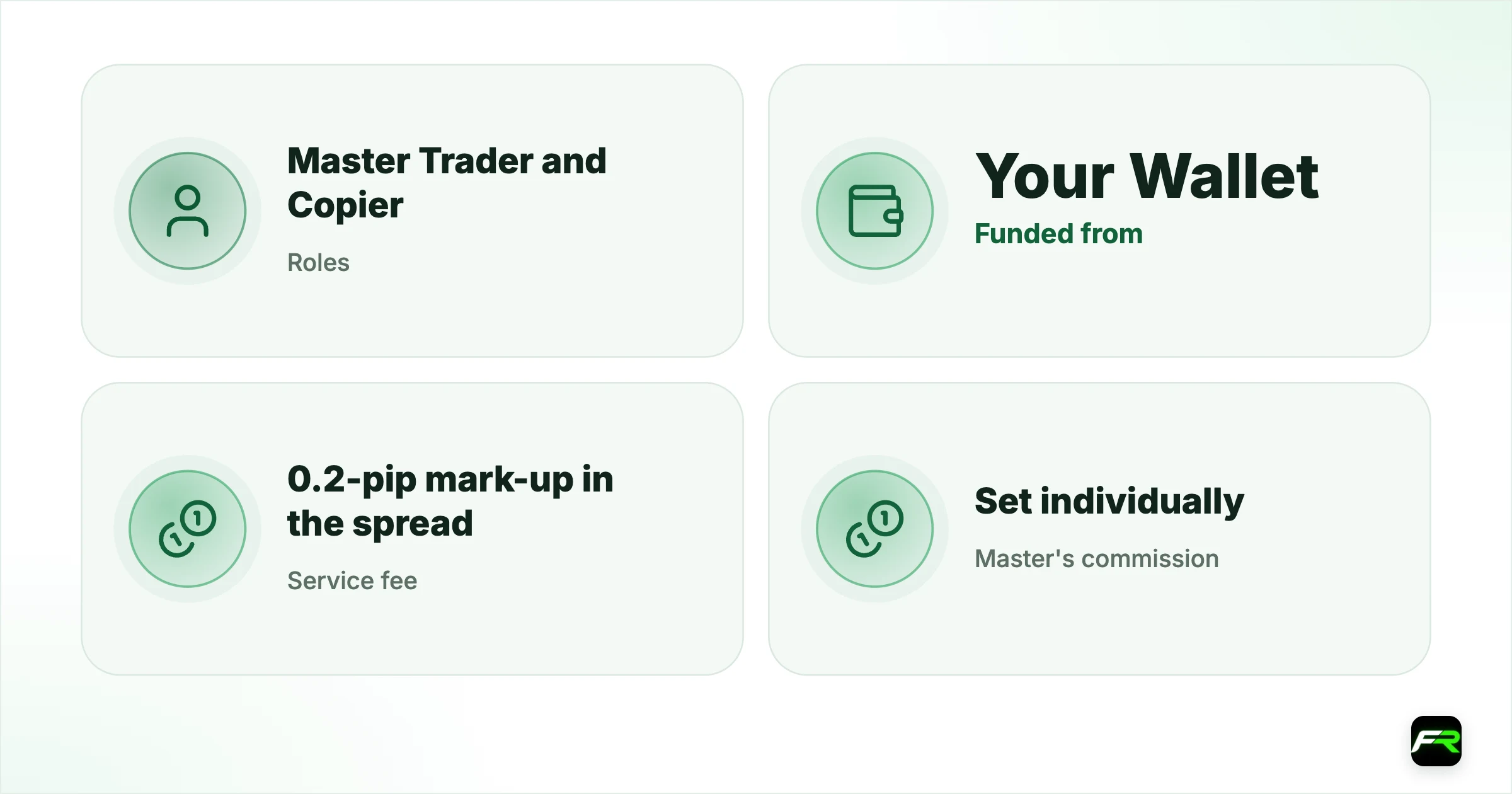
Two costs apply. Elev8's service fee is included in the spread as a mark-up of 0.2 pips. The Master Trader's commission is set by each Master and shown in their statistics. You can unsubscribe at any moment, at which point your invested funds and any profit return to your Wallet.
| Roles | Master Trader and Copier |
|---|---|
| Funded from | Your Wallet |
| Service fee | 0.2-pip mark-up in the spread |
| Master's commission | Set individually; shown in each Master's stats |
| Masters you can follow | Unlimited |
| Stop copying | Unsubscribe at any moment |
How to start copying
- Sign up, verify your profile and top up your Wallet.
- Browse Master Traders and open their statistics.
- Subscribe to a Master and press Set up copying.
- Specify the copying proportion and decide whether to add support funds.
- Press Start copying; the funds are taken from your Wallet and copying begins.
The copying proportion decides how large your copied trades are compared with the Master's. Support funds are extra money set aside to keep copied positions open through drawdowns. Both settings shape your risk more than the choice of Master does, so set them deliberately.
What to look at before you subscribe
Elev8 tells Copiers to examine a Master Trader's statistics first. It lists the risk score, gain, profit and loss, number of copiers, commission and order history.
| Statistic | What it tells you | What to watch for |
|---|---|---|
| Risk score | How aggressively the Master trades | High scores mean large swings in your account |
| Gain | Percentage return over the period | A short, steep gain is often luck or heavy risk |
| Profit and loss | Money made and lost | Compare the worst loss with the average win |
| Number of copiers | How many people follow | Popularity isn't proof of skill |
| Commission | The Master's fee | Higher fees need better results to be worth it |
| Order history | Every trade taken | Look for stops, and for losers that were added to |
Order history is the most revealing. Scroll through it for patterns: many small wins and one enormous loss, positions added as a trade goes wrong, or trades with no stop that sat in loss for weeks. Those are signs of grid or martingale methods, which look smooth until the day they don't.
What copying costs
| Cost | Amount | Who receives it |
|---|---|---|
| Service fee | 0.2 pips added to the spread | Elev8 |
| Master's commission | Set by the Master | The Master Trader |
| Normal spread | Floating, from 0.6 pips | Built into each copied trade |
| Swaps | None | Not applicable |
On one standard lot of EUR/USD, 0.2 pips is $2. A Copier whose share of the Master's trading comes to 10 lots a month pays about $20 in service fees on top of the ordinary spread. Any Master who trades very often costs you more, whatever their results.
The Master's commission is charged at the moment an order is opened, according to the answers Elev8 gives to Masters. Check the commission figure in the Master's stats and make sure you understand what it is a percentage of before you subscribe.
How to stop and withdraw
You can unsubscribe from a Master Trader and stop copying at any moment. When you do, all funds invested with that Master and your profit from copying are credited to your Wallet. Withdrawals are made from the Wallet.
One sentence in the FAQ deserves to be read twice. If you end your subscription at a loss, you don't receive your full initial investment back; the loss is subtracted from it. Copy trading has no capital guarantee. Money allocated to a Master is at risk in exactly the way money in your own trading account is.
Nobody refunds a copied loss. The Master is paid a commission, and you carry the result.
How Masters are paid
A look at the Master's side helps you judge incentives. Each Master sets a commission for their Copiers. Elev8 keeps 12% of the commission a Master earns from all Copiers. Its example: a Master charging 20% whose Copiers make $200 profit in a week earns $40, less 12%, for a net $35.20.
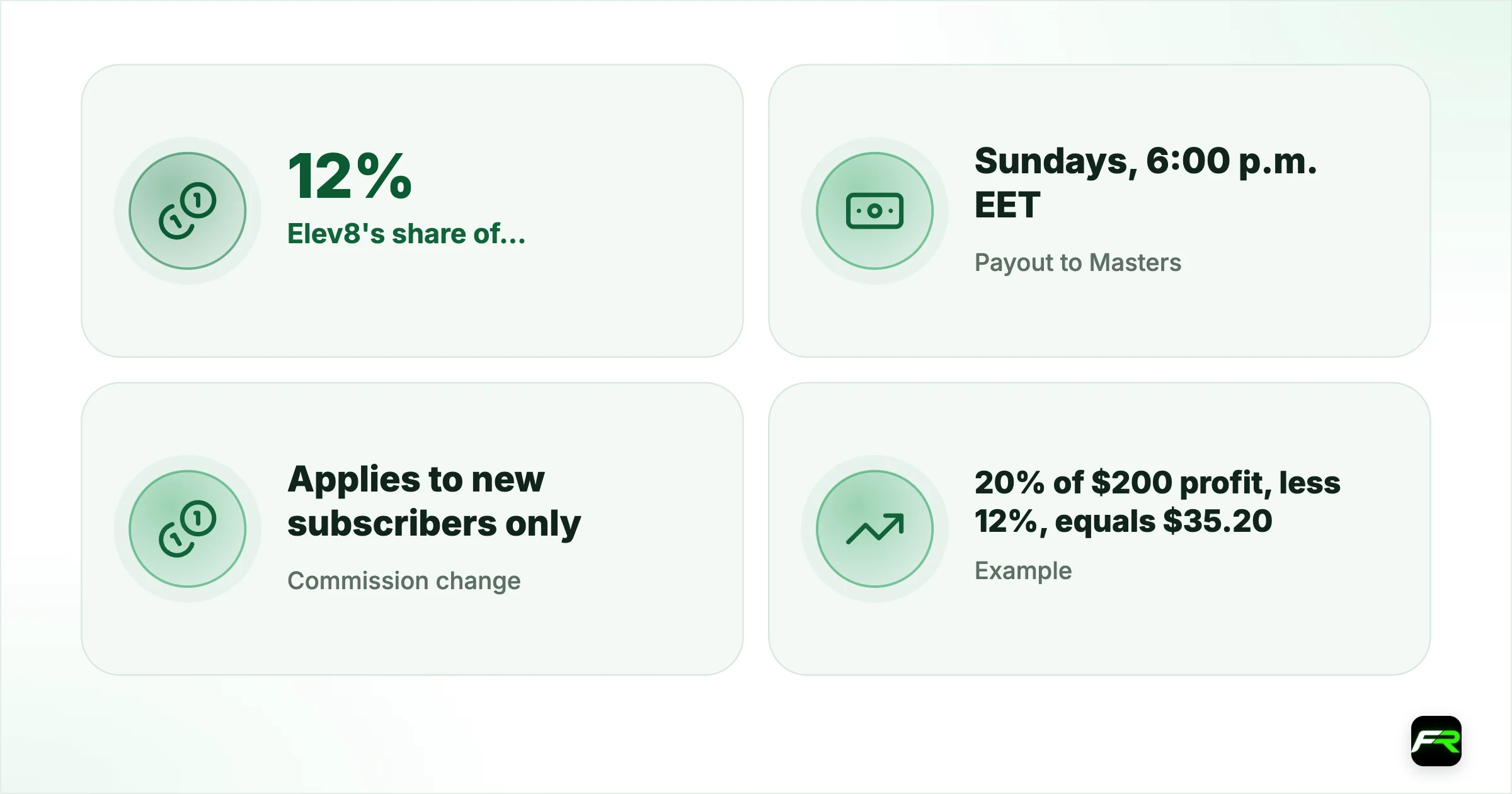
Commission is paid to Masters every Sunday at 6:00 p.m. EET, into their Wallet. A Master who changes their commission can only apply the new rate to people who subscribe afterwards. Current Copiers keep the rate they signed up at.
| Item | Detail |
|---|---|
| Elev8's share of Master commission | 12% |
| Payout to Masters | Sundays, 6:00 p.m. EET |
| Commission change | Applies to new subscribers only |
| Example | 20% of $200 profit, less 12%, equals $35.20 |
Risks to weigh
- Past results describe the past. A strong quarter says little about the next one.
- Short histories hide the losing streak every method has.
- A copying proportion that is too high turns the Master's normal drawdown into your stop out.
- Frequent trading by the Master raises your costs through the 0.2-pip fee.
- Many followers can mean good marketing as easily as good trading.
- Losses reduce your investment, and no one makes them good.
Leverage on your side matters too. Copied positions use margin from the funds you allocated, and Elev8's negative balance protection limits your loss to what you put in. Our Elev8 leverage guide explains margin, and the fees guide lists the other costs.
A cautious way to begin
- Allocate a small amount you could lose completely.
- Pick two or three Masters with different styles and at least several months of history.
- Set a modest copying proportion on each.
- Review results weekly, and compare them with the Master's own stats.
- Unsubscribe from any Master whose drawdown passes the limit you set at the start.
Decide that limit before you subscribe, and write it down. A rule such as stopping at a 20% loss of the allocation is easy to follow in advance and hard to invent while you are watching a position sink.
Copy trading against trading yourself
| Point | Copying a Master | Trading yourself |
|---|---|---|
| Time needed | Low | High |
| Skill needed | Choosing people | Choosing trades |
| Costs | Spread, 0.2-pip fee, Master's commission | Spread only |
| Control | Proportion, support funds, unsubscribe | Full |
| What you learn | Limited unless you study the trades | A great deal |
Copy trading isn't a shortcut around learning. It replaces one hard decision with another. If you want to build your own skill alongside it, open a free demo as described in our Elev8 demo account guide and practise while a small allocation is being copied.
Sort Masters by the length of their history, not by gain. A modest return held for a year tells you more than a spectacular month.
Keep your own log beside the platform's numbers. Note the date you subscribed, the amount allocated, the proportion and the Master's commission. Each week, add the value of the allocation. After two or three months that record shows you plainly whether copying has paid for its costs.
Spread your allocation in time as well as across people. A start with a third of the amount, with more added later if results hold up, protects you from the bad luck of joining a Master just before their worst month.
The 0.2-pip fee is fair, and the freedom to unsubscribe at any time is important. What I'd stress is the FAQ line about losses coming out of your investment. Copy trading moves the work to someone else. The risk stays with you.
Hendra put $150 from his Wallet behind two Master Traders at a low copying proportion. One had a nine-month history and a moderate risk score; the other showed a fast recent gain. The second lost 22% of his allocation in three weeks, passing the 20% limit he had written down, so he unsubscribed and kept the first.
Frequently asked
Does Elev8 offer copy trading?
Yes. Copiers subscribe to Master Traders, set a copying proportion and fund the copying from their Wallet. You can follow an unlimited number of Masters at once.
How much does Elev8 copy trading cost?
The service fee is a mark-up of 0.2 pips included in the spread. Each Master Trader also charges a commission, which is set individually and shown in their stats.
Can I stop copying at any time?
Yes. You can unsubscribe at any moment, and the funds invested with that Master plus any profit are credited to your Wallet.
Will I get my investment back if I stop at a loss?
Not in full. Elev8 says the amount of loss is subtracted from your initial investment when you end a subscription at a loss.
How do I choose a Master Trader?
Examine their stats first: risk score, gain, profit and loss, number of copiers, commission and order history. A long history and controlled losses matter more than a high recent gain.
How are Master Traders paid?
Masters set a commission for Copiers. Elev8 takes 12% of the commission a Master earns and pays the rest to the Master's Wallet every Sunday at 6:00 p.m. EET.
Related reading
The team behind this guide
Researched, checked and approved by five forex specialists
Every guide is written, fact-checked and edited before it goes live, and updated when the facts change. Spotted an error? Tell us.