 IC Markets




































Prop Firm Profit Splits Explained: 80, 90 and 100 Per Cent
The headline split is the easiest number to compare and the least important. What it applies to, and when, decides what you actually take home.
 WriterAbir KhanWriterWrites the guides · checks every figure against primary sources View profileAbout Abir →
 Market analysisTanbir Habib RiyadForex & Crypto AnalystForex and crypto analyst · technical and fundamental analysis View profileAbout Tanbir →
 Fact-checking & riskJannatul FerdaushFact-Checker & Risk AnalystFact-checks every figure · risk analysis · Applied Statistics, University of Dhaka View profileAbout Jannatul →
 Trading reviewJowel RanaCo-Founder & Forex TraderCo-founder · forex trader · reviews guides from a trader's view View profileAbout Jowel →
 Final approvalRanjan NiskrityFounder, Owner & Forex TraderFounder and owner · forex trader · signs off every guide View profileAbout Ranjan →
The profit split is the share of your funded account’s profit that the firm pays you. Most established firms advertise 80 or 90 per cent, and some advertise 100 per cent. The figure is real, but it rarely tells you which firm pays more over a year.
What the split applies to
The split is taken from your profit since the last payout, not from the account. On a $100,000 funded account that makes $4,000 in a cycle, an 80 per cent split pays $3,200 and a 90 per cent split pays $3,600. The $400 difference matters, but it is small next to whether you make the $4,000 at all, or keep the account long enough for a second cycle.
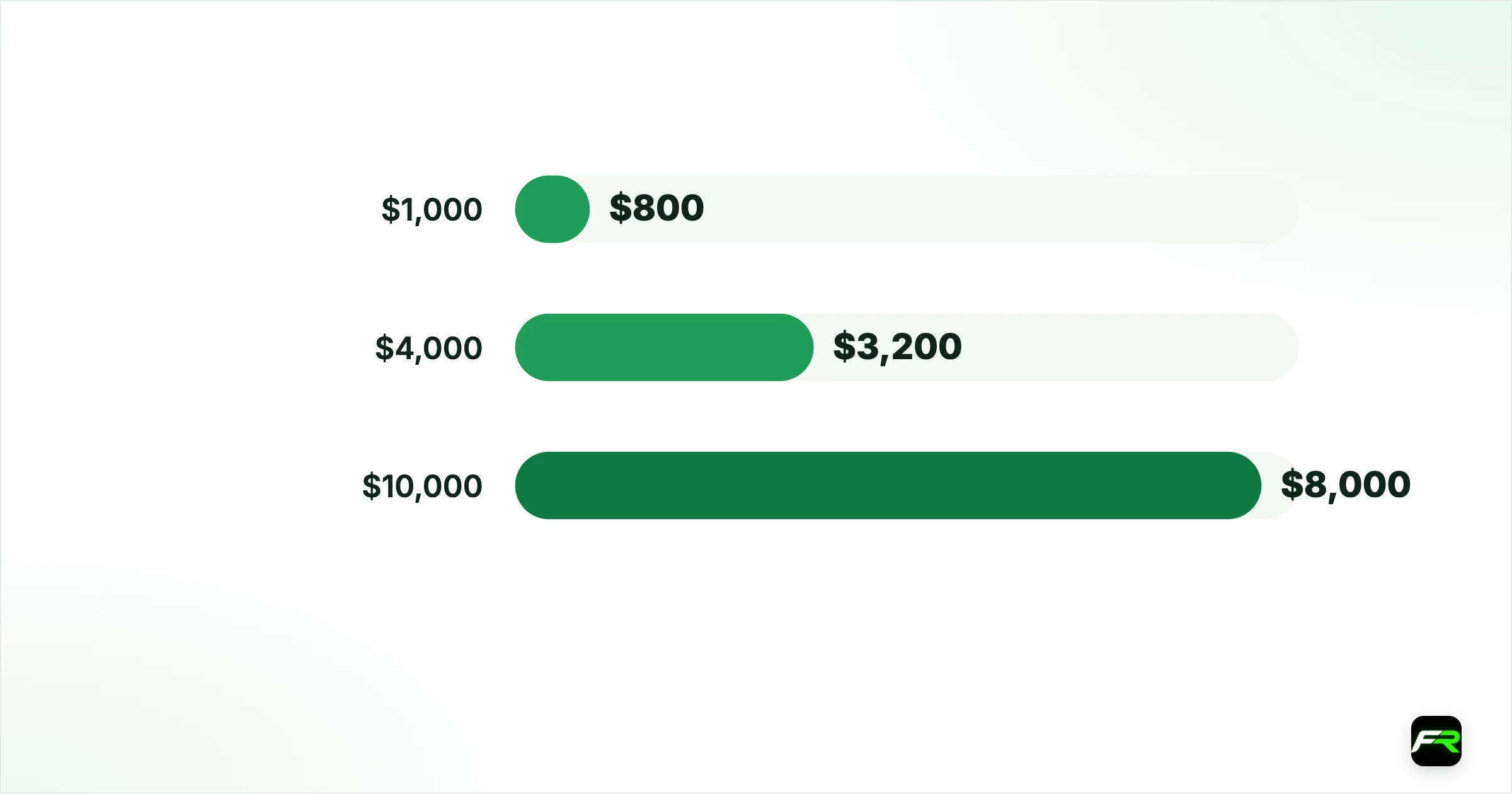
| Profit in the cycle | 80% split | 90% split | Difference |
|---|---|---|---|
| $1,000 | $800 | $900 | $100 |
| $4,000 | $3,200 | $3,600 | $400 |
| $10,000 | $8,000 | $9,000 | $1,000 |
Splits that change over time
Many firms start lower and raise the split as you prove yourself. At FTMO the 2-Step pays 80 per cent by default and rises to 90 per cent through its scaling plan or Premium programme; its 1-Step and Instant accounts pay 90 per cent from the start. The trade-off on those plans is elsewhere: the 1-Step has a tighter 3 per cent daily loss limit and a trailing maximum loss, and its fee is not refunded.
That pattern is common across the industry. A higher split is often paired with stricter rules, a higher fee or a non-refundable fee, because the firm has to recover the difference somewhere.
What “100 per cent” usually means
- It may apply only to the first payout, or only up to a cap.
- It may be an add-on you pay extra for at checkout.
- It may sit on a plan with a tighter drawdown or a consistency rule that makes payouts harder to reach.
None of this is a trick if it is written down. It means the split on its own is a poor way to choose between firms.
Compare these instead
- The rules on the plan the split belongs to: daily loss, maximum loss, and whether it is static or trailing.
- The waiting period and conditions for the first payout.
- Whether the challenge fee is refunded, and when.
- The firm’s record of paying, and how long it has operated.
A trader compares a 90 per cent plan with a 3 per cent daily limit and a trailing floor against an 80 per cent plan with a 5 per cent daily limit and a static floor. On the tighter plan one fast losing day closes the account before the second payout. On the looser plan the trader survives the same day and is paid twice. Over the year, 80 per cent of two cycles beats 90 per cent of one.
See prop firm rules compared for the rules that sit behind each firm’s headline split.
Frequently asked
What is a profit split in prop trading?
It is the share of your funded account's profit that the firm pays you, usually 80 to 90 per cent. On $4,000 of profit, an 80 per cent split pays $3,200 and a 90 per cent split pays $3,600.
What profit split does FTMO pay?
80 per cent by default on the 2-Step, rising to 90 per cent through its scaling plan or Premium programme, and 90 per cent on the 1-Step and FTMO Instant accounts.
Is a 100 per cent profit split real?
It can be, but check the conditions. It is often limited to the first payout, capped, sold as a paid add-on, or attached to a plan with stricter rules.
Is a higher profit split always better?
No. A higher split often comes with tighter loss limits, a higher or non-refundable fee, or harder payout conditions. Surviving to a second and third payout matters more than the headline percentage.
Related reading
The team behind this guide
Researched, checked and approved by five forex specialists
Every guide is written, fact-checked and edited before it goes live, and updated when the facts change. Spotted an error? Tell us.