IC Markets




































Should a South African Forex Trader Register a Company?
Trading through a company can lower the tax rate, but costs, dividends tax and SARS scrutiny usually make your own name the better choice.
 WriterAbir KhanWriterWrites the guides · checks every figure against primary sources View profileAbout Abir →
 Market analysisTanbir Habib RiyadForex & Crypto AnalystForex and crypto analyst · technical and fundamental analysis View profileAbout Tanbir →
 Fact-checking & riskJannatul FerdaushFact-Checker & Risk AnalystFact-checks every figure · risk analysis · Applied Statistics, University of Dhaka View profileAbout Jannatul →
 Trading reviewJowel RanaCo-Founder & Forex TraderCo-founder · forex trader · reviews guides from a trader's view View profileAbout Jowel →
 Final approvalRanjan NiskrityFounder, Owner & Forex TraderFounder and owner · forex trader · signs off every guide View profileAbout Ranjan →
This is a general overview, not tax advice. SARS assesses each trader's facts individually, and the classification of your trading and the deductions you can claim depend on your specific situation. A registered tax practitioner is worth the fee.
Once a trader starts making regular profit at a high marginal rate, someone always suggests trading through a company to pay the lower corporate rate instead. It is possible, and for a small number of traders it makes sense, but the maths is less favourable than it first looks once you account for getting the money out, the running costs, and how SARS views companies set up mainly to save tax. This guide works through it.
The headline comparison
| Trading in your own name | Trading through a company | |
|---|---|---|
| Rate on profit | Your marginal rate, 18-45% | The corporate income tax rate on company profit |
| Getting money to yourself | Already yours | Salary (taxed at your marginal rate) or dividend (dividends tax on top of corporate tax) |
| Running costs | None beyond your own return | Annual financial statements, CIPC returns, separate tax number, accounting fees |
| Admin | One ITR12, provisional tax | Company returns, provisional tax for the company, payroll if you draw a salary |
| SARS view | Standard | Scrutiny if the structure looks purely tax-motivated |
Why the company rate is not the whole story
The company pays corporate tax on its profit. Then, to spend the money, you take it out as salary or dividends. Salary is taxed at your marginal rate, which puts you close to where you started. A dividend triggers dividends tax on top of the corporate tax already paid, and the combined effective rate can land near the top personal marginal rate anyway. The company structure only wins clearly if you are leaving most of the profit inside the company to compound, not drawing it to live on.
When a company can make sense
- You are consistently profitable at a scale that justifies the running costs, not in your first year or two.
- Most profits will stay in the entity to reinvest, rather than being drawn out.
- There are other reasons for the entity: bringing in a partner, ring-fencing liability, a broader trading or investment business.
- A practitioner runs it properly, so the compliance cost is controlled.
When it does not
For the large majority of individual retail traders, a company adds cost and admin for little or no tax saving, because they need the profit to live on and will draw it out. It also creates a second set of returns to get wrong. If your trading profit is a few tens of thousands of rand a year, a company is almost certainly the wrong move. Trade in your own name, register for provisional tax, and keep good records.
SARS can challenge a structure whose main purpose is to reduce tax, and can also treat an owner-managed trading company's profits as effectively the individual's in some circumstances. A company is not a way to make trading profit disappear from your personal tax picture.
Wandile formed a company for his trading after a strong year, expecting to pay the corporate rate and keep more. In practice he drew most of the profit as salary to cover his bond and school fees, so it was taxed at his marginal rate anyway, and he added about R18,000 a year in accounting and compliance costs plus a second provisional tax cycle. After two years he closed the company and went back to trading personally. His accountant's view was that a company only pays off if you can leave the money in it, which he could not.
The maths on R300,000 of profit
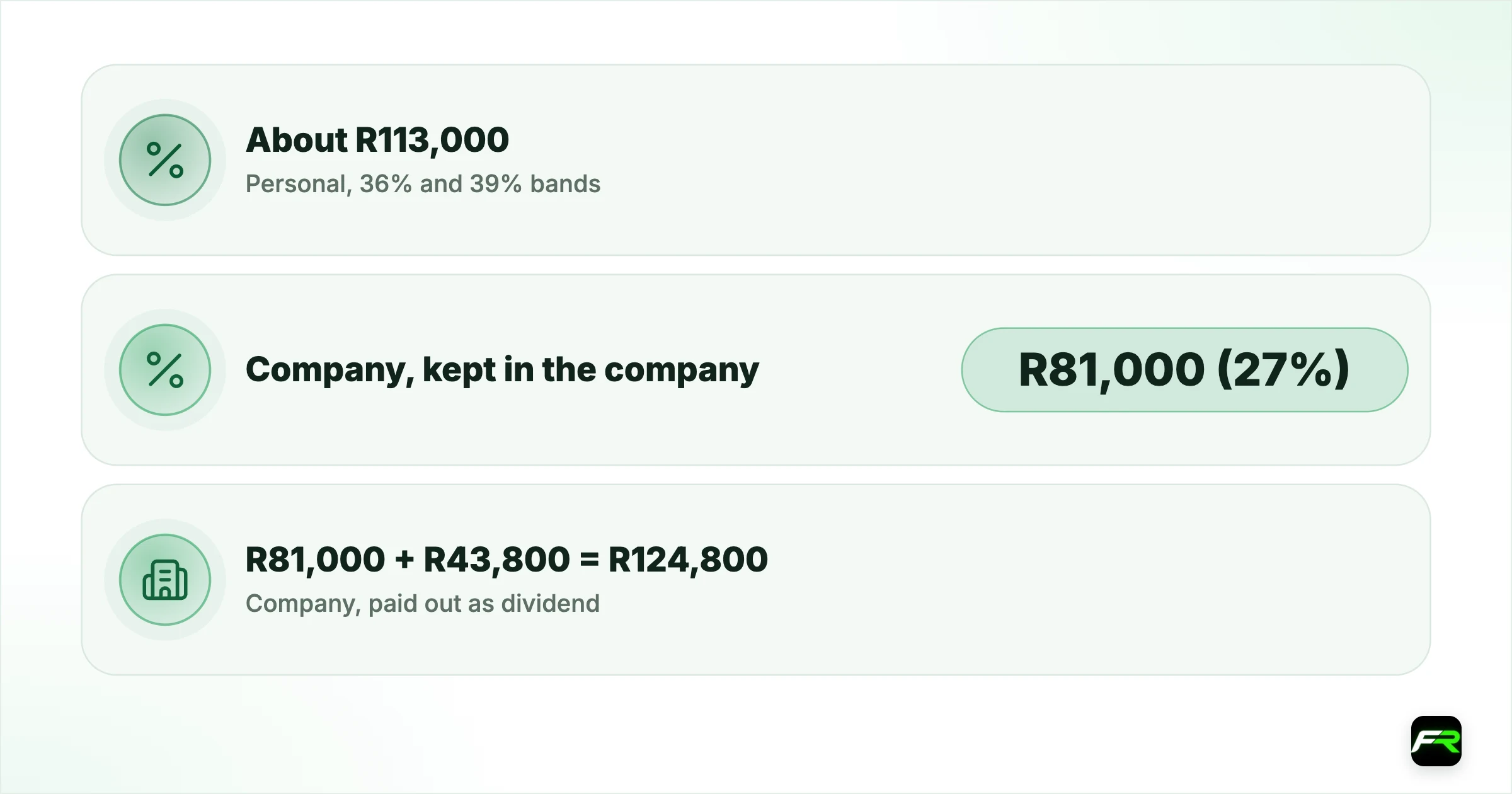
The current rates make the comparison concrete. Company profit is taxed at 27 per cent. A dividend paid out of what is left carries dividends tax of 20 per cent. Set that against an individual earning a R550,000 salary, so that the trading profit sits on top of income already in the 36 per cent bracket:
| Route | Tax on R300,000 | Left to spend |
|---|---|---|
| Personal, 36% and 39% bands | About R113,000 | About R187,000 |
| Company, kept in the company | R81,000 (27%) | R219,000, but it stays in the company |
| Company, paid out as dividend | R81,000 + R43,800 = R124,800 | About R175,200 |
Drawn as a dividend, the company route leaves less in your hand than trading personally, before counting the costs of running the company. It only comes out ahead while the money stays inside the company, which is the point made above, now with numbers.
What it costs to set up and keep a company
CIPC's own fee list makes registration cheap: R175 for a private company using the standard memorandum of incorporation, including the name. The annual return for a company turning over less than R10 million costs R450, or R600 if filed late. Most of the real expense is the accountant. Annual financial statements, the company's own tax return and two provisional tax cycles, plus payroll if you draw a salary, will usually cost far more than the CIPC fees, and that figure should be in your sums before you decide.
A reasonable default
- Trade in your own name.
- Register for provisional tax once trading is regular.
- Set aside 35 to 40 per cent of profit withdrawals for tax.
- Keep full records and claim the legitimate expense deductions.
- Revisit the company question only if you become consistently profitable at scale and can retain profits in the entity, and then only with a practitioner's advice.
The company question comes up every time someone has a good quarter. My answer is almost always the same: if you need the money to live on, the company saves you nothing and costs you admin. Come back when you are profitable enough to leave the profit inside the entity, and bring an accountant.
Frequently asked
Should I register a company to trade forex in South Africa?
Usually not, for an individual. The corporate rate advantage largely disappears once you draw the money as salary or dividends, and the company adds accounting and compliance costs. Trading in your own name is simpler for most retail traders.
Does a company reduce the tax on forex profits?
Only if you retain most of the profit inside the company. If you draw it as salary it is taxed at your marginal rate, and a dividend adds dividends tax on top of corporate tax, with a combined rate near the top personal bracket.
When does a trading company make sense?
When you are consistently profitable at a scale that justifies the running costs, want to retain profits to reinvest rather than draw them, or have other reasons for the entity such as a partner or liability ring-fencing.
What are the running costs of a trading company?
Annual financial statements, CIPC annual returns, a separate tax number and provisional tax cycle, accounting fees, and payroll administration if you pay yourself a salary. Budget for these before forming one.
Can SARS challenge a trading company?
Yes. SARS can challenge a structure set up mainly to reduce tax, and in some cases treat an owner-managed trading company's profit as effectively the individual's. A company does not remove trading profit from your personal tax picture.
How much does it cost to register a company with CIPC?
CIPC charges R175 to register a private company with a standard memorandum of incorporation, including name reservation. Annual returns cost R450 for a company turning over less than R10 million, or R600 if late. Accounting fees for statements and tax returns are the larger, ongoing cost.
Related reading
The team behind this guide
Researched, checked and approved by five forex specialists
Every guide is written, fact-checked and edited before it goes live, and updated when the facts change. Spotted an error? Tell us.