IC Markets






































The Records SARS Wants to See From a Forex Trader
A checklist of exactly what to keep, in what form, and for how long, so a SARS query or audit is a filing exercise rather than a crisis.
 WriterAbir KhanWriterWrites the guides · checks every figure against primary sources View profileAbout Abir →

 Market analysisTanbir Habib RiyadForex & Crypto AnalystForex and crypto analyst · technical and fundamental analysis View profileAbout Tanbir →

 Fact-checking & riskJannatul FerdaushFact-Checker & Risk AnalystFact-checks every figure · risk analysis · Applied Statistics, University of Dhaka View profileAbout Jannatul →

 Trading reviewJowel RanaCo-Founder & Forex TraderCo-founder · forex trader · reviews guides from a trader's view View profileAbout Jowel →

 Final approvalRanjan NiskrityFounder, Owner & Forex TraderFounder and owner · forex trader · signs off every guide View profileAbout Ranjan →

This is a general overview, not tax advice. SARS assesses each trader's facts individually, and the classification of your trading and the deductions you can claim depend on your specific situation. A registered tax practitioner is worth the fee.
SARS can review your returns going back several years, and a forex trader is a more likely candidate for a query than a plain salaried employee. The difference between a stressful audit and a quick response is whether you kept records as you went. Reconstructing a year of trades and exchange rates after the fact, once a broker has limited how far back you can pull statements, is genuinely hard. This is the checklist.
The core records
- Monthly broker statements showing every trade opened and closed, with dates, sizes, and profit or loss per trade.
- Deposit and withdrawal records for every transfer between your bank and the broker, in both the original currency and rand.
- The exchange rate used on the date each deposit and withdrawal was processed, so profit can be stated in rand.
- A monthly profit-and-loss summary in rand, one line per month, that ties back to the broker statements.
- Bank statements covering the account you use for trading transfers, matching the deposits and withdrawals.
- Expense records: invoices and proof of payment for anything you deduct, with the apportionment basis for shared items.
| Record | Where it comes from | Keep for |
|---|---|---|
| Broker trade statements | Download monthly from the broker portal | 5 years after the return is filed |
| Deposit and withdrawal confirmations | Broker portal and bank | 5 years |
| Exchange rates on transfer dates | Your bank's advice, or a rates archive | 5 years |
| Monthly rand P&L summary | You compile it | 5 years |
| Expense invoices | Suppliers | 5 years |
Why the rand conversion matters
The assessment is done in rand. If your account is in US dollars, every profit figure has to be converted. The cleanest method is to record the rand value of each deposit and withdrawal at the actual rate on the day, and work your profit from the movement in rand terms. Section 25D also lets an individual elect a properly calculated average rate for the whole tax year, covered below. Whichever method you use, apply it consistently and log the rate each time money moves.
A simple monthly routine
- On the first of each month, download last month's broker statement and save it with a clear filename.
- Record any deposits or withdrawals from that month in your spreadsheet, with date, currency amount, rand amount and rate.
- Add one line to your P&L summary: month, realised profit or loss in rand.
- File any expense invoices from the month in the same folder.
- That is the whole routine. Fifteen minutes a month.
Ntando got a SARS verification letter asking him to support the trading figure on his return. Because he had a folder with every monthly broker statement, a spreadsheet of deposits and withdrawals with rates, and a month-by-month rand P&L, he uploaded the lot in an afternoon and the query was closed with no adjustment. A trader he knows received the same letter, had kept nothing, could no longer download older statements, and spent weeks reconstructing figures that SARS then partly rejected.
If your broker only lets you download statements for a limited period, export and save them regularly. Losing access to your own trade history because you waited is a common and avoidable problem.
Spot rate or average rate: the two lawful methods
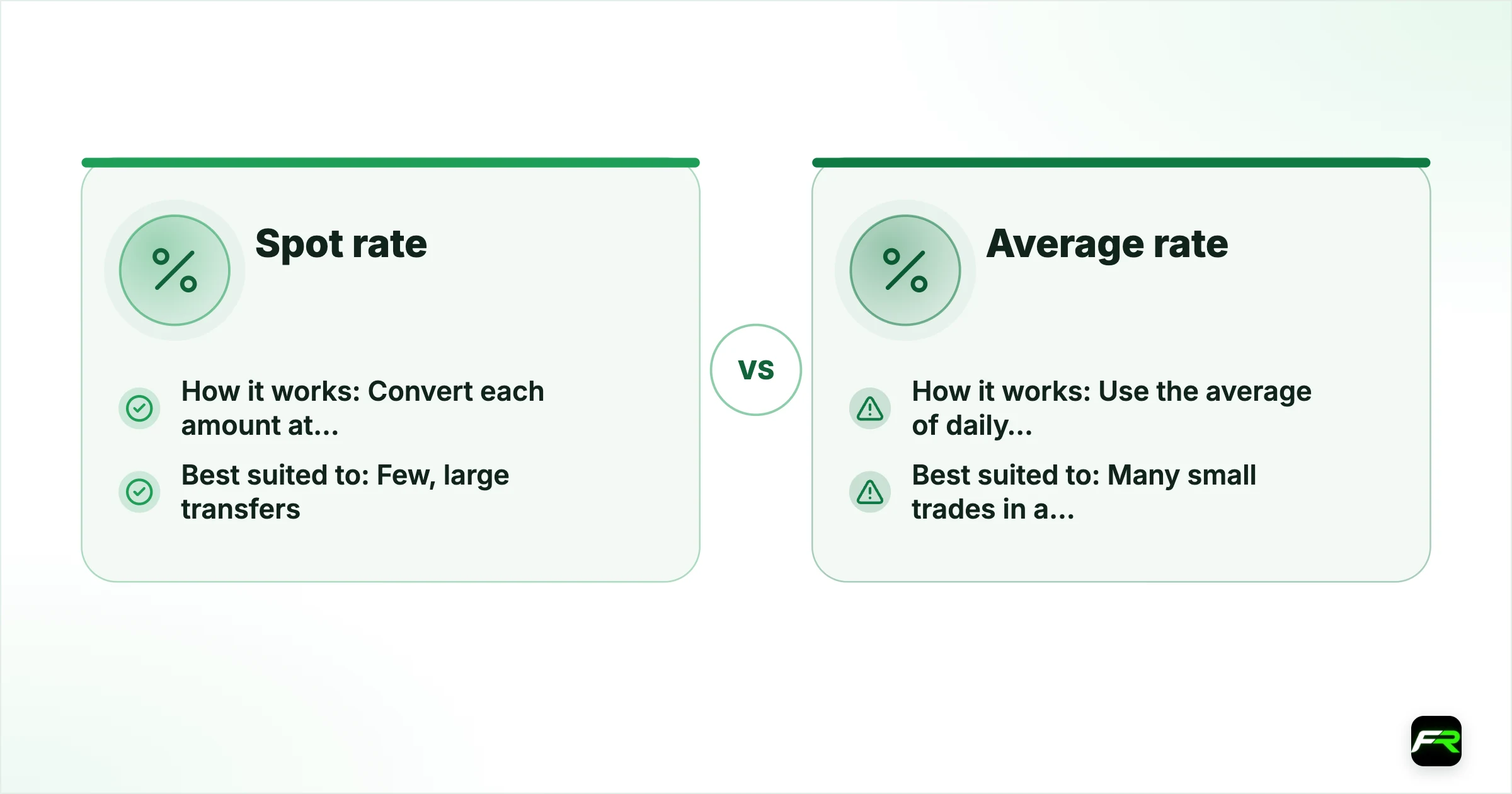
Section 25D of the Income Tax Act sets the rules for turning foreign-currency amounts into rand. The default is the spot rate on the day of each transaction. SARS's interpretation note on the section adds an option that many traders miss: an individual may elect to use the average exchange rate for the whole tax year instead.
| Method | How it works | Best suited to |
|---|---|---|
| Spot rate | Convert each amount at the rate on the day it arose | Few, large transfers; precise records |
| Average rate (election) | Use the average of daily or monthly closing rates for the tax year | Many small trades in a US dollar account |
If you elect the average rate, calculate it from closing rates at consistent daily or monthly intervals across the year, apply it to every foreign amount in that year, and note the choice in your working papers. Switching methods within one year to suit the result is not allowed. For most traders with a dollar account the average method is simpler and entirely acceptable; a trader with a ZAR base account avoids the question because the broker already reports in rand.
Where each record comes from
- Trade history: the statement export in your broker's client portal. Choose a format that includes open and close times, prices and profit.
- Deposits and withdrawals: the transactions page in the portal, matched to your bank statement.
- Exchange rates: your bank's transfer confirmations for spot rates, or the published daily closing rates for an average.
- Expenses: supplier invoices and the payment line on your bank statement.
If you are already behind
If you have traded for a year or more with no records, start now for the current year and reconstruct what you can for prior years: pull the oldest statements still available, get bank records, and use a historical rates source for the conversion. A tax practitioner can help present incomplete prior years and, if there is undeclared profit, use SARS' voluntary disclosure route before it becomes an audit. The main SARS guide covers voluntary disclosure.
A forex audit is only frightening if you have nothing. With a folder of monthly statements and a rand P&L spreadsheet, it is an upload and a short email. The fifteen minutes a month it takes to keep that folder is the best-value admin a trader can do.
Frequently asked
What records does SARS want from a forex trader?
Monthly broker statements, every deposit and withdrawal in original currency and rand with the exchange rate used, a monthly rand profit-and-loss summary, matching bank statements, and invoices for any expenses you deduct.
How long must I keep trading records?
Keep supporting records for at least five years after the relevant return is filed. SARS can review returns going back several years, so err on the side of keeping more.
How do I convert my trading profit to rand?
Record the rand value of each deposit and withdrawal at the actual exchange rate on the day, and calculate profit from the movement in rand terms. Alternatively, section 25D(3) lets an individual elect the average exchange rate for the tax year, calculated from daily or monthly closing rates and applied consistently.
My broker only shows recent statements. What do I do?
Download and save statements regularly, at least monthly, so you keep a full history. If you lose access to older records, use a historical exchange-rate source and your bank statements to reconstruct, and consider a practitioner.
I have traded for two years with no records. What now?
Start proper records for the current year, reconstruct prior years as far as available statements and bank records allow, and speak to a tax practitioner. If there is undeclared profit, SARS has a voluntary disclosure process to correct it before an audit.
Can I use an average exchange rate for my trading profit?
Yes. Section 25D(3) lets an individual elect to use the average exchange rate for the tax year, worked out from daily or monthly closing rates and applied consistently. The default is the spot rate on each transaction date. Record which method you used in your working papers.
Related reading
The team behind this guide
Researched, checked and approved by five forex specialists
Every guide is written, fact-checked and edited before it goes live, and updated when the facts change. Spotted an error? Tell us.