IC Markets





































Declaring Forex Losses to SARS: What Actually Counts
A trading loss can reduce your overall tax if your trading is a genuine trade. If SARS sees a hobby, the loss can be ring-fenced. Here is how it works and how to stay on the right side of the line.
 WriterAbir KhanWriterWrites the guides · checks every figure against primary sources View profileAbout Abir →
 Market analysisTanbir Habib RiyadForex & Crypto AnalystForex and crypto analyst · technical and fundamental analysis View profileAbout Tanbir →
 Fact-checking & riskJannatul FerdaushFact-Checker & Risk AnalystFact-checks every figure · risk analysis · Applied Statistics, University of Dhaka View profileAbout Jannatul →
 Trading reviewJowel RanaCo-Founder & Forex TraderCo-founder · forex trader · reviews guides from a trader's view View profileAbout Jowel →
 Final approvalRanjan NiskrityFounder, Owner & Forex TraderFounder and owner · forex trader · signs off every guide View profileAbout Ranjan →
This is a general overview, not tax advice. SARS assesses each trader's facts individually, and the classification of your trading and the deductions you can claim depend on your specific situation. A registered tax practitioner is worth the fee.
Most retail forex accounts lose money, so for many South African traders the tax question in year one is about losses, not profits. The good news: if your trading is a real trade, a loss can be set off against your salary and other income, reducing your total tax for the year. Against that, where SARS decides your trading is a hobby or is not carried on with a genuine profit motive, it can ring-fence the loss so it only offsets future trading gains. This guide covers the difference.
How a deductible loss works
If your trading is revenue in nature and carried on as a trade, your net trading loss for the year is treated like any business loss. It reduces your taxable income. So if you earn a salary of R400,000 and make a R30,000 trading loss, your taxable income for the year is around R370,000, and you have effectively saved tax at your marginal rate on that R30,000. You claim it on your ITR12 by declaring the trading result honestly, as a negative figure.
Ring-fencing: when the loss is trapped
South African tax law lets SARS ring-fence losses from certain activities, including those that look like a hobby or a tax-shelter. If ring-fenced, your R30,000 trading loss does not reduce your salary tax this year. Instead it is carried forward and can only be set against trading profit in future years. Factors that push SARS towards ring-fencing:
- The activity has made losses in most of the last several years with no realistic path to profit.
- It is run casually, with no strategy, no records, and sporadic activity.
- The structure looks designed mainly to create a deduction against other income.
- There is no meaningful time or capital committed to it as a genuine venture.
| Situation | Loss treatment |
|---|---|
| Businesslike trading, records kept, genuine profit motive | Deductible against other income this year |
| Casual, no records, losses every year, no plan | Likely ring-fenced; carried forward against future trading profit only |
| First or second year of losses, clearly trying to build a trade | Usually deductible, but keep evidence of the businesslike approach |
How to keep losses deductible
- Keep proper records from day one: every trade, a monthly rand profit-and-loss figure, and your strategy written down.
- Trade with regularity and a plan, not impulsively once a month.
- Commit real, if modest, time and capital, and be able to show it.
- Track your progress toward profitability. A trader who is clearly learning and improving looks like a trade; one who repeats the same losses for years does not.
- Get a practitioner to file the year with losses, so the declaration is framed correctly.
Dineo lost about R25,000 in her first year, trading a defined strategy most weekdays and journalling every trade. Her practitioner declared the loss on her ITR12 and set it against her salary, saving tax at her marginal rate. The records showing a consistent, businesslike approach were what made the deduction defensible. A friend who lost a similar amount trading haphazardly with no records had his loss queried and ended up carrying it forward instead.
Do not invent or inflate a loss to reduce salary tax. SARS can see your broker records through information-sharing and audit, and a fabricated trading loss is under-declaration in reverse, with the same penalties. Declare the real number.
The ring-fencing test in section 20A, and the 2026 change
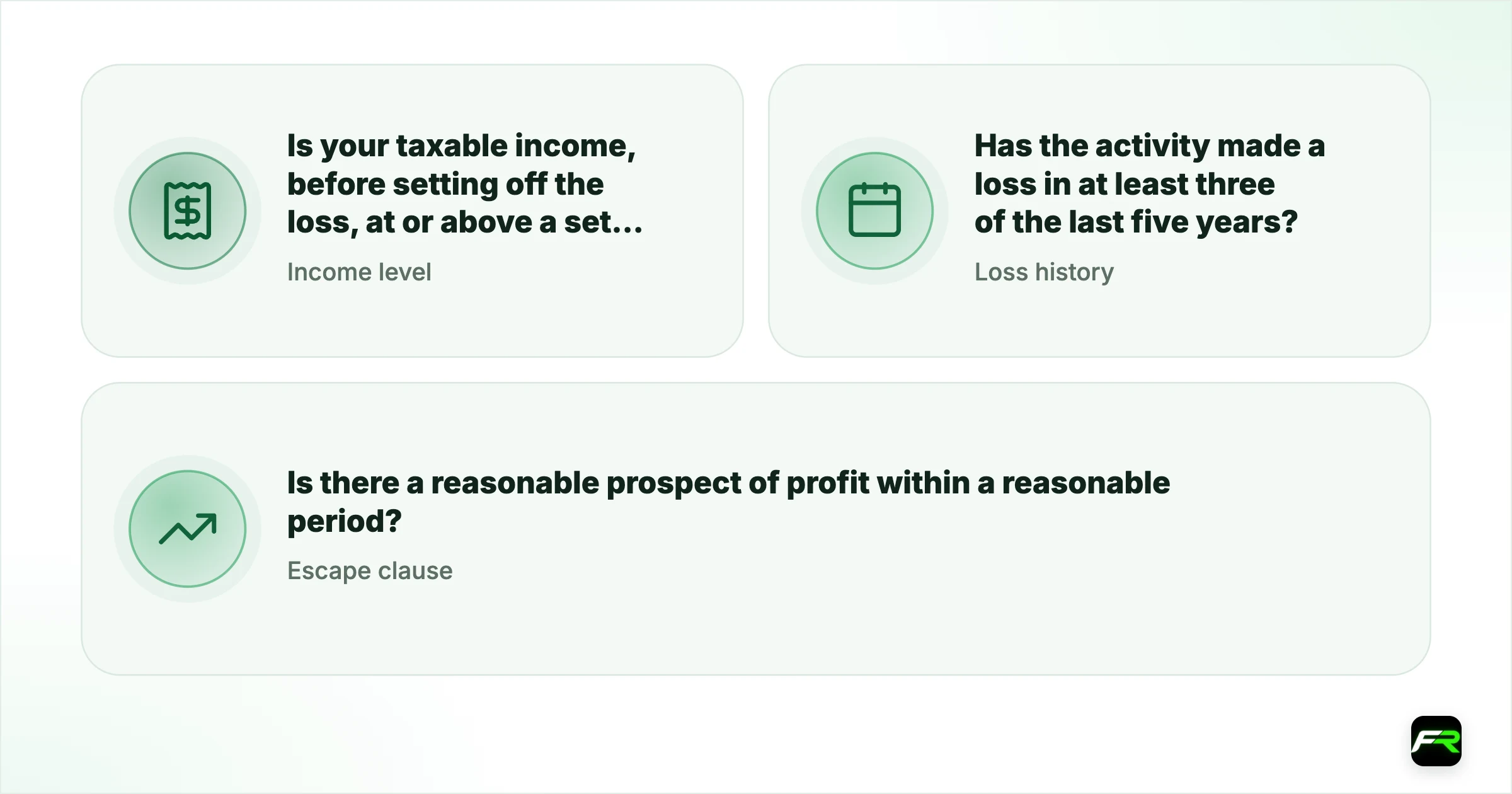
Ring-fencing is set out in section 20A of the Income Tax Act, and it is more mechanical than its reputation. SARS's guide on the section runs it as a series of steps, and the first two are simple tests that decide whether the rule can apply at all:
| Test | What it asks | What changed for 2026/27 |
|---|---|---|
| Income level | Is your taxable income, before setting off the loss, at or above a set threshold? | The threshold is now where the 39% rate starts (R695,800 for 2026/27), not only the 45% bracket |
| Loss history | Has the activity made a loss in at least three of the last five years? | Unchanged; the five years include the current one |
| Escape clause | Is there a reasonable prospect of profit within a reasonable period? | Unchanged; your records are the evidence |
SARS confirmed the change in its July 2026 practitioner newsletter: for years of assessment starting on or after 1 March 2026, ring-fencing can apply from the 39 per cent marginal rate. Many more salaried traders now sit above that line. A losing trader earning a good salary therefore needs records showing a genuine, improving trade more than ever.
Declaring a loss on the ITR12
A trading loss goes on your return in the section for local business, trade and professional income, with the activity described plainly as forex or derivatives trading. Declare the net figure in rand from your monthly summary, and keep the broker statements that support it. If you also have deductible expenses, they sit in the same section and increase the loss rather than being claimed somewhere else.
Write a one-page summary each year: your strategy, hours traded, results by month and what you changed. If SARS ever applies the reasonable-prospect test, that page is your case.
Carrying a loss forward
Whether ring-fenced or simply larger than your other income, an unused trading loss is carried forward to the next tax year and set against trading profit (or, if not ring-fenced, other income) then. Keep a clear record of the accumulated loss each year so you can apply it when you do have a profitable year. The records guide covers what to retain.
The traders who get the loss deduction are the ones who can show SARS a real operation: a strategy, a journal, regular activity, a trajectory. Those who lose the deduction treated trading as a punt and have nothing to show for it. Good records are not just for the profitable years.
Frequently asked
Can I claim forex trading losses against my salary?
If your trading is a genuine trade, revenue in nature and run in a businesslike way, yes. A net trading loss for the year reduces your total taxable income, saving tax at your marginal rate.
What is ring-fencing?
SARS can ring-fence a loss from an activity that looks like a hobby or a tax shelter, so it cannot reduce your other income this year. Instead it is carried forward and set only against future profit from the same activity.
How do I keep my losses deductible?
Keep full records, trade with a plan and regularity, commit real time and capital, and be able to show progress toward profitability. A businesslike operation is treated as a trade; a casual one may be ring-fenced.
Do I have to declare a losing year to SARS?
If you are registered as a provisional taxpayer or otherwise required to file, yes, and it is in your interest to, because a deductible loss reduces your tax. Declare the real figure from your records.
What happens to a loss I cannot use this year?
It is carried forward to the next tax year and set against trading profit, or other income if it is not ring-fenced. Keep a running record of the accumulated loss.
Does ring-fencing apply to me if I earn under R695,800?
For the 2026/27 year, section 20A only applies once your taxable income, before setting off the loss, reaches the point where the 39 per cent rate starts, about R695,800. Below that, the mechanical ring-fencing rule does not apply, although SARS can still question whether you are carrying on a trade at all.
Related reading
The team behind this guide
Researched, checked and approved by five forex specialists
Every guide is written, fact-checked and edited before it goes live, and updated when the facts change. Spotted an error? Tell us.