IC Markets





































Income or Capital Gains? How SARS Classifies Your Forex Profits
For an active trader, forex profit is revenue, taxed as ordinary income at your marginal rate. The lower capital gains treatment almost never applies. Here is the test SARS uses and why.
 WriterAbir KhanWriterWrites the guides · checks every figure against primary sources View profileAbout Abir →
 Market analysisTanbir Habib RiyadForex & Crypto AnalystForex and crypto analyst · technical and fundamental analysis View profileAbout Tanbir →
 Fact-checking & riskJannatul FerdaushFact-Checker & Risk AnalystFact-checks every figure · risk analysis · Applied Statistics, University of Dhaka View profileAbout Jannatul →
 Trading reviewJowel RanaCo-Founder & Forex TraderCo-founder · forex trader · reviews guides from a trader's view View profileAbout Jowel →
 Final approvalRanjan NiskrityFounder, Owner & Forex TraderFounder and owner · forex trader · signs off every guide View profileAbout Ranjan →
This is a general overview, not tax advice. SARS assesses each trader's facts individually, and the classification of your trading and the deductions you can claim depend on your specific situation. A registered tax practitioner is worth the fee.
People hope forex profit is a capital gain, because the capital gains inclusion rate makes the effective tax lower. For an active trader it is not. SARS treats profit from frequent, short-term currency trading as revenue in nature, meaning ordinary income taxed at your marginal rate of 18 to 45 per cent. This guide explains the income-versus-capital test, why trading falls on the income side, and the narrow cases where capital might apply.
The test: intention and behaviour
South African tax law distinguishes between an asset held to produce a long-term return (capital) and an asset traded to profit from short-term price movement (revenue). SARS and the courts look at your intention and your actual behaviour, including:
- Frequency. Many trades points to revenue. A single long-held position points to capital.
- Holding period. Minutes, hours or days is revenue. Years leans capital.
- Intention. Buying a currency to profit from a move is a scheme of profit-making, which is revenue.
- Organisation. A businesslike operation with a strategy, journal and regular activity looks like a trade.
- Use of leverage. Margin trading on CFDs is inherently short-term speculation, which is revenue.
| Activity | Likely treatment |
|---|---|
| Regular CFD or margin forex trading, short holds | Revenue: ordinary income at marginal rate |
| Day trading spot forex, dozens of trades a month | Revenue: ordinary income |
| Holding a foreign-currency cash amount for years | Possibly capital |
| A one-off conversion of rand to dollars, held long term | Possibly capital |
Why active trading is revenue
A retail forex trader placing regular trades, often on leverage, holding for short periods, with the explicit aim of profiting from price movement, ticks every box on the revenue side. There is no realistic argument that this is a long-term capital investment. If you are reading a guide about forex trading tax, SARS will treat your gains as income. Planning around a capital gains outcome is planning for something that will not happen.
The narrow capital cases
Capital treatment might apply if you bought a foreign-currency amount, or a foreign-currency-denominated asset, as a genuine long-term holding and it happened to gain because the rand weakened. For example, someone who moved savings into a foreign bank account years ago and later brings it back. That is not trading. It is an investment that had currency exposure. The moment you are actively opening and closing positions to catch moves, you are on revenue account.
Riaan assumed his forex profits would be taxed as capital gains and set aside far too little. His practitioner explained that 400 leveraged trades over the year, most held less than a day, was textbook revenue, taxed at his 36 per cent marginal rate rather than the much lower effective capital rate he had budgeted for. He had under-provisioned by about R18,000. Now he treats every rand of trading profit as ordinary income for planning.
Do not assume capital gains treatment and set money aside on that basis. If SARS assesses your trading as revenue, which for active trading it will, you can face a shortfall of tens of per cent of your profit, plus penalties and interest for underpaying provisional tax.
Three traders, three likely outcomes
Classification is easier to grasp with people than with principles. These three illustrative profiles show how the same broad rules play out. None is a ruling, and SARS looks at each taxpayer's facts, but the direction is clear in each case.
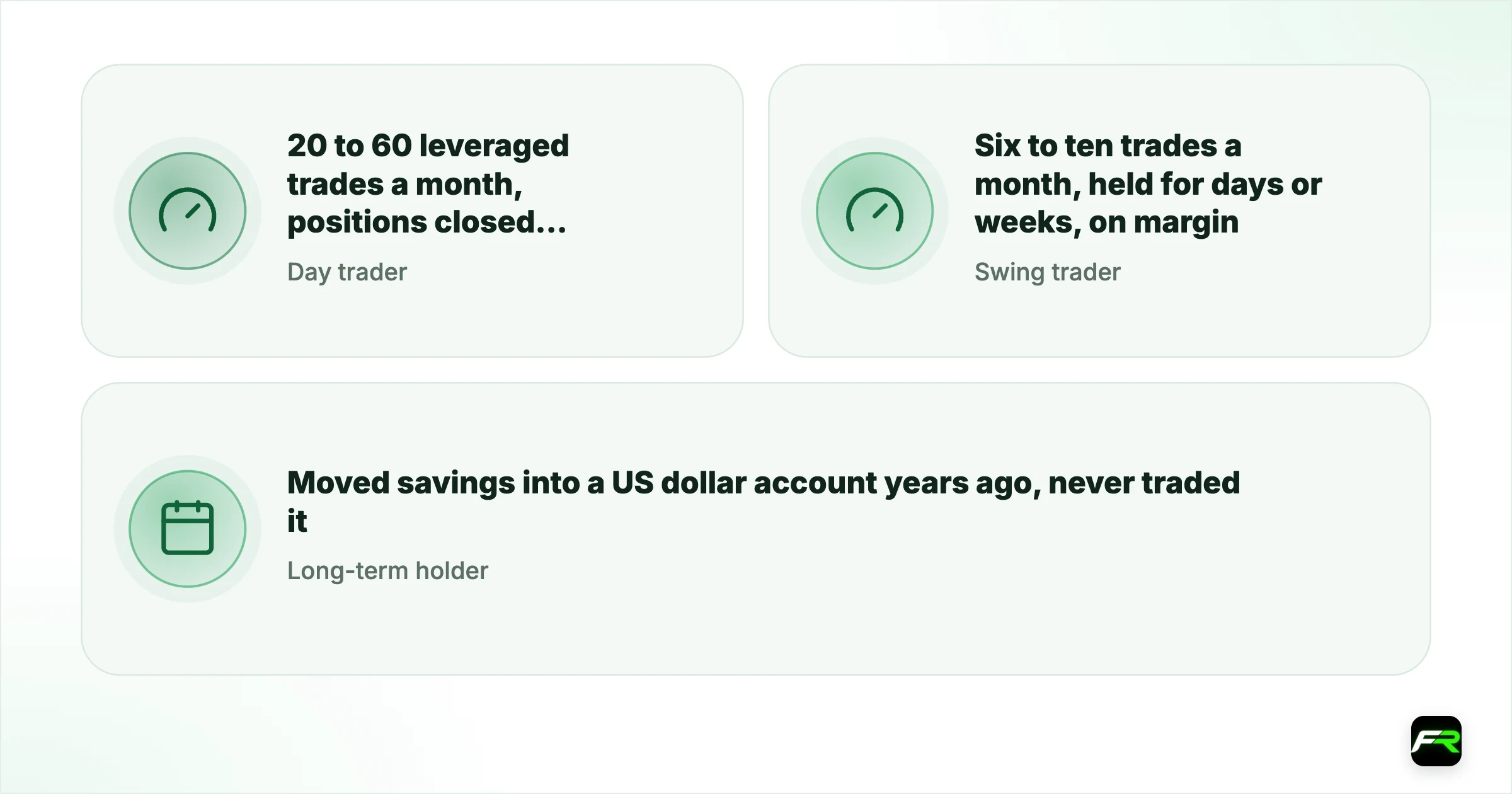
| Profile | Behaviour | Likely treatment |
|---|---|---|
| Day trader | 20 to 60 leveraged trades a month, positions closed same day | Revenue: taxed at marginal rate |
| Swing trader | Six to ten trades a month, held for days or weeks, on margin | Revenue: short-term profit-seeking |
| Long-term holder | Moved savings into a US dollar account years ago, never traded it | Possibly capital on the currency gain |
The swing trader is the case people argue about, because the holding periods are longer. What usually decides it is intention: positions opened on margin to profit from a price move are part of a profit-making scheme, however long they stay open. Holding for weeks rather than minutes does not turn a trade into an investment.
What the inclusion rate means for your bill
For individuals, only 40 per cent of a net capital gain is included in taxable income, after an annual exclusion of R50,000 for 2026/27, so the highest effective rate on a gain is 18 per cent. Revenue profit is taxed in full, up to 45 per cent. On R100,000 of profit that gap can be worth tens of thousands of rand, which explains both why people hope for capital treatment and why SARS looks closely at those who claim it.
The inclusion rate and annual exclusion are the figures for individuals; companies and trusts are treated differently. Confirm the current figures on sars.gov.za or with a practitioner before relying on them.
What this means for your planning
- Treat all active trading profit as ordinary income at your marginal rate.
- Register for provisional tax if you trade regularly.
- Set aside 35 to 40 per cent of profit withdrawals for tax.
- Keep records that show a businesslike operation, which also helps if you want losses treated as deductible against other income.
- If you genuinely have a long-term foreign-currency holding as well, keep it clearly separate from your trading activity.
Every year a few traders come to us convinced their profits are capital gains because that is what a forum told them. They are almost always wrong. Frequent leveraged trading to catch price moves is the definition of revenue. Budget for your marginal rate and you will never be unpleasantly surprised.
Frequently asked
Is forex trading profit a capital gain in South Africa?
For an active trader, no. SARS treats frequent short-term currency trading as revenue in nature, taxed as ordinary income at your marginal rate of 18 to 45 per cent. Capital gains treatment applies only to genuine long-term holdings, not trading.
What does SARS look at to decide income versus capital?
Your intention and behaviour: how often you trade, how long you hold, whether you use leverage, and whether the aim is to profit from price movement. Frequent leveraged short-term trading is revenue.
Could any of my forex activity be capital?
Only a genuine long-term holding of foreign currency or a foreign-currency asset that you are not actively trading. Keep any such holding clearly separate from your trading account and activity.
Why does the classification matter?
Capital gains are taxed at a lower effective rate because only a portion is included in taxable income. Revenue is taxed in full at your marginal rate. Assuming the wrong one leaves you under-provisioned for tax.
Does my broker being offshore make it capital?
No. The location of the broker has no bearing on whether the profit is revenue or capital. Active trading profit is revenue regardless of where the account is held.
Can I treat some trades as capital and others as income?
Only if the activities are genuinely separate. A long-term foreign-currency holding kept apart from your trading account might be capital, while your active trades are revenue. Mixing them in one account and picking the label after the event will not stand up.
Related reading
The team behind this guide
Researched, checked and approved by five forex specialists
Every guide is written, fact-checked and edited before it goes live, and updated when the facts change. Spotted an error? Tell us.