IC Markets





























How Long Does It Take to Double a $100 Forex Account at 1% to 2% Risk?
At realistic monthly returns, doubling an account takes years, not weeks. Here is the compounding maths, what different win rates and risk levels really produce, and why adding savings beats chasing returns.
 WriterAbir KhanWriterWrites the guides · checks every figure against primary sources View profileAbout Abir →
 Market analysisTanbir Habib RiyadForex & Crypto AnalystForex and crypto analyst · technical and fundamental analysis View profileAbout Tanbir →
 Fact-checking & riskJannatul FerdaushFact-Checker & Risk AnalystFact-checks every figure · risk analysis · Applied Statistics, University of Dhaka View profileAbout Jannatul →
 Trading reviewJowel RanaCo-Founder & Forex TraderCo-founder · forex trader · reviews guides from a trader's view View profileAbout Jowel →
 Final approvalRanjan NiskrityFounder, Owner & Forex TraderFounder and owner · forex trader · signs off every guide View profileAbout Ranjan →
Doubling a $100 forex account at sensible risk usually takes years, not weeks. At a steady 3% a month, which would be an excellent sustained result, it takes about two years. A 5% monthly return takes a little over 14 months, and 10% a month about seven, but very few traders sustain 10% monthly without taking risks that also put the account in danger.
This page shows the compounding maths, what returns different win rates and risk levels produce, and why the fastest way to grow a small account is to add savings while proving your strategy, not to raise risk.
| Rule of 72 | Months to double ≈ 72 ÷ monthly % |
|---|---|
| At 3% a month | About 24 months |
| At 5% a month | Roughly 14 to 15 months |
| At 10% a month | Around 7 months |
| Faster route | Add savings, keep risk steady |
The compounding table
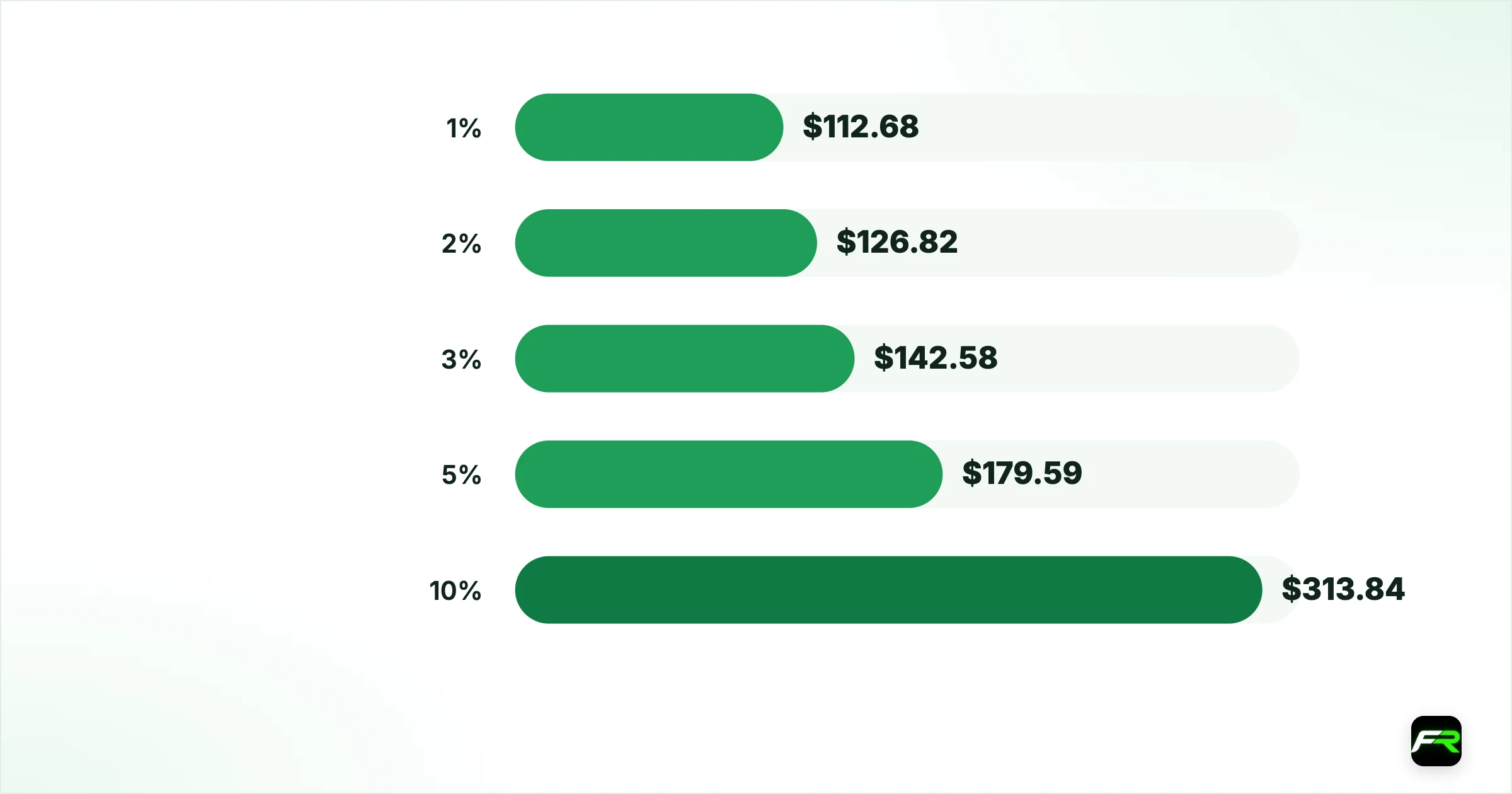
| Monthly return | Months to double | $100 after 12 months | $100 after 24 months |
|---|---|---|---|
| 1% | 70 | $112.68 | $126.97 |
| 2% | 35 | $126.82 | $160.84 |
| 3% | 23.4 | $142.58 | $203.28 |
| 5% | 14.2 | $179.59 | $322.51 |
| 10% | 7.3 | $313.84 | $984.97 |
The figures assume the same return every month with profits left in the account. Real results vary month to month, and losing months stretch the timeline. The compounding calculator lets you test your own numbers, including deposits.
What 1% to 2% risk can produce
Monthly return depends on how much you risk per trade, how often you trade, your win rate and your reward-to-risk ratio. A trader risking 1% per trade, winning half the time with winners twice the size of losers, earns 0.5% per trade on average before costs. With eight trades a month, that is about 4% a month, an outstanding result few traders reach consistently.
| Win rate | Reward : risk | Expectancy per trade at 1% risk | 8 trades a month |
|---|---|---|---|
| 40% | 1.5 : 1 | 0% | Break-even before costs |
| 50% | 1.5 : 1 | +0.25% | About +2% |
| 50% | 2 : 1 | +0.5% | About +4% |
| 60% | 1 : 1 | +0.2% | About +1.6% |
Spreads, commissions and swaps reduce these figures. Our risk-reward calculator shows how the combination of win rate and ratio sets your edge.
Why raising risk does not shorten the wait
Doubling risk to 4% per trade doubles the expected monthly return on paper, but it also doubles the drawdowns. A normal losing streak of eight trades costs about 8% at 1% risk and about 28% at 4% risk. Recovering from 28% needs a gain of about 39%. Higher risk makes the path so rough that most traders abandon the plan or blow the account before the average catches up.
| Risk per trade | Loss after 8 losing trades | Gain needed to recover |
|---|---|---|
| 1% | 7.7% | 8.4% |
| 2% | 14.9% | 17.5% |
| 4% | 27.9% | 38.6% |
| 10% | 57.0% | 132.3% |
The faster route: add savings
A $100 account that adds $50 a month and earns 2% a month reaches about $800 after 12 months, mostly from deposits. The same account without deposits reaches about $127. Building the account from savings while you prove the strategy at small risk is the realistic way to reach a size where returns start to matter in money.
A trader in Lagos starts with $100 and plans to double it in two months by risking 10% per trade. Six straight losses in the first three weeks leave $53. The trader restarts with $100, adds $40 a month from salary, and risks 1% per trade. Twelve months later the account is about $650, with three profitable months, two flat and one small loss, and a tested plan.
What realistic looks like
- Many retail CFD accounts lose money; ESMA's analysis found most do.
- Among profitable traders, a few percent a month on average is a strong result.
- Losing months are normal and should be planned for.
- Consistency over a year matters more than any single month.
Costs eat small returns
On a $100 account, a 1-pip spread on 0.01 lots costs $0.10 per trade. Eight trades a month cost about $0.80, or 0.8% of the account, before commissions and swaps. If your expected return is 2% a month, costs take a large share of it. Trading fewer, better setups on liquid pairs during their main sessions keeps costs low relative to the edge. Our trading cost calculator shows the total.
Prop firms as a shortcut
Some traders skip growing a small account and buy prop firm challenges, which give access to larger notional balances if passed. The challenge fee is a cost that is often lost, and the rules, such as daily loss limits, are strict. For traders who already have a tested plan, a challenge can be a sensible step; for those still learning, it usually adds cost without adding skill. Run the numbers with our prop firm calculator first.
Measure progress differently
On a $100 account, dollar gains are small whatever you do, so judge progress by process: did you follow the plan, keep risk at 1% to 2%, and log every trade? After three to six months, look at win rate, average win versus average loss, and maximum drawdown. Those numbers tell you whether the strategy deserves more money. Our guide to exporting MT5 history shows how to build the review.
When to increase risk
Only after a long enough record, typically a hundred trades or more, showing positive expectancy and a drawdown you can live with. Even then, increase size by growing the account, not by raising the percentage risk much above 2%. Professional traders who have survived for years rarely risk more than that per trade.
Set a target in trades, not money: "100 trades at 1% risk with a full journal". It keeps attention on what you control.
Offers to double your account in weeks, from signal groups or account managers, are a warning sign. Sustainable returns do not work that way.
Frequently asked
How long does it take to double a forex account?
At 3% a month compounded, about two years; at 5%, about 14 months; at 10%, about seven. Very few traders sustain 10% a month. Use the rule of 72: divide 72 by the monthly return to estimate the months needed.
Can I double $100 in a month?
Only by risking so much that you are more likely to lose most of it. Doubling in a month needs a 100% return, which at sensible risk would take years. Treat any promise of that as a warning sign.
What is a realistic monthly return in forex?
For profitable traders, a few percent a month on average over a year is strong. Many retail accounts lose money. Losing months are normal even for good traders, so plan for them.
Does compounding work on small accounts?
Yes, mathematically, but the dollar amounts stay small for a long time. Adding regular savings while compounding at low risk grows a small account much faster than returns alone.
Should I increase risk to grow faster?
Generally no. Higher risk deepens drawdowns, and recovering from a deep drawdown needs a much larger gain. Keep risk at 1% to 2% per trade and grow the account through deposits and time.
How many trades before I know my strategy works?
Usually a hundred or more, logged with entry, exit, risk and outcome. That sample shows win rate, average win and loss, and drawdown with some reliability. Fewer trades can mislead either way.
Official sources: ESMA: CFD product intervention measures
Related reading
The team behind this guide
Researched, checked and approved by five forex specialists
Every guide is written, fact-checked and edited before it goes live, and updated when the facts change. Spotted an error? Tell us.