IC Markets





























Is 1:500 Leverage Good for a $100 Forex Account?
Leverage of 1:500 does not raise your risk on its own; lot size does. But on a $100 account it lets you open positions big enough to lose everything in one move. Here is the maths and a safer way to use it.
 WriterAbir KhanWriterWrites the guides · checks every figure against primary sources View profileAbout Abir →
 Market analysisTanbir Habib RiyadForex & Crypto AnalystForex and crypto analyst · technical and fundamental analysis View profileAbout Tanbir →
 Fact-checking & riskJannatul FerdaushFact-Checker & Risk AnalystFact-checks every figure · risk analysis · Applied Statistics, University of Dhaka View profileAbout Jannatul →
 Trading reviewJowel RanaCo-Founder & Forex TraderCo-founder · forex trader · reviews guides from a trader's view View profileAbout Jowel →
 Final approvalRanjan NiskrityFounder, Owner & Forex TraderFounder and owner · forex trader · signs off every guide View profileAbout Ranjan →
Leverage of 1:500 on a $100 account is not dangerous by itself, because your profit and loss depend on lot size, not on leverage. What 1:500 changes is how big a position the broker lets you open: about 0.42 lots of EUR/USD on $100, a size where a 24-pip move would wipe out the account. Used with small lot sizes, 1:500 simply leaves more free margin. Combined with big positions, it ends small accounts quickly.
This page shows the numbers, compares 1:500 with lower leverage on the same trade, and sets out rules that make high leverage safe to have, if not something to rely on.
| What leverage changes | Margin held per trade |
|---|---|
| What it does not change | Profit or loss per pip |
| Max EUR/USD size on $100 at 1:500 | About 0.42 lots (all margin used) |
| Sensible size on $100 | 0.01 to 0.02 lots on major pairs |
| EU, UK and Australia retail cap | Major pairs limited to 1:30 |
Same trade, different leverage
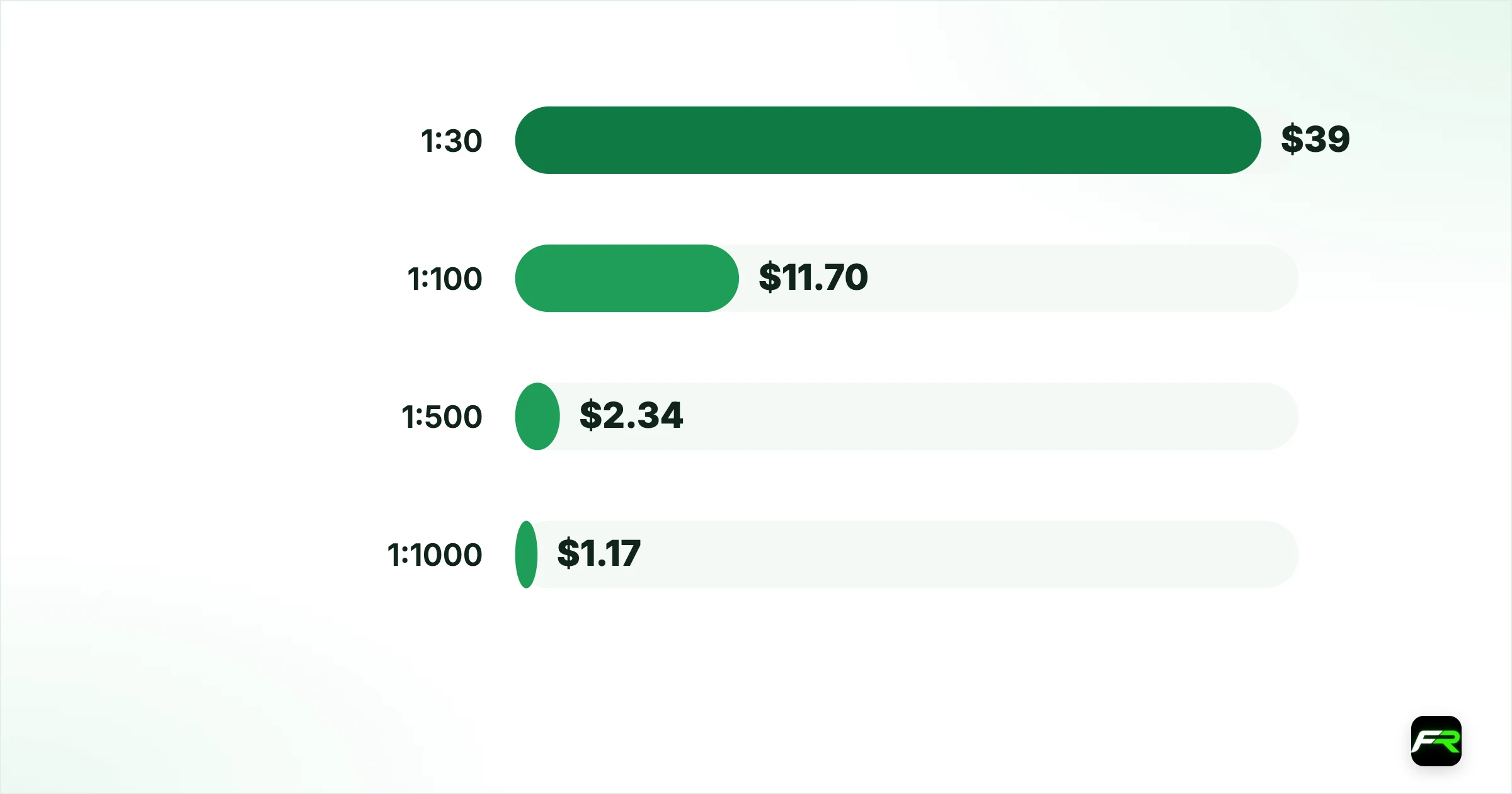
| Leverage | Margin for 0.01 lot EUR/USD | Free margin left on $100 | Loss on a 20-pip move |
|---|---|---|---|
| 1:30 | $39 | $61 | $2 |
| 1:100 | $11.70 | $88.30 | $2 |
| 1:500 | $2.34 | $97.66 | $2 |
| 1:1000 | $1.17 | $98.83 | $2 |
EUR/USD at 1.17 in the example. The loss on the same 0.01-lot trade is $2 at every leverage. Higher leverage only leaves more free margin, which protects the account from a margin call if you keep the size small.
Where 1:500 goes wrong
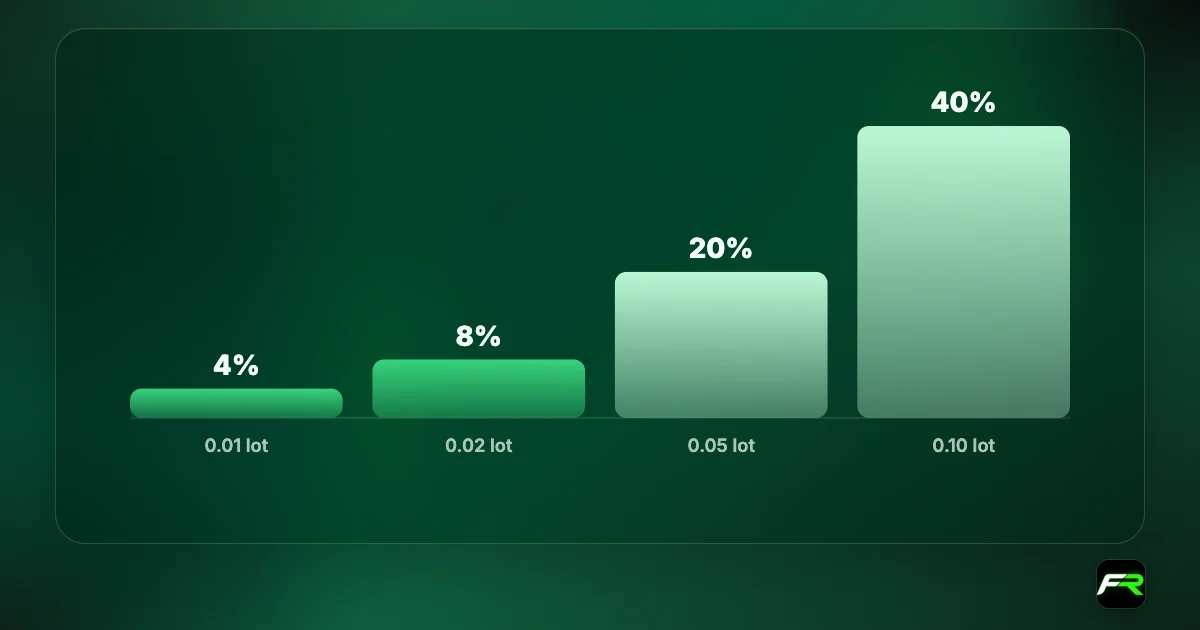
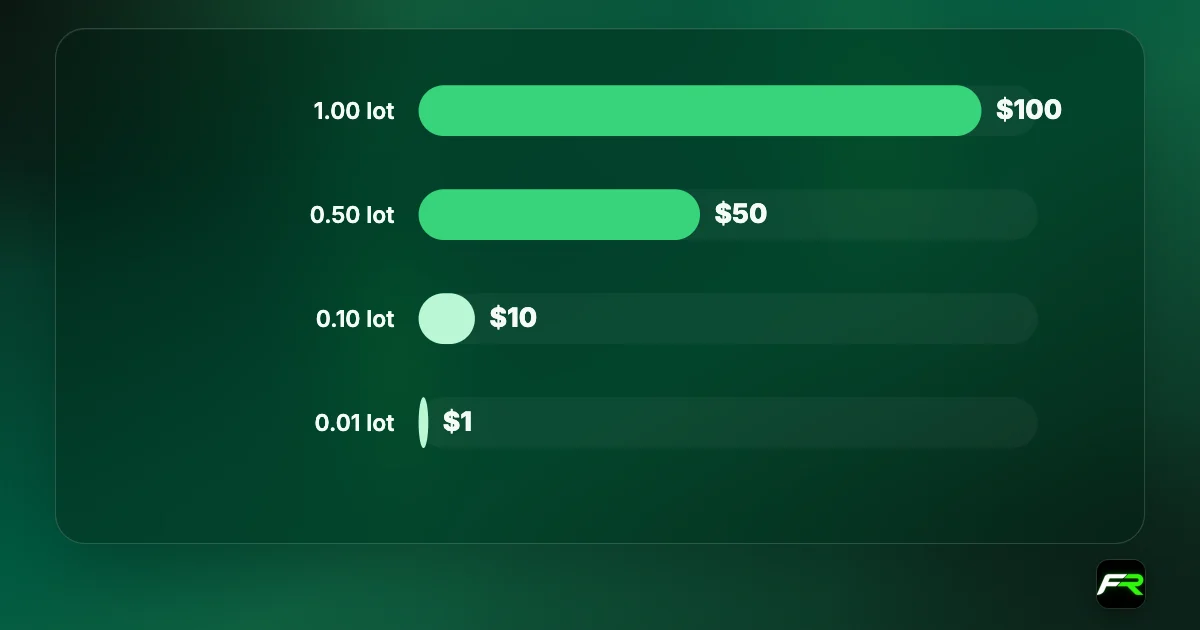
The risk appears when traders use the low margin to open bigger positions. At 1:500, $100 can hold 0.42 lots of EUR/USD. Each pip is then worth about $4.20, so a 24-pip move, a normal hour on a busy day, costs the whole account. Even 0.10 lots, which feels modest, risks $1 per pip, 1% of the account for every pip.
| Lot size on $100 | Pip value | Pips to lose 10% | Pips to lose everything |
|---|---|---|---|
| 0.01 | $0.10 | 100 | 1,000 |
| 0.05 | $0.50 | 20 | 200 |
| 0.10 | $1.00 | 10 | 100 |
| 0.42 (maximum at 1:500) | $4.20 | 2.4 | 24 |
Why regulators cap leverage
ESMA found that most retail CFD accounts lose money and restricted retail leverage in the EU to 1:30 on major pairs, 1:20 on gold and minor pairs, and lower on other products. The UK's FCA and Australia's ASIC apply equivalent limits. Offshore entities of the same brokers can offer 1:500 or more, but with weaker protections. If your account is with an offshore entity, the higher leverage is available; whether to use it is your decision.
A safe way to have 1:500
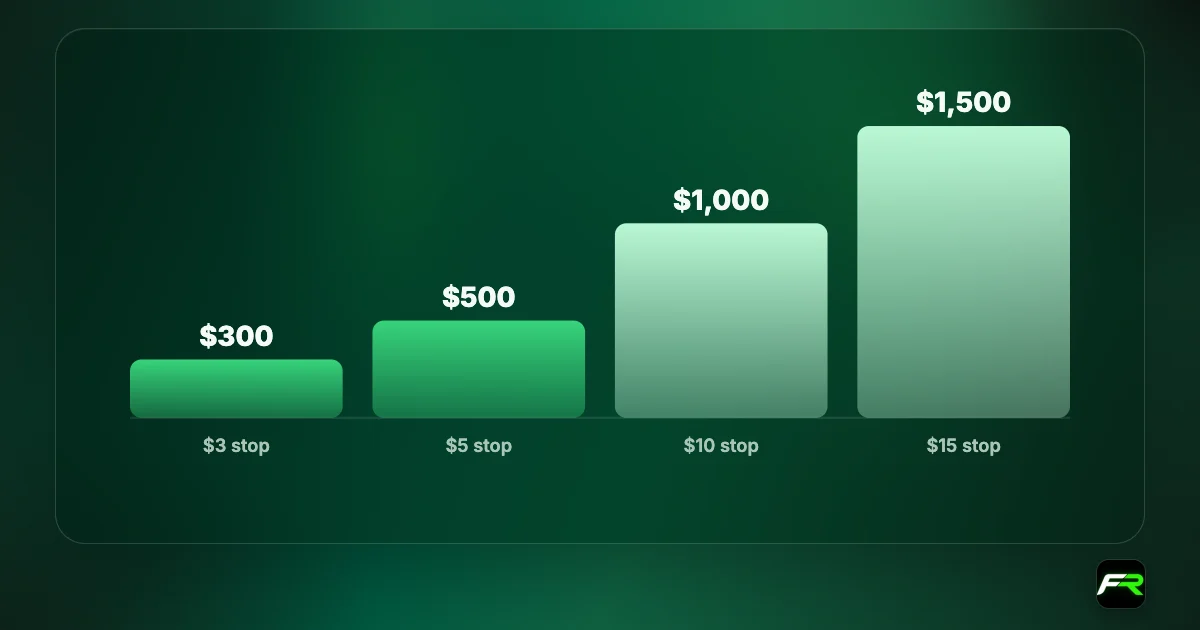
- Decide your risk per trade first: 1% to 2% of the account, $1 to $2 on $100.
- Set your stop from the chart, not from what the account can afford.
- Work out the lot size: risk ÷ (stop in pips × pip value per lot).
- Use leverage only so the margin fits comfortably; ignore the maximum size.
- Keep used margin under a fifth of equity across all trades.
Following these steps, 1:500 and 1:100 produce exactly the same trades on a $100 account. The higher leverage just leaves more breathing room. Step three is done for you by the position size calculator.
A trader in Nairobi with $100 at 1:500 plans a GBP/USD trade with a 15-pip stop and wants to risk $1.50. The size is $1.50 ÷ (15 × $10 per lot) = 0.01 lots. Margin is about $2.64. A friend on the same account size uses 0.30 lots because "the margin is only $79". When a 15-pip move goes against them, the friend loses $45 and the trader $1.50.
Leverage and gold on small accounts
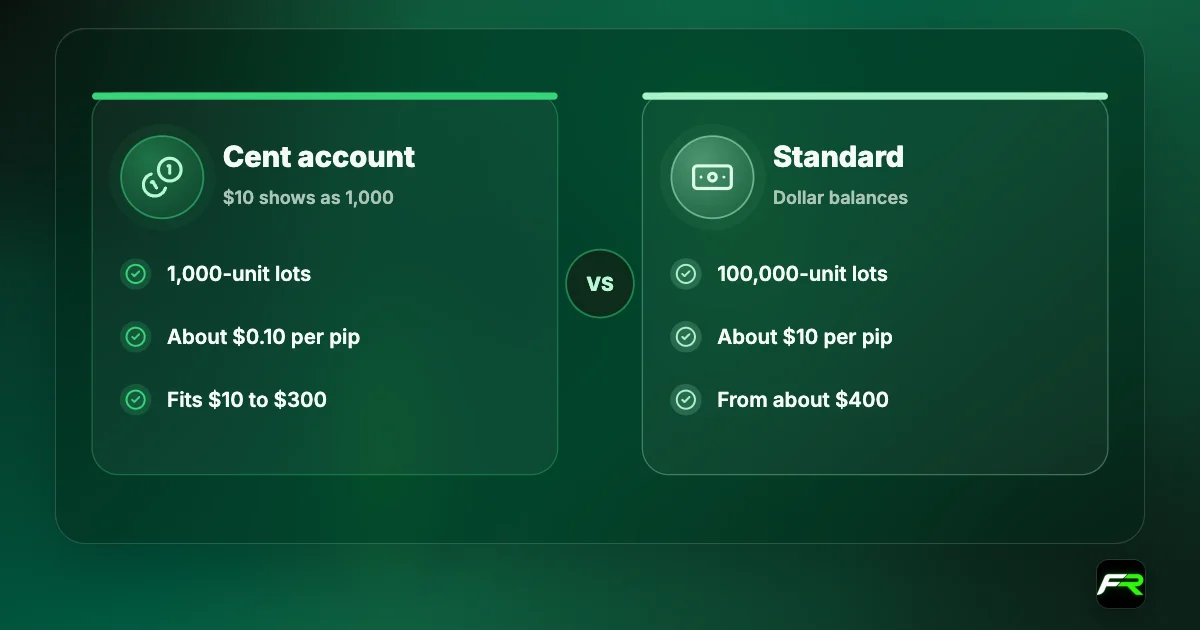
Gold is where small accounts with high leverage get hurt most. At 1:500, 0.10 lots of gold needs about $84 of margin at $4,200, which a $100 account can technically hold. But each $1 move is $10, and gold often moves $20 to $60 in a day. Our guide to margin for 0.01 lot of gold shows why 0.01 lots is the realistic maximum on $100.
Leverage changes automatically
Many brokers lower leverage as equity grows, or before weekends and major news. A $100 account might have 1:500 or more, but at $5,000 the same account might drop to 1:200 or 1:100 on some instruments. Brokers explain their tiers in their leverage pages; see our guides to Exness leverage and FXTM leverage.
High leverage and news
Around major releases, prices can move 20 to 50 pips on major pairs in minutes, and more on gold. A position sized for a quiet day can lose several percent of a small account in that time. Some brokers also reduce leverage temporarily around news, which raises margin on open trades. On a $100 account, the simplest rule is to avoid holding new positions through high-impact news unless the size is already small enough for the worst case.
Comparing two accounts
Imagine two $100 accounts, one at 1:30 and one at 1:500, both trading 0.01 lots with 20-pip stops. After 50 trades their results are identical, because each trade risked the same $2. The only difference appears on a bad run: the 1:30 account has less free margin and may reach a margin call sooner if several trades are open together. Leverage rewards discipline and punishes over-sizing; it never adds an edge by itself.
Should a beginner choose lower leverage?
If having high leverage tempts you to open large positions, choose lower leverage, such as 1:30 to 1:100. It acts as a brake: the platform simply will not open sizes that would wipe out the account. If you are disciplined about sizing from risk, higher leverage costs nothing extra and protects against margin calls. Be honest about which kind of trader you are.
After every losing trade, check the lot size against your written maximum. If you broke it, the problem was sizing, not leverage.
High leverage combined with no stop loss is the most common way small accounts are lost in a single day.
Frequently asked
Is 1:500 leverage good for a $100 account?
It can be safe if you trade small sizes, such as 0.01 lots on major pairs, because losses depend on lot size, not leverage. Danger starts when the low margin tempts you to open large positions that a normal move can wipe out.
What leverage should I use with $100?
Any leverage that leaves comfortable free margin for 0.01 to 0.02 lot trades. If high leverage tempts you to over-size, choose 1:30 to 1:100 as a brake. Size every trade from a 1% to 2% risk with a stop loss.
Does higher leverage mean bigger profits?
No. Profit per pip depends on lot size. Higher leverage only lowers the margin held, so you can open bigger positions, which increases both possible profits and possible losses.
How much can I lose with 1:500 leverage?
With negative balance protection, up to your account balance. Without a stop loss and with a large position, a small move can lose most of it. A 24-pip move against a full 0.42-lot EUR/USD position on $100 would wipe out the account.
Why do EU brokers only offer 1:30?
ESMA restricted retail leverage to 1:30 on major pairs after finding that most retail CFD accounts lose money. The UK and Australia apply similar caps. Brokers' offshore entities may offer more, with weaker protections.
Can I change leverage later?
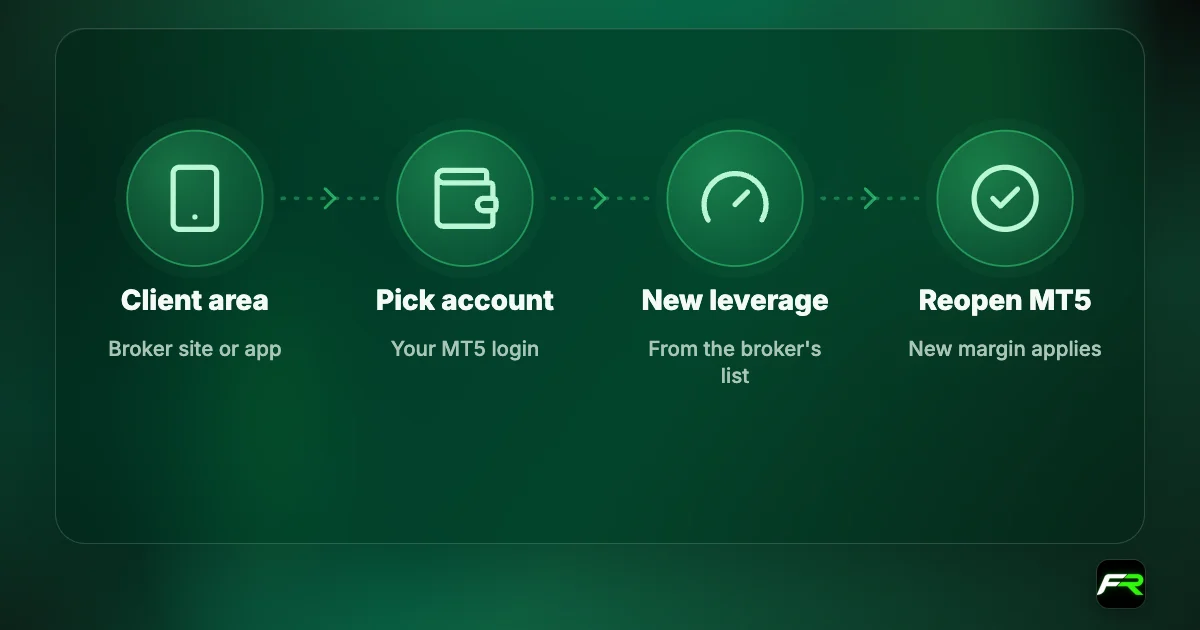
Yes, usually in your broker's client area, sometimes only with no open positions. Some brokers also adjust leverage automatically as equity grows or around weekends and news.
Official sources: ESMA: CFD product intervention measures
Related reading
The team behind this guide
Researched, checked and approved by five forex specialists
Every guide is written, fact-checked and edited before it goes live, and updated when the facts change. Spotted an error? Tell us.