IC Markets





























Why Spreads Widen at the 5pm New York Rollover (and What to Do About It)
Every trading day, spreads jump for a few minutes around 5pm New York time as banks roll positions and liquidity thins. Here is why it happens, how big it gets and how to protect open trades.
 WriterAbir KhanWriterWrites the guides · checks every figure against primary sources View profileAbout Abir →
 Market analysisTanbir Habib RiyadForex & Crypto AnalystForex and crypto analyst · technical and fundamental analysis View profileAbout Tanbir →
 Fact-checking & riskJannatul FerdaushFact-Checker & Risk AnalystFact-checks every figure · risk analysis · Applied Statistics, University of Dhaka View profileAbout Jannatul →
 Trading reviewJowel RanaCo-Founder & Forex TraderCo-founder · forex trader · reviews guides from a trader's view View profileAbout Jowel →
 Final approvalRanjan NiskrityFounder, Owner & Forex TraderFounder and owner · forex trader · signs off every guide View profileAbout Ranjan →
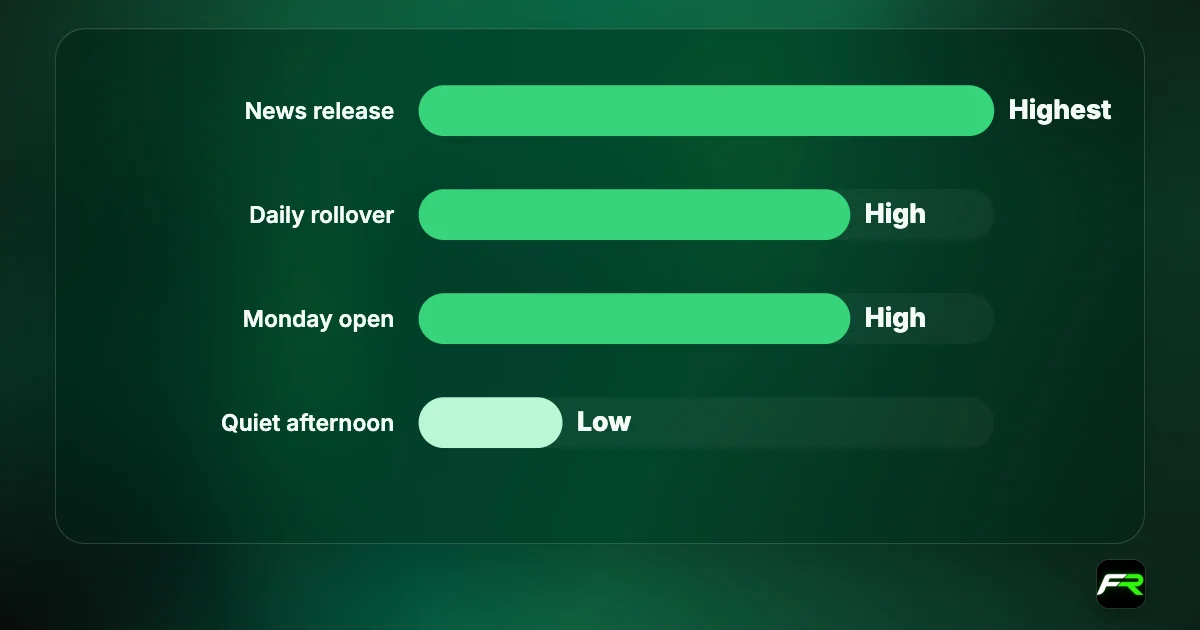
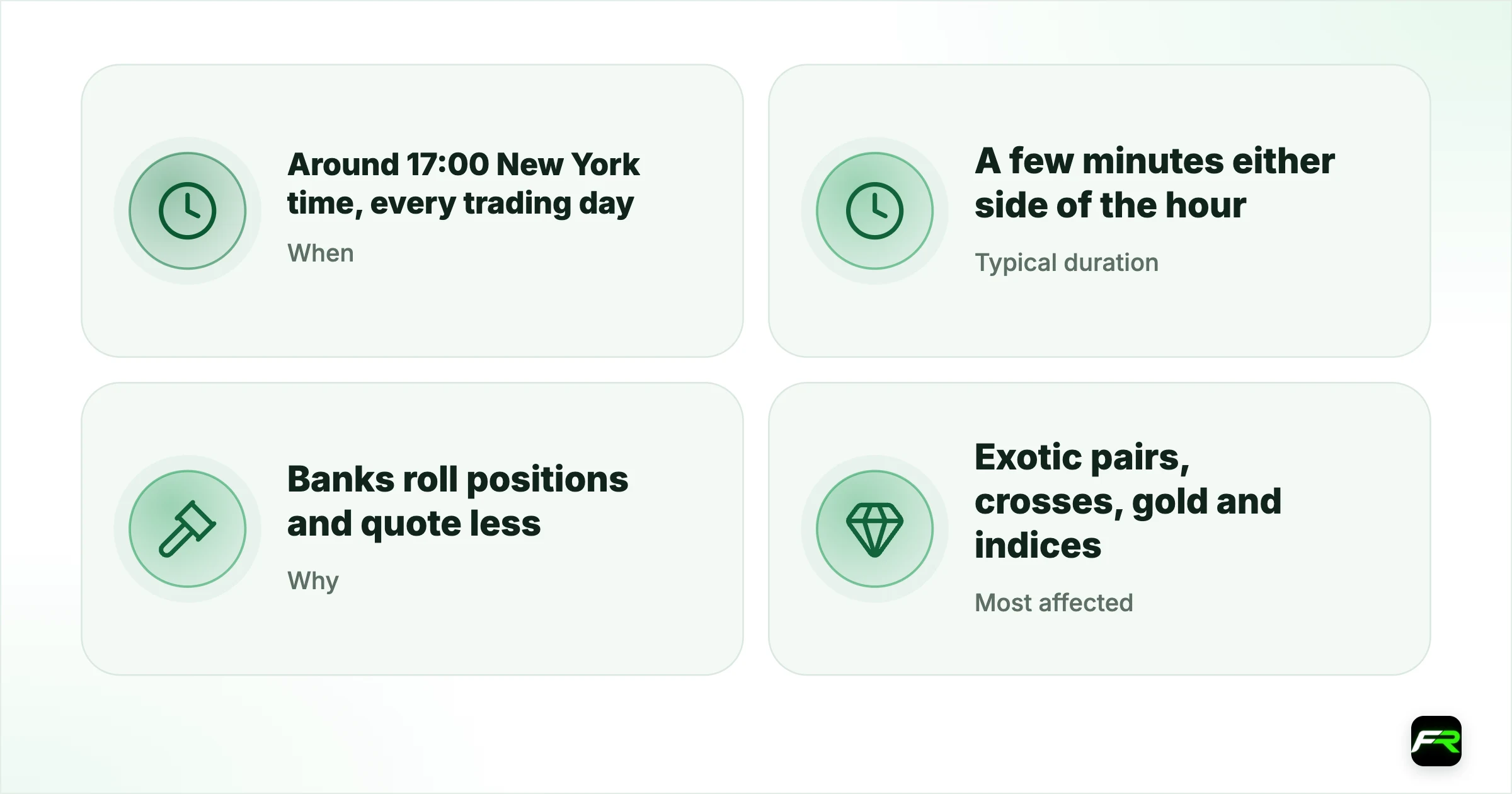
Spreads widen around 5pm New York time because that is when the forex trading day ends. Banks and liquidity providers close their books, roll open positions to the next value date and briefly pull or widen their prices. With fewer quotes in the market, the gap between buy and sell prices on your platform grows, sometimes to several times its normal size, for a few minutes either side of the hour.
It happens every trading day, so it is predictable. Learning the time in your own clock, and how it affects open stops and new orders, saves money and avoids stop-outs that have nothing to do with your analysis.
| When | Around 17:00 New York time, every trading day |
|---|---|
| Typical duration | A few minutes either side of the hour |
| Why | Banks roll positions and quote less |
| Most affected | Exotic pairs, crosses, gold and indices |
| Same moment | Overnight swap is applied |
What the rollover is
Spot forex trades settle two business days after the trade date. At the end of each trading day, positions still open are rolled forward so they do not settle. The forex industry uses 5pm New York time as the cut-off for this, which is why most brokers' server clocks show midnight at that moment, at GMT+2 in winter and GMT+3 in summer.
During the roll, banks reprice the interest owed on positions, update risk systems and hand over from the New York session to the Asia-Pacific session. For a short time very little liquidity is offered, and what is offered is quoted wider to cover the risk of a sudden move.
When it happens in your time zone
| Location | Rollover in summer (US daylight time) | Rollover in winter |
|---|---|---|
| New York | 17:00 | Unchanged |
| London | 22:00 | Unchanged (both clocks shift) |
| Lagos (WAT) | 22:00 | 23:00 |
| Nairobi (EAT) | 00:00 | 01:00 |
| Karachi (PKT) | 02:00 | 03:00 |
| Singapore (SGT) | 05:00 | 06:00 |
US daylight saving runs from the second Sunday in March to the first Sunday in November. Our market hours tool shows the rollover and each session in your own clock automatically.
Which markets widen most
Major pairs such as EUR/USD and USD/JPY widen the least, because even at quiet times there are many quotes. Crosses such as GBP/NZD, exotic pairs such as USD/ZAR or USD/TRY, and gold often widen far more, sometimes to ten times their daytime spread. Index and energy CFDs usually stop for a short break around this time, so they may show no quotes at all.
| Instrument | Normal daytime spread (example) | Rollover spread (example) |
|---|---|---|
| EUR/USD | 0.1 to 1 pip | 2 to 4 pips |
| GBP/JPY | 1 to 3 pips | 6 to 12 pips |
| USD/ZAR | 50 to 120 points | 300 to 1,000+ points |
| XAU/USD (gold) | $0.10 to $0.30 | $0.80 to $3.00 |
The figures are illustrative ranges to show scale, not quotes from a specific broker. Watch your own platform's spread at 16:55 New York time for a week to see your broker's pattern.
How it can hit open trades
Your stop loss on a buy triggers when the bid falls to it, and on a sell when the ask rises to it. When the spread widens, the ask moves up and the bid moves down even if the market's mid price stays still. A sell position with a tight stop above the market can be closed by the wider ask alone. Traders who see a stop hit at 5pm with no real price move have usually met the rollover spread.
Pending orders behave the same way. A buy limit just under the price can fill on the widened ask, and a sell stop just under the bid can trigger as the bid drops. Our guide to forex spreads explains the bid and ask mechanics in more detail.
A trader in Nairobi sells GBP/JPY at 196.50 with a stop loss at 196.60, a ten-pip stop, and leaves it overnight. At 00:58 Nairobi time in winter, the rollover spread widens from 2 pips to 11 pips. The ask touches 196.61 for a few seconds while the mid price barely moves, the stop triggers, and the trade closes for a 10-pip loss. A stop 25 pips away, sized smaller, would have survived.
How to protect yourself
- Do not open new trades from about ten minutes before to ten minutes after 17:00 New York time.
- Keep stops on crosses, exotics and gold wider than the rollover spread, and size positions to match.
- Avoid pending orders very close to price that could trigger on the spread alone.
- Watch your broker's tick chart around the rollover to learn the pattern for your symbols.
- If you scalp, stop trading before the rollover and start again once the Asian session settles.
Swap is charged at the same moment
Positions open at the rollover receive or pay the overnight swap, the interest difference between the two currencies plus the broker's markup. On most instruments it is charged three times on Wednesday night to cover the weekend. Our guides to triple swap Wednesday and calculating swap cost explain the numbers.
Rollover and Expert Advisors
Automated strategies are especially exposed, because they keep trading through times a person would avoid. A scalping EA that enters on the widened rollover spread pays several times its usual cost, and one with tight stops may be stopped out repeatedly. Many EAs include a time filter for this; set it to skip roughly 16:50 to 17:15 New York time, converted to your broker's server time, which is often 23:50 to 00:15.
Backtests can hide the problem. Historical data with fixed spreads, or with spreads sampled once a minute, may not show the rollover jump at all. Test on tick data with real variable spreads, or on a demo account for a few weeks, before trusting an EA that trades near the day's end.
Raw and ECN accounts
Raw-spread and ECN accounts pass through the market spread plus a commission. They show the rollover widening very clearly, because there is no fixed markup smoothing it. Standard accounts with a markup also widen, but the change can look smaller in percentage terms. Neither account type avoids the rollover; it is a feature of the underlying market.
Add a recurring alarm on your phone for ten minutes before rollover in your time zone. It is the simplest way to avoid entering at the worst moment of the day.
Brokers may widen spreads more around holidays and month-end, when the rollover meets thin markets. Take extra care on the last trading day of the month and before long weekends.
Frequently asked
Why do forex spreads widen at 5pm New York time?
That is when the forex trading day ends and banks roll open positions to the next value date. Liquidity providers quote less, and what they quote is wider, for a few minutes either side of the hour. Fewer quotes mean a bigger gap between buy and sell prices.
How long does the rollover spread last?
Usually a few minutes either side of 17:00 New York time, though illiquid pairs and gold can stay wider for 15 to 30 minutes until the Asian session settles. Watch your platform's spread around that time for a week to learn your broker's pattern.
Can the rollover spread trigger my stop loss?
Yes. Stops on buys trigger on the bid and on sells on the ask. A wider spread moves both away from the mid price, so a tight stop can be hit even if the market barely moves. Keep stops wider than the typical rollover spread.
What time is the forex rollover in my country?
It is 17:00 in New York, which is 22:00 in London year-round. In Lagos it is 22:00 in US summer and 23:00 in winter; in Nairobi 00:00 and 01:00. Use a market hours tool to convert it automatically.
Is swap charged at rollover?
Yes. Positions held through the rollover receive or pay the overnight swap. On most instruments, Wednesday's rollover charges three days to cover the weekend. Positions closed before the rollover pay no swap for that day.
Do ECN accounts avoid rollover spreads?
No. ECN and raw accounts pass through the market spread, so the rollover widening shows clearly on them. Standard accounts widen too. The effect comes from the underlying market, not from the account type.
Official sources: MetaTrader 5 Help
Related reading
The team behind this guide
Researched, checked and approved by five forex specialists
Every guide is written, fact-checked and edited before it goes live, and updated when the facts change. Spotted an error? Tell us.