IC Markets





























Triple Swap Wednesday Explained: Why Swaps Are Charged Three Times
Brokers charge or pay three days of swap on Wednesday night because spot forex settles two days after the trade. Here is the settlement logic, a worked cost example and how to plan around it.
 WriterAbir KhanWriterWrites the guides · checks every figure against primary sources View profileAbout Abir →
 Market analysisTanbir Habib RiyadForex & Crypto AnalystForex and crypto analyst · technical and fundamental analysis View profileAbout Tanbir →
 Fact-checking & riskJannatul FerdaushFact-Checker & Risk AnalystFact-checks every figure · risk analysis · Applied Statistics, University of Dhaka View profileAbout Jannatul →
 Trading reviewJowel RanaCo-Founder & Forex TraderCo-founder · forex trader · reviews guides from a trader's view View profileAbout Jowel →
 Final approvalRanjan NiskrityFounder, Owner & Forex TraderFounder and owner · forex trader · signs off every guide View profileAbout Ranjan →
Triple swap Wednesday is the night when brokers charge or pay three days of overnight swap on open forex positions instead of one. It happens because spot forex settles two business days after the trade date. A position rolled on Wednesday moves its settlement date from Friday to Monday, across the weekend, so it carries three days of interest.
If your swap is negative, holding through Wednesday's rollover costs three times the usual amount. A positive swap works the other way: you receive three days of credit. Either way, it is worth knowing before you hold a large position into Wednesday night.
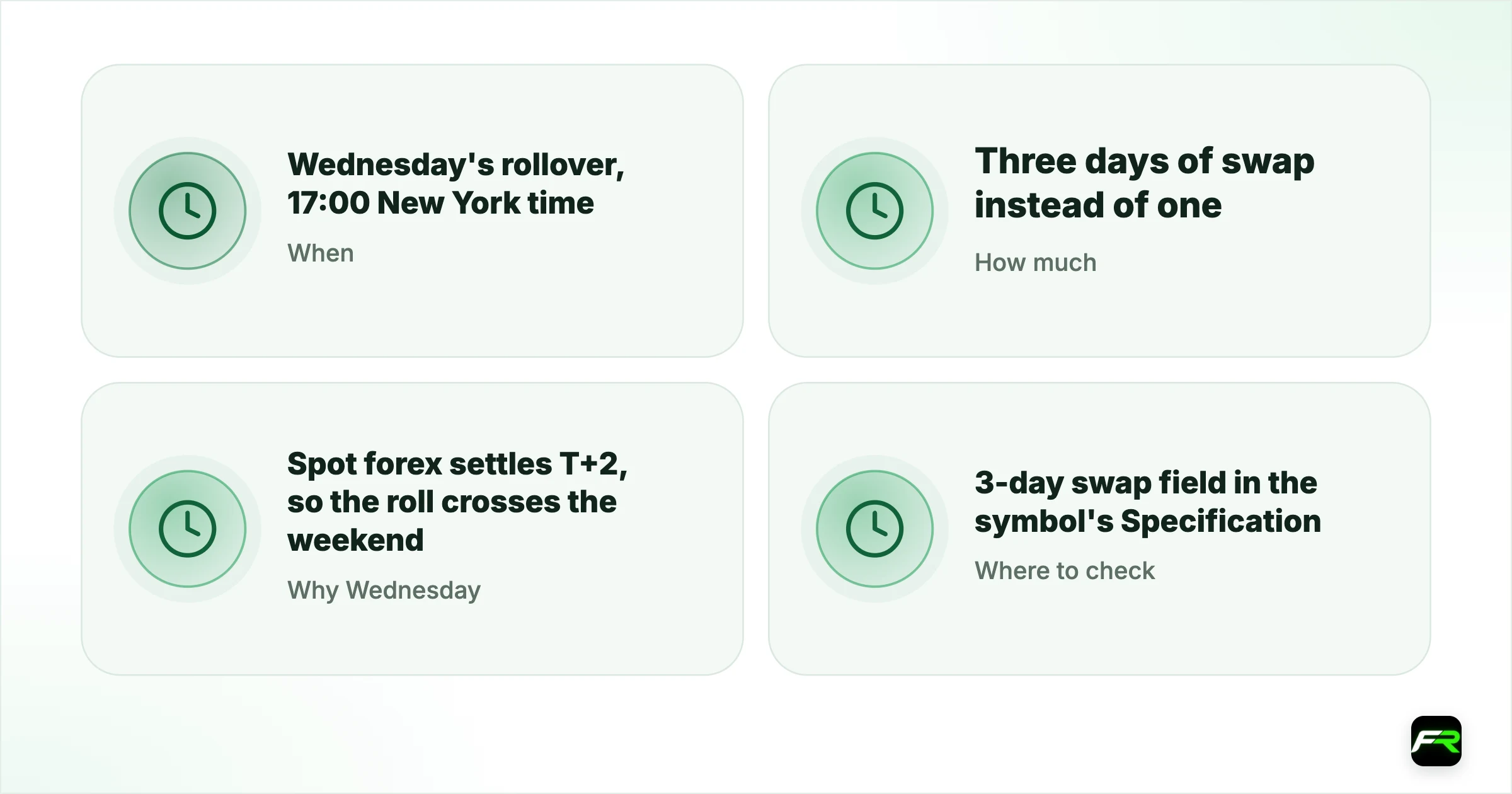
| When | Wednesday's rollover, 17:00 New York time |
|---|---|
| How much | Three days of swap instead of one |
| Why Wednesday | Spot forex settles T+2, so the roll crosses the weekend |
| Where to check | 3-day swap field in the symbol's Specification |
| Exceptions | Some CFDs use Friday or charge daily including weekends |
The settlement logic in plain words
When you trade spot forex, the deal is due to settle two business days later, known as T+2. Brokers keep retail positions open indefinitely by rolling them to the next settlement date each night, and the swap is the interest difference for that extra time.
On Monday night, the settlement date moves from Wednesday to Thursday, one day. Tuesday night takes it from Thursday to Friday, again one day. Wednesday night moves it from Friday to the following Monday, because banks do not settle on Saturday or Sunday. That jump covers three calendar days, so the swap triples. On Thursday and Friday nights it is back to one day each.
| Rollover night | Settlement date moves | Days of swap |
|---|---|---|
| Monday | Wednesday to Thursday | 1 |
| Tuesday | Thursday to Friday | 1 |
| Wednesday | Friday to Monday | 3 |
| Thursday | Monday to Tuesday | 1 |
| Friday | Tuesday to Wednesday | 1 |
Why not Friday?
Many traders expect the weekend charge on Friday, because that is when the market closes. Settlement dates drive the charge, not trading days. By Friday night the settlement date is already the next Tuesday or later, so the weekend has been paid for on Wednesday. Holding over the weekend does not add extra forex swap at Friday's rollover on standard spot pairs.
Instruments that work differently
CFDs on indices, commodities and some metals do not follow forex settlement, so brokers may apply the triple charge on Friday instead. Crypto CFDs, which trade at weekends, are often charged every calendar day. Swap-free Islamic accounts may replace swaps with a fixed fee, sometimes charged from a set number of days. The Specification window shows the 3-day swap day for each symbol; read it rather than assuming.
A worked cost example
Suppose EUR/USD shows a long swap of minus 8 points per lot per night on your account, and you hold 2 lots. On a five-digit quote, one point on a standard lot of EUR/USD is worth $1. One normal night costs 8 × $1 × 2 = $16. Wednesday night costs three times that, $48. So a position held Monday to Friday nights pays $16 + $16 + $48 + $16 + $16 = $112 in swap.
A trader in Karachi buys 1 lot of GBP/JPY on Wednesday afternoon, expecting a two-day move, without checking the swap. The account shows a positive long swap on GBP/JPY, so Wednesday night credits three days. Two weeks later the same trader sells GBP/JPY on Wednesday, where the short swap is negative, and pays three days on the first night. Checking the Specification before entry now forms part of the trading plan.
How to find the triple swap day for a symbol
- Right-click the symbol in Market Watch and choose Specification.
- Read Swap long and Swap short, and the Swap type (points, percentage or money).
- Find the 3-day swap or triple swap line, which names the day.
- Use the swap calculator to turn points into money for your lot size.
Triple swap and carry trades
Traders who buy a high-interest currency against a low-interest one, a carry trade, earn a positive swap each night. Wednesday's triple credit is a noticeable part of that return. In 2026, with US rates well above Japan's, long USD/JPY has typically shown a positive long swap at many brokers, while short USD/JPY pays. The figures differ by broker and change when central banks move, so check your own Specification rather than relying on general patterns.
Carry is never free money. A currency move of a few cents can wipe out months of swap credit, and yen pairs carry intervention risk. Our yen carry trade guide covers that risk in detail.
Triple swap on prop and swap-free accounts
Prop firm accounts usually charge swap like a normal account, so Wednesday's triple charge counts against your daily loss limit if it is negative. Check whether the firm's daily drawdown uses balance or equity at the rollover; a large triple swap on a big position can be enough to breach a tight limit on its own. On swap-free accounts, read whether the replacement fee is charged per night or only after a set number of days.
Planning around it
- Short-term trades with a negative swap: close before Wednesday's rollover if the setup allows.
- Carry trades with a positive swap: Wednesday adds three days of credit, a real part of the return.
- Large positions: compare three days of swap with your expected profit; it can be a large share.
- Islamic accounts: read the fee schedule, since some charge after a grace period instead.
Do not let swap alone decide a trade. A few dollars of swap matters far less than a good or bad entry. It is one of the costs to include, like spread and commission, in the trading cost calculator.
If you plan to hold a trade only a day or two, enter after Wednesday's rollover when the swap on your direction is negative. It saves two days of charges for free.
Swap rates change. Brokers update them as central banks move rates and as their own funding costs change, so check the current figure rather than last month's.
Frequently asked
Why is swap tripled on Wednesday?
Spot forex settles two business days after the trade. Wednesday's rollover moves the settlement date from Friday to Monday, across the weekend, so it covers three days of interest. Brokers therefore charge or pay three days of swap that night.
Do I pay swap over the weekend in forex?
Not separately on standard spot pairs. The weekend is covered by the triple swap on Wednesday night. Holding through Friday's rollover charges a normal single day. Some CFDs and crypto work differently, so check each symbol.
What time is triple swap charged?
At Wednesday's rollover, 17:00 New York time, which is midnight on most brokers' servers. Positions open at that moment receive or pay three days of swap. A position closed before it pays none for that day.
Is triple swap always on Wednesday?
For spot forex at most brokers, yes. Index, commodity and some metal CFDs may use Friday instead, and crypto CFDs are often charged daily including weekends. The 3-day swap line in each symbol's Specification shows the day.
Can triple swap be positive?
Yes. If the swap for your direction is positive, Wednesday night credits three days. Traders who hold positive-carry positions, such as some yen pairs, receive a larger credit that night.
Do Islamic accounts pay triple swap?
Swap-free accounts do not pay interest-based swap, but some brokers charge a fixed administration fee instead, sometimes after a grace period and sometimes tripled on Wednesday. Read the broker's Islamic account terms for the exact schedule.
Official sources: MetaTrader 5 Help
Related reading
The team behind this guide
Researched, checked and approved by five forex specialists
Every guide is written, fact-checked and edited before it goes live, and updated when the facts change. Spotted an error? Tell us.